





Cigarettes represent one of the most heavily taxed consumer goods in the United States. For the average smoker, the price tag at the checkout counter is rarely just the cost of the product itself; it is a complex mosaic of federal and state excise taxes, sales taxes, and local levies. While policymakers often justify these taxes as a mechanism to discourage "sinful" behavior or to offset the public health externalities associated with second-hand smoke, the reality of cigarette taxation is far more complex, revealing a landscape defined by fiscal volatility, extreme regressivity, and a thriving illicit market.
The Geography of Taxation: A State-by-State Breakdown
The U.S. tax structure for cigarettes is characterized by a stark lack of uniformity. Every state levies an excise tax on cigarettes, but the rates vary dramatically based on local policy, budgetary needs, and public health priorities.
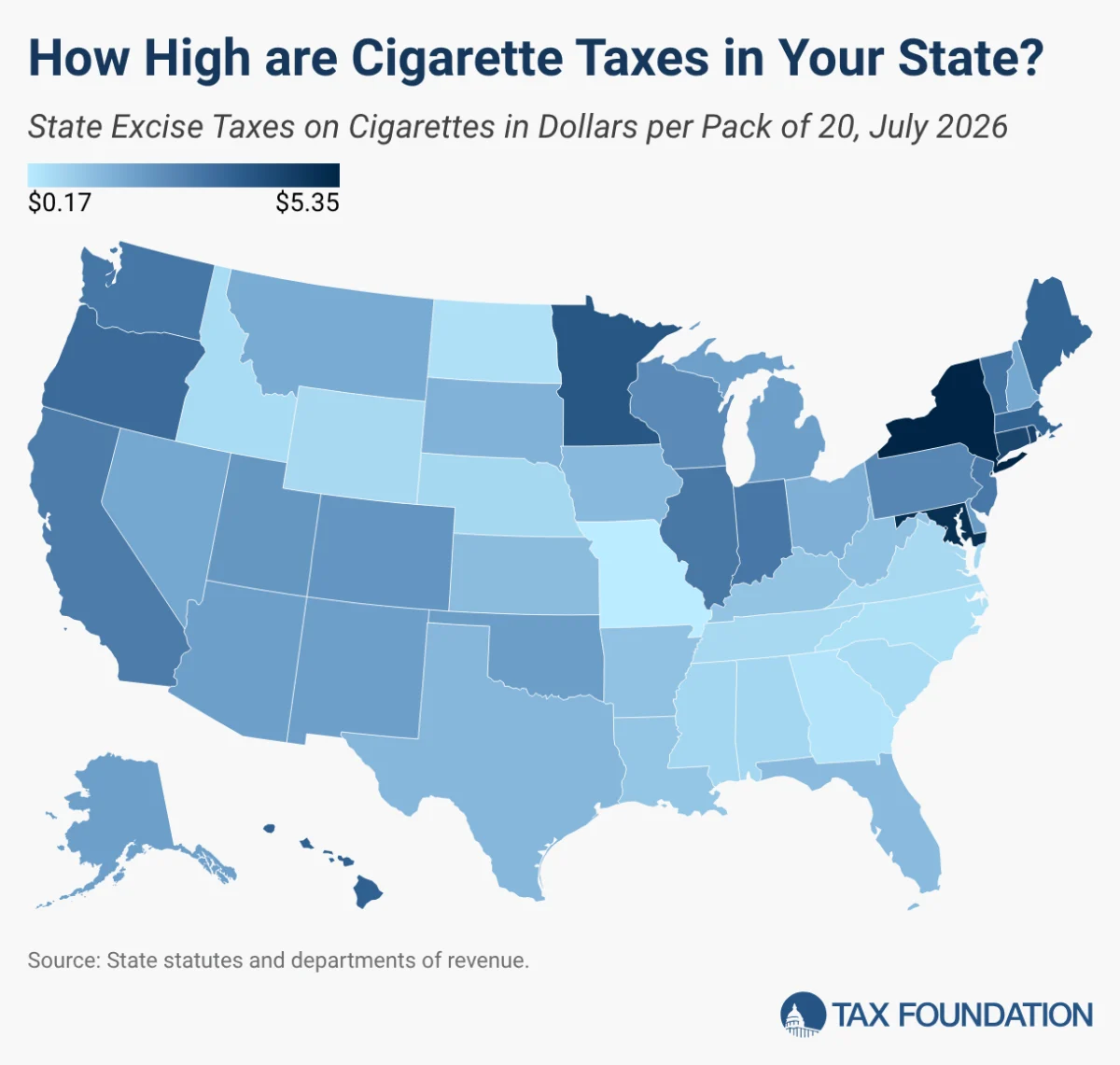
As of July 2026, New York holds the title for the highest state excise tax in the nation, levying a staggering $5.35 per pack of 20 cigarettes. This is closely followed by the District of Columbia at $5.07 and Maryland at $5.00. At the opposite end of the spectrum, Missouri maintains the lowest state burden at just $0.17 per pack. Georgia, North Dakota, and North Carolina round out the states with the lowest tax rates, all hovering well below the 50-cent mark.
State Excise Taxes on Cigarettes (Per Pack of 20, July 2026)
| State | Tax Rate | Rank | State | Tax Rate | Rank |
|---|---|---|---|---|---|
| New York | $5.35 | 1 | Kansas | $1.29 | 34 |
| Maryland | $5.00 | 2 | West Virginia | $1.20 | 35 |
| Rhode Island | $4.50 | 3 | Arkansas | $1.15 | 36 |
| Connecticut | $4.35 | 4 | Kentucky | $1.10 | 37 |
| Minnesota | $3.88 | 5 | Louisiana | $1.08 | 38 |
| Hawaii | $3.60 | 6 | Mississippi | $0.68 | 39 |
| Massachusetts | $3.51 | 7 | Alabama | $0.68 | 40 |
| Maine | $3.50 | 8 | Nebraska | $0.64 | 41 |
| Oregon | $3.33 | 9 | Tennessee | $0.62 | 42 |
| Vermont | $3.08 | 10 | Virginia | $0.60 | 43 |
| Washington | $3.03 | 11 | Wyoming | $0.60 | 44 |
| New Jersey | $3.00 | 12 | Idaho | $0.57 | 45 |
| Indiana | $3.00 | 13 | South Carolina | $0.57 | 46 |
| Illinois | $2.98 | 14 | North Carolina | $0.45 | 47 |
| California | $2.87 | 15 | North Dakota | $0.44 | 48 |
| Pennsylvania | $2.60 | 16 | Georgia | $0.37 | 49 |
| Wisconsin | $2.52 | 17 | Missouri | $0.17 | 50 |
| Colorado | $2.24 | 18 | DC | $5.07 | 2 |
Source: State statutes and departments of revenue.
A Chronology of Decline: From Revenue Reliance to Fiscal Instability
Historically, cigarette taxes were viewed as a "golden goose" for state treasuries—a consistent, high-yield revenue stream that was politically easy to enact. However, the trajectory of tobacco tax revenue has shifted significantly over the last several decades.
Throughout the late 20th century, smoking rates began a steady, long-term decline due to increased awareness of health risks and more rigorous public health messaging. While this trend represents a major victory for public health, it created a structural crisis for state budgets that had become overly dependent on tobacco revenue.
When revenues began to slip, many states responded by aggressively hiking tax rates. In the short term, these hikes often provided a temporary revenue spike. However, these increases have historically accelerated the long-term decline in consumption. By making the product prohibitively expensive, states successfully encouraged more people to quit, but they also created a "death spiral" for the tax revenue itself. Today, states find themselves in a precarious position: they are chasing diminishing returns while battling the inflationary erosion of the real value of these tax dollars.
The Federal Layer: The "Invisible" Tax Burden
It is important to note that the state excise tax is only part of the story. Every pack of 20 cigarettes sold in the United States is subject to a federal excise tax of $1.01. This base layer exists regardless of the state, ensuring that the federal government maintains a constant, albeit declining, stake in the tobacco market. When combined with state-level levies, the total tax burden in some jurisdictions can account for nearly half of the final retail price of a pack of cigarettes.
The Regressive Reality: Who Truly Pays?
One of the most critical critiques of cigarette taxation is its inherently regressive nature. Economists define a regressive tax as one that takes a larger percentage of income from low-income earners than from high-income earners. Because the excise tax is a flat fee per pack, it represents a significantly larger portion of a lower-income individual’s disposable income.
Data from 2023 underscores this disparity. While the top 10 percent of income earners contribute a large share of federal income taxes, they contribute a much smaller relative share of tobacco taxes compared to their peers in lower income brackets. In states like New York, the effective tax rate on the lowest income quintile is more than 22 times higher than the effective rate on the highest income quintile. Even in states with the "least" regressive structures, such as Utah, the burden remains overwhelmingly skewed toward those with the least financial flexibility.
Economic Implications: Smuggling and the Illicit Market
The vast differentials in tax rates between neighboring states—such as the massive gap between Maryland and Virginia—create a strong economic incentive for cross-border trade and, more dangerously, illicit smuggling.
When a consumer can save over $4.00 per pack simply by driving across a state line, the "reasonable" choice for a budget-conscious consumer is to shop elsewhere. This behavior shifts revenue away from the state that enacted the tax and into the coffers of its neighbor. More concerning is the growth of the illicit market. Smuggled or black-market cigarettes bypass taxes, regulations, and quality controls entirely.
Enforcement efforts by agencies like the ATF have struggled to contain this growth. Furthermore, when policymakers implement additional restrictions, such as flavor bans, they inadvertently grant a monopoly to illicit actors, who move in to satisfy the demand that legal retailers are no longer permitted to meet. The end result is a market where the state loses control, tax revenue disappears, and public health is arguably harmed by the lack of oversight on unregulated products.
Conclusion: Rethinking Excise Policy
The evidence suggests that cigarette taxes are a fundamentally unreliable foundation for government funding. Their volatility, combined with their extreme regressivity and the unintended consequence of fostering black markets, makes them an increasingly poor choice for financing general government services.
As states continue to face budgetary pressures, the path forward likely requires a fundamental rethink of tax policy. Rather than relying on the declining, volatile, and regressive revenues of excise taxes, policymakers should shift toward broader, more stable, and more equitable tax bases. By reserving excise taxes for specific, related programs—such as smoking cessation or public health initiatives—rather than using them to plug general budget gaps, states can create a more transparent and sustainable fiscal future.
In the long run, the goal should be a tax system that is as reliable as the services it funds, rather than one that chases a shrinking consumer base while inadvertently fueling the very illicit markets it seeks to regulate.
