





In the evolving landscape of the Canadian automotive market, few vehicles hold as much cultural and practical weight as the Toyota RAV4 Hybrid. It is a perennial best-seller, consistently positioned as the "goldilocks" solution for the modern family: spacious enough for road trips, reliable enough for Canadian winters, and efficient enough to soothe the sting of volatile gas prices.
But as hybrid technology becomes the dominant alternative to the traditional internal combustion engine—with hybrid market share in Canada hitting a record 17.2 per cent by the end of 2025—a critical question remains: Do these vehicles deliver on their promise in the real world, or is the "hybrid premium" lost once you leave the city limits? To find out, Auto Service World conducted an intensive seven-day field test using real-world rental data to separate marketing claims from pavement reality.
Main Facts: The Hybrid Surge
According to data from S&P Global Mobility, the hybrid powertrain is currently the fastest-growing segment in the Canadian automotive industry. While zero-emission vehicles (ZEVs) continue to grab headlines, hybrids are quietly winning the pragmatic war. In Ontario alone, hybrid market share reached 19.7 per cent—more than double the province’s ZEV adoption rate.
The appeal is clear: the RAV4 Hybrid promises a "best of both worlds" scenario. It offers the familiar, rugged utility of a mid-size SUV paired with the low-speed efficiency of an electric motor. However, as our testing revealed, the vehicle’s performance is highly sensitive to one primary variable: the driver’s environment.
Chronology: A Tale of Two Trips
To ensure a fair assessment of how the RAV4 Hybrid behaves across different use cases, we utilized Turo—the peer-to-peer car-sharing platform—to secure two identical models for separate, real-world deployments. By bypassing traditional test-drive routes curated by manufacturers, we were able to capture genuine performance data under unpredictable, everyday conditions.
The Urban Commute (Vancouver)
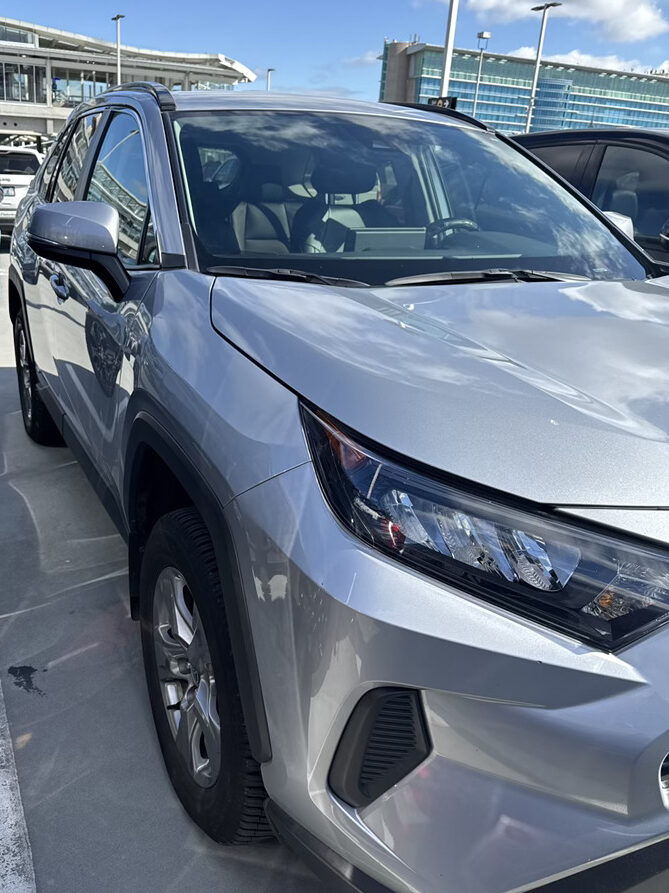
The first phase of testing took place in Vancouver. The vehicle was retrieved via a Turo host at Vancouver International Airport. This segment was characterized by stop-and-go traffic, frequent traffic lights, and lower average speeds typical of a major metropolitan area.
The Highway Expedition (Toronto to Detroit)
The second phase involved a long-distance road trip from Toronto to a professional conference in Detroit. This route consisted almost entirely of sustained high-speed highway driving, providing a stark contrast to the Vancouver data. The host provided a seamless door-to-door experience, mirroring the convenience of modern mobility services.
Supporting Data: Decoding the Fuel Economy
The results of our week-long experiment were telling. The RAV4 Hybrid’s fuel consumption fluctuated between 5.2 L/100km and 7.1 L/100km, a significant spread that underscores the importance of drive cycles.
City Performance: The Hybrid Sweet Spot
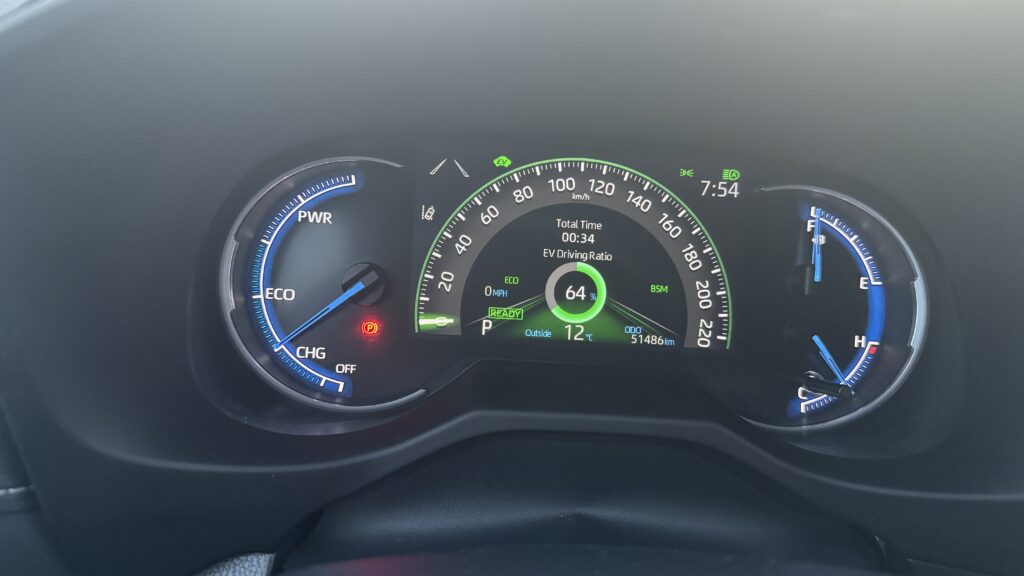
In the Vancouver test, the RAV4 Hybrid excelled. During a 33-kilometre suburban run, the vehicle returned an impressive 5.2 L/100km. More importantly, the onboard telematics indicated a 63 per cent EV driving ratio, meaning the gasoline engine remained dormant for nearly two-thirds of the journey.
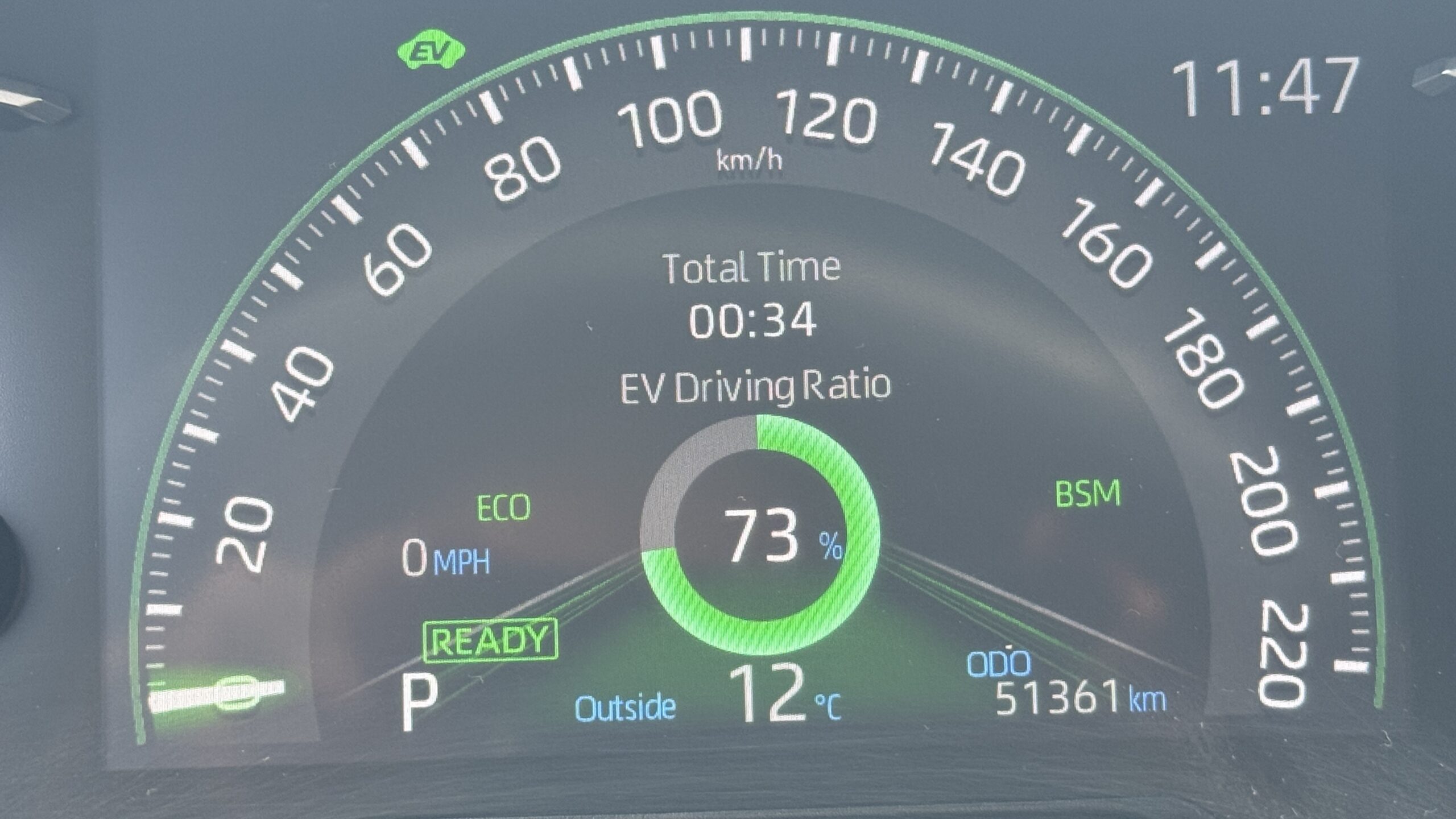
In even heavier urban congestion, we saw the EV ratio climb to 73 per cent. This is where the physics of the hybrid system shine. Every time the driver applies the brakes, the electric motor reverses its function, acting as a generator to replenish the nickel-metal hydride battery. When accelerating from a stop, that stored energy provides the necessary torque to get the vehicle moving without engaging the combustion engine. It is a seamless, quiet, and highly efficient cycle.
Highway Realities: Where the Advantage Fades
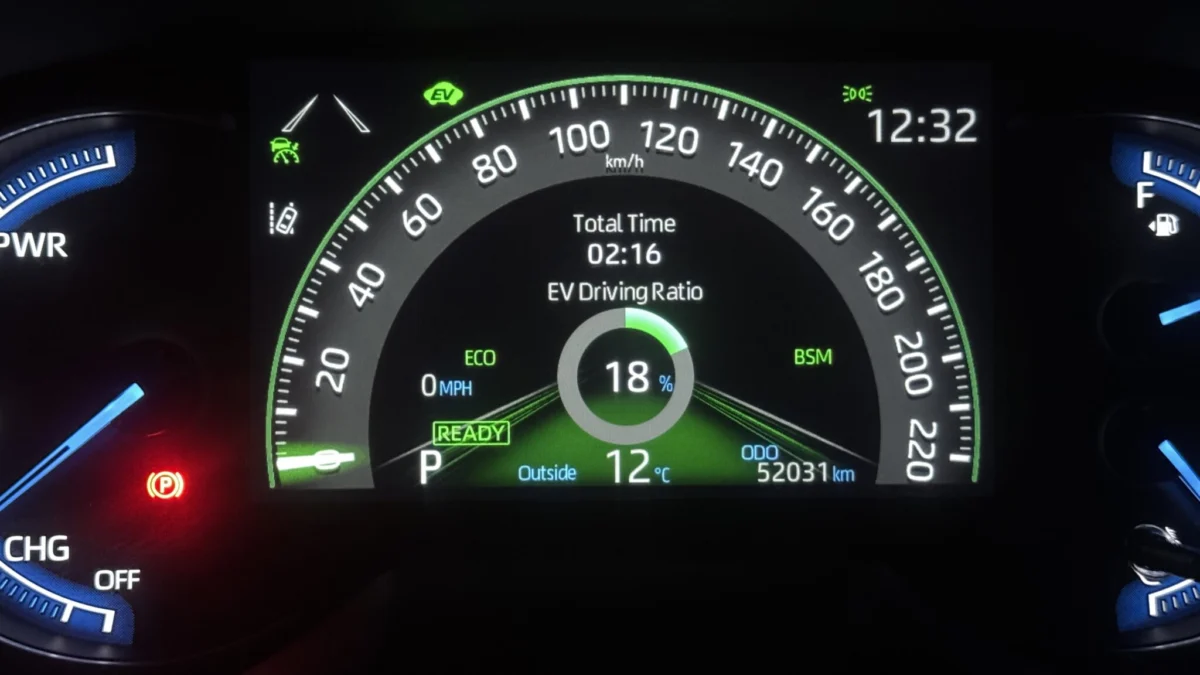
The narrative shifted dramatically during the Toronto-to-Detroit run. Over a 214-kilometre stretch of sustained highway speed, the EV ratio plummeted to 18 per cent, with fuel consumption rising to 6.5 L/100km.
At speeds of 100 km/h or higher, the aerodynamic drag and the energy required to maintain momentum exceed the capabilities of the electric motor. Furthermore, there is no "braking" to regenerate energy, and the constant load prevents the vehicle from entering its electric-only coasting mode. In these conditions, the electric motor becomes a secondary support system, and the gasoline engine takes over the bulk of the workload. A shorter, 27.5-kilometre high-speed sprint yielded a 33 per cent EV ratio and 5.7 L/100km, confirming that whenever speed remains high, the hybrid system’s competitive advantage against a modern, efficient internal combustion engine begins to diminish.
Official Responses and Engineering Perspectives
While Toyota has not commented specifically on this independent test, the engineering philosophy behind their Hybrid Synergy Drive (HSD) system is well-documented. Toyota’s design goal has never been to eliminate the gasoline engine, but to "load-level" it.
By allowing the electric motor to handle the engine’s most inefficient moments—such as idling at lights or rapid acceleration from a standstill—the engine can be tuned to operate at its most efficient thermal range. However, Toyota engineers have long acknowledged that hybrid systems are optimization tools rather than magic bullets. When the engine is required to run continuously at highway speeds, the efficiency gains provided by the electric assist are neutralized by the added weight of the battery and the complexity of the transmission system.
Implications: Making the Right Choice
The implications for the Canadian consumer are profound. As we move further into the decade, the pressure to "go green" is often conflated with "go electric or hybrid." However, the data suggests that vehicle choice should be dictated by a rigorous audit of one’s own habits.
Who is the RAV4 Hybrid for?
The RAV4 Hybrid is arguably the perfect vehicle for the urban and suburban professional. If your weekly routine involves school runs, grocery trips, and stop-and-go commuting, the hybrid system will consistently save you money at the pump while providing a quieter, more refined cabin experience. The regenerative braking system is a literal investment in your daily commute, turning the frustration of traffic into battery energy.
Where to Think Twice
Conversely, if your lifestyle is defined by the open road, the hybrid premium may be a sunk cost. For those whose commutes involve long, consistent highway stretches, or for those living in rural areas where the distance between towns is measured in hours rather than minutes, the fuel savings of the hybrid might be negligible. In these instances, a well-tuned conventional internal combustion engine—which is often lighter and less expensive to purchase—may prove to be the more economical and practical long-term choice.
Final Verdict
The RAV4 Hybrid is an engineering marvel, but it is not a "one-size-fits-all" solution. Its value is contingent upon the driver’s ability to maximize the electric motor’s potential. Before heading to the dealership, buyers should look beyond the sticker on the window and examine their own driving patterns.
If your car spends most of its life in the "stop-and-go" rhythm of the city, the RAV4 Hybrid is a formidable choice. If, however, your life is lived on the highway, take a moment to calculate whether the hybrid technology will truly pay for itself. In the world of automotive efficiency, understanding the "how" is just as important as the "what." The RAV4 Hybrid is a master of the city; the question remains: are you?
