




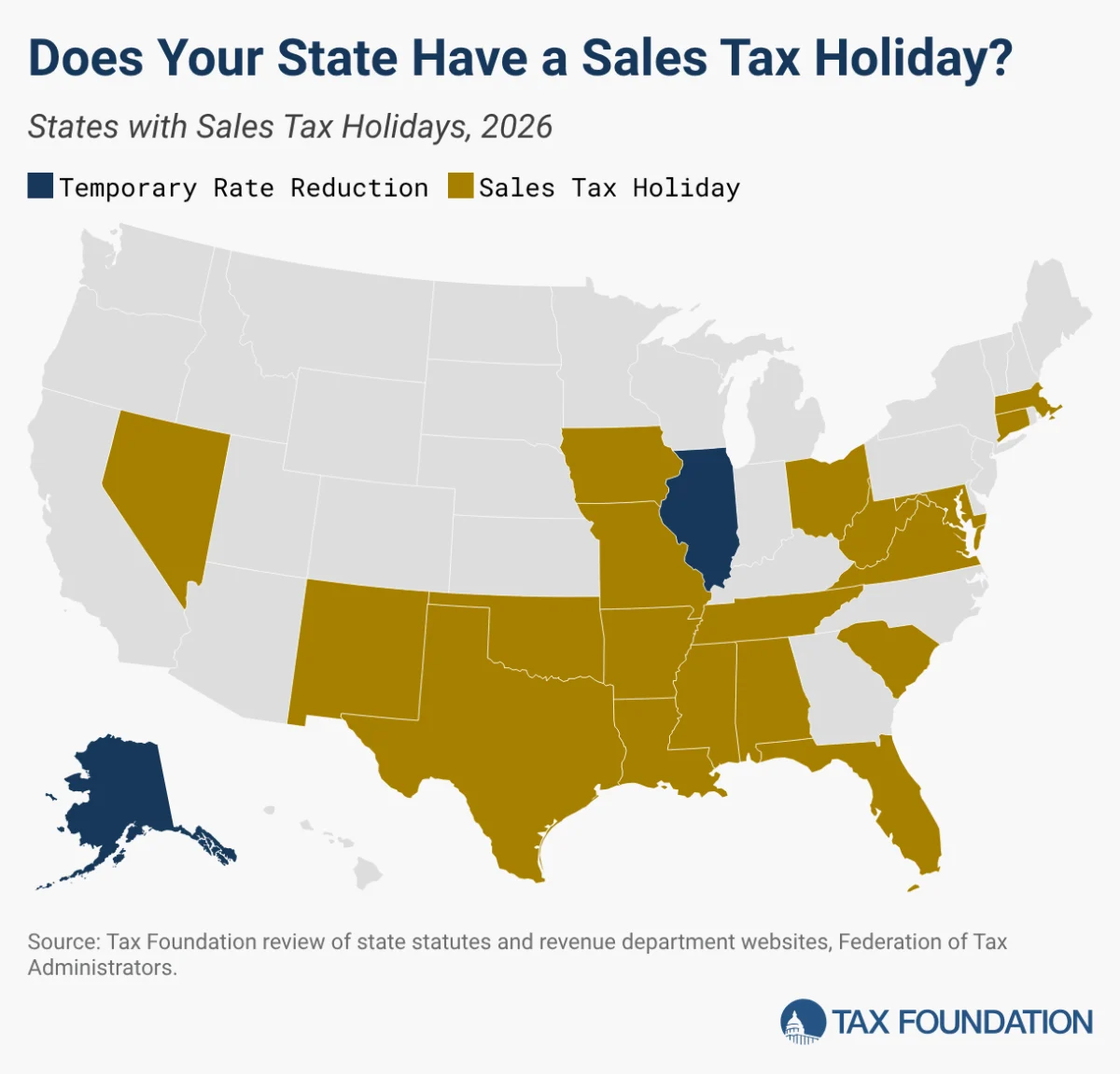
Despite their enduring popularity on the campaign trail, sales tax holidays—designated windows during which governments suspend sales taxes on specific goods—remain one of the most economically inefficient tax policies in the United States. As of 2026, 20 states have implemented these temporary exemptions, a marginal increase from the 19 that held them in 2025. While these holidays are frequently marketed as a boon for household budgets and a catalyst for retail growth, a deeper analysis reveals a complex web of administrative burdens, distorted market behavior, and a failure to provide meaningful, long-term economic relief.
The State of Play: A Growing Trend
The 2026 landscape for sales tax holidays reflects a persistent political appetite for visible, short-term tax cuts. Illinois, for example, has reintroduced a holiday that had previously been on the books in 2010 and 2022. Similarly, Alabama has expanded its repertoire by adding a new exemption for SNAP-eligible food items, supplementing its existing relief programs for severe weather preparedness and back-to-school supplies.
These figures represent only state-level programs. They do not account for localized municipal exemptions, such as those found in Alaska, nor do they include the various "gas tax holidays" that states have sporadically introduced to mitigate the impact of fluctuating fuel costs. The persistence of these policies suggests that policymakers view them as essential tools for demonstrating responsiveness to voter concerns, even when the underlying economic logic remains highly debated.
Chronology and Structural Mechanics
The mechanics of sales tax holidays are as varied as the states that implement them. Generally, these events are scheduled to coincide with high-demand periods—such as the "back-to-school" rush in August or the start of the Atlantic hurricane season.
A primary example of the volatility inherent in these policies is Illinois’ recent legislative action. Public Act 104-0468, signed into law on June 16, 2026, reinstated a back-to-school holiday just weeks before its August implementation date. The law reduced the state’s 6.25 percent sales tax rate to 1.25 percent for a ten-day window. For retailers—especially those operating online—this short notice creates a significant compliance hurdle. Last-minute legislative shifts force businesses to scramble to update point-of-sale systems, re-classify inventory, and manage legal liability regarding tax collection, all under a tight, high-pressure deadline.
The Economic Mirage: Retail Activity vs. Real Growth
Proponents frequently argue that sales tax holidays stimulate the economy by driving consumers into stores. However, empirical studies consistently show that these holidays do not create new demand; rather, they merely shift the timing of existing consumption.
Consumers who planned to purchase a laptop or school supplies generally wait for the tax-free window to make their purchase. While this might result in a localized, short-term spike in retail activity, it creates a corresponding lull in the weeks before and after the holiday. Consequently, the state does not see an increase in overall sales tax revenue, nor does it see a boost in long-term economic output. The state simply loses the tax revenue it would have collected during normal, year-round shopping patterns.
Furthermore, the "impulse purchase" argument—the idea that consumers buy extra items while they are already at the store—fails to move the needle. Research indicates that the incidental revenue generated by such purchases is far outweighed by the significant loss in tax revenue from the items that would have been purchased regardless of the tax break.
Implications for Businesses and Consumers
The hidden costs of sales tax holidays extend beyond government revenue loss. For small businesses, these events can be a logistical nightmare. Unlike large retailers with dedicated legal and IT departments, small firms often struggle to manage the compliance burden of temporary tax changes. They face higher staffing requirements to handle the artificial surge in demand and often lack the sophisticated software necessary to pivot tax rates on a product-by-product basis accurately.
The Price Tag of "Free"
One of the most concerning aspects of sales tax holidays is the potential for retailers to capture the value of the tax break. When demand is artificially concentrated into a short window, retailers may increase prices or reduce discounts they otherwise would have offered, effectively neutralizing the tax savings for the consumer. Some research suggests that companies can absorb as much as 20 percent of the benefit through price adjustments, meaning the intended tax relief is transferred to the seller rather than the buyer.
The Impact on Lower-Income Households
While these holidays are often framed as a benefit for low-income families, the reality is frequently the opposite. Because these events are fixed in time, they lack flexibility. A low-income family may not have the luxury of waiting until the week before school starts to buy supplies, nor the liquidity to stock up on bulk items during the holiday window. By the time the holiday arrives, essential goods are often out of stock due to the artificial demand surge, forcing lower-income shoppers to pay higher prices or settle for lower-quality alternatives.
The Administrative Burden: Nevada’s Alternative
Not all states approach these holidays with the same structure. Nevada, for instance, utilizes a model for its National Guard tax holiday that shifts the administrative weight entirely to the consumer. Participants must pay the tax upfront, then file for a refund from the state months later, providing documentation to prove their eligibility. While this protects retailers from the administrative chaos of instant tax-free processing, it creates a barrier for the consumer. The time and effort required to navigate the bureaucracy of a refund process often deter individuals from participating, particularly for smaller, lower-value items.
Structural Weaknesses in State Tax Codes
The prevalence of sales tax holidays serves as a tacit admission that a state’s sales tax code is flawed. If a government believes that a 5-to-8 percent tax rate is an impediment to economic activity for one week, they are implicitly acknowledging that the tax is a drag on growth for the other 51 weeks of the year.
Rather than engaging in "gimmick" tax relief, the more sound economic approach would be to address the structural issues of the tax system itself. Broadening the tax base—by including more goods and services—while simultaneously lowering the overall rate would create a more stable, efficient, and equitable system. Such a change would provide permanent, year-round relief that does not require the distortion of market signals or the imposition of heavy administrative costs on the private sector.
Conclusion: A Call for Meaningful Reform
Sales tax holidays represent a triumph of politics over policy. They offer a visible, albeit ineffective, way for elected officials to signal that they are "doing something" for taxpayers. However, the costs—both direct and indirect—are significant. By creating winners and losers through the arbitrary selection of exempt products, states introduce uncertainty and inequity into the marketplace.
As more states consider their tax policies for the coming years, the trend toward sales tax holidays highlights a missed opportunity for genuine, long-term economic development. True tax relief should be permanent, predictable, and simple. When states prioritize temporary holidays over comprehensive, rate-lowering reforms, they are choosing the path of least political resistance at the expense of long-term economic health. For now, with 20 states currently utilizing these tools, the illusion of relief appears likely to persist, leaving the fundamental problems of complex and burdensome tax structures largely unaddressed.
