





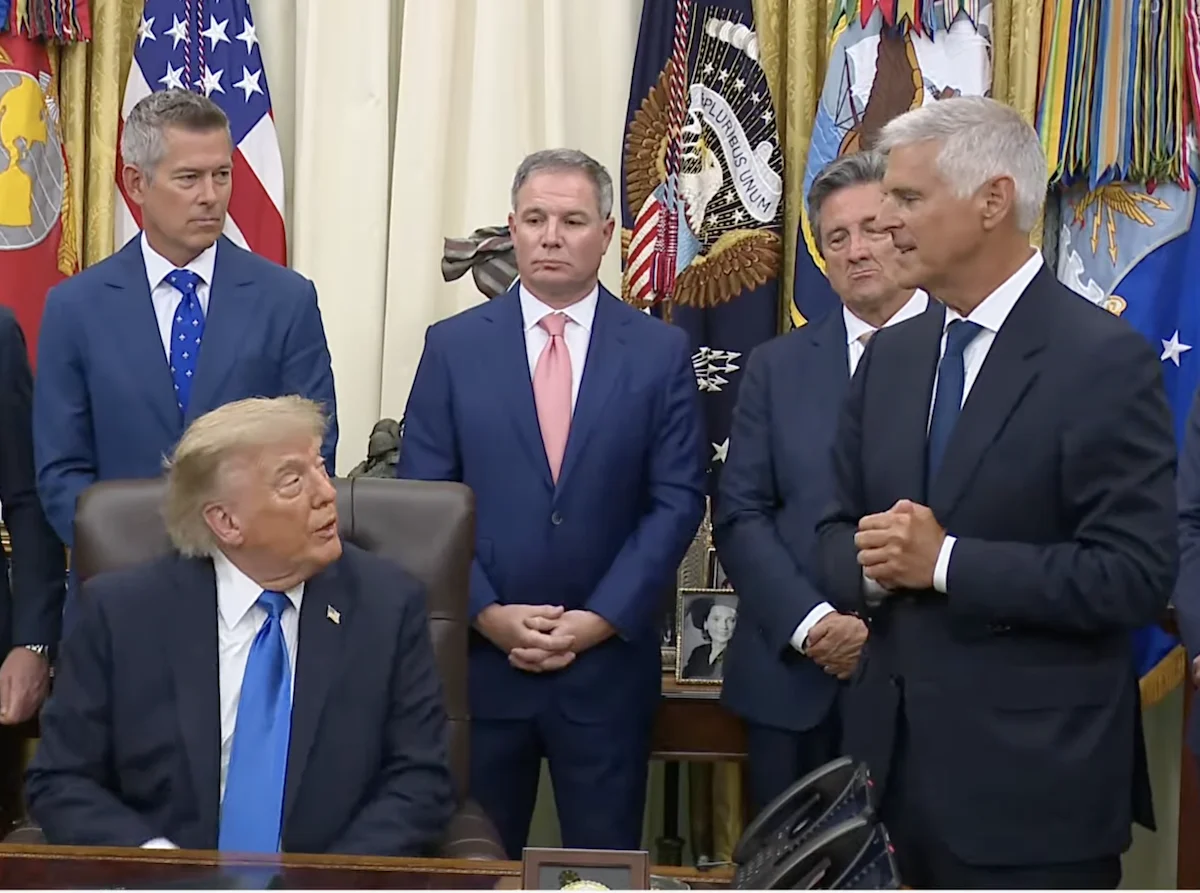
In a bold strategic pivot aimed at reclaiming the title of the world’s most-visited nation, a coalition of the American travel industry’s most powerful executives has formally petitioned the Trump administration to adopt a new, ambitious national mandate: welcoming 100 million international visitors annually by the year 2030.
This proposal, unveiled during a high-stakes summit held at the White House this past Wednesday, represents a significant escalation in the private sector’s efforts to revitalize a tourism economy that has struggled to regain its pre-pandemic momentum. The delegation, which included senior leadership from the U.S. Travel Association, global hospitality giants like Hilton and Marriott, aviation powerhouse American Airlines, and digital travel conglomerate Booking Holdings, presented the 100-million-visitor target as a key lever for national economic growth and global soft-power projection.
If realized, this goal would represent a staggering 46% increase over projected 2025 arrival figures and would vault the United States roughly 25% past its historic pre-pandemic peak. More importantly, it is a direct challenge to France, the current global leader in international arrivals, signaling a shift toward an era of aggressive, government-backed tourism expansion.
Chronology: From Pandemic Stagnation to the World Cup Catalyst
The roadmap toward this goal is inextricably linked to the recent experience of the 2026 FIFA World Cup. As the United States shared hosting duties with Canada and Mexico across 11 domestic cities, the event was initially viewed as a "silver bullet" for the American travel sector—a massive global stage to demonstrate that the U.S. was once again open, efficient, and welcoming to international travelers.
The Summer Disappointment
However, the reality of the post-tournament landscape has been sobering. Data from June and July revealed that inbound overseas visitation remained stubbornly below year-over-year expectations, suggesting that the "World Cup bump" was not the panacea that many industry analysts had hoped for. Despite the high-profile nature of the matches, the logistical hurdles—ranging from lengthy visa processing times to perceptions of high costs and bureaucratic friction—continued to suppress arrival numbers.
The Pivot to 2030
Recognizing that the World Cup did not trigger an immediate, organic surge in tourism, travel executives shifted their strategy from hoping for a spontaneous recovery to demanding a formalized federal policy. The Wednesday meeting served as the formal launch of this new initiative. By centering the 100-million-visitor goal, the industry is effectively asking the Trump administration to treat international tourism as a critical component of national infrastructure, akin to trade or defense, rather than a secondary byproduct of economic activity.
Supporting Data: The Economic Case for Growth
To understand the scale of the challenge, one must look at the current trajectory of the U.S. travel economy. While the post-COVID recovery has been steady, it has not been linear.
- The Gap to Close: The current trajectory suggests that the U.S. will see arrivals in the range of 65 to 70 million by 2025. Bridging the gap to 100 million requires an aggressive, sustained annual growth rate that exceeds the global average.
- Economic Multiplier: According to the U.S. Travel Association, every international visitor contributes significantly more to the domestic economy than a domestic traveler. This includes spending on luxury accommodation, long-haul aviation, high-end dining, and professional services. A goal of 100 million visitors is projected to inject billions of dollars into the U.S. GDP, potentially supporting hundreds of thousands of new jobs in the hospitality and service sectors.
- The Competitive Landscape: France, which historically captures the top spot in the UN World Tourism Organization rankings, has perfected the art of "soft power" tourism. By contrast, the U.S. has historically been fragmented in its international marketing, relying on state-level entities rather than a unified federal promotional strategy. The proposed 2030 goal necessitates a transition toward a "Brand USA" model that is better funded and more surgically targeted at emerging markets like India, Brazil, and Southeast Asia.
Official Responses and Strategic Hurdles
The reception from the Trump administration has been cautiously optimistic, with the President and his cabinet secretaries acknowledging the importance of the industry’s request. However, the policy path to 100 million is fraught with structural obstacles.
The Visa Bottleneck
A primary point of contention raised by the executives is the current state of the U.S. visa system. Long wait times at embassies abroad—sometimes stretching into hundreds of days for first-time applicants—are the single largest deterrent to international tourism. The industry is pushing for a digital overhaul, suggesting that the streamlined entry procedures tested during the World Cup should be the new standard for all international arrivals.
Federal Funding and Marketing
The U.S. government has historically lagged behind competitors in funding its national tourism marketing body. While executives are lobbying for increased budget allocations, they are also calling for a regulatory environment that prioritizes "frictionless travel." This includes modernizing airport processing, reducing customs wait times, and improving the intermodal connectivity between urban centers and tourist destinations.
Geopolitical Stability
The administration’s response also hinges on the broader geopolitical climate. While the travel industry argues that tourism is a tool for diplomacy, the administration must balance this with ongoing security concerns. The challenge, therefore, is to create a "trusted traveler" infrastructure that allows for rapid security screening while maintaining the high security standards that are non-negotiable for the current administration.
Implications: A New Era for U.S. Global Standing
The push for 100 million visitors by 2030 is more than just a numbers game; it is a declaration of intent.
Economic Implications
If the U.S. reaches this target, it will transform the domestic hospitality market. Hotels will need to increase capacity, airports will require significant capital improvements, and cities will need to invest in infrastructure that supports increased foot traffic. It effectively forces a national conversation about transit and urban planning—a topic that has often been neglected in favor of regional development.
Cultural and Diplomatic Implications
Tourism is the ultimate form of soft power. By inviting 100 million individuals from across the globe to experience the United States, the country can effectively counter negative international narratives and strengthen bilateral ties. The World Cup proved that when the U.S. makes an effort to showcase its cities, the global interest is immense. Converting that interest into long-term tourism loyalty is the next phase of the strategy.
The "France" Factor
Finally, there is the prestige of the title itself. For decades, France has held the distinction of being the world’s most-visited destination. While the U.S. has often held the title for the highest tourism revenue, trailing in total visitor volume has been a point of institutional frustration for American travel leaders. Surpassing France would not only be a symbolic victory but would solidify the U.S. position as the undisputed center of the global travel ecosystem.
Conclusion
The road to 100 million visitors by 2030 is steep, requiring unprecedented collaboration between the private sector and the federal government. The "World Cup experiment" provided the proof-of-concept that the U.S. is capable of managing large-scale, high-complexity tourism events. Now, the challenge is to scale that efficiency to a permanent, national policy. As the Trump administration weighs the feasibility of this goal, the message from the travel sector is clear: the United States has the potential to be the world’s premier destination, provided it is willing to build the infrastructure, streamline the bureaucracy, and commit to the vision of a truly globalized, open-door America.
Whether this goal is met by 2030 will likely be the definitive benchmark for the success of this administration’s economic engagement with the rest of the world.
