




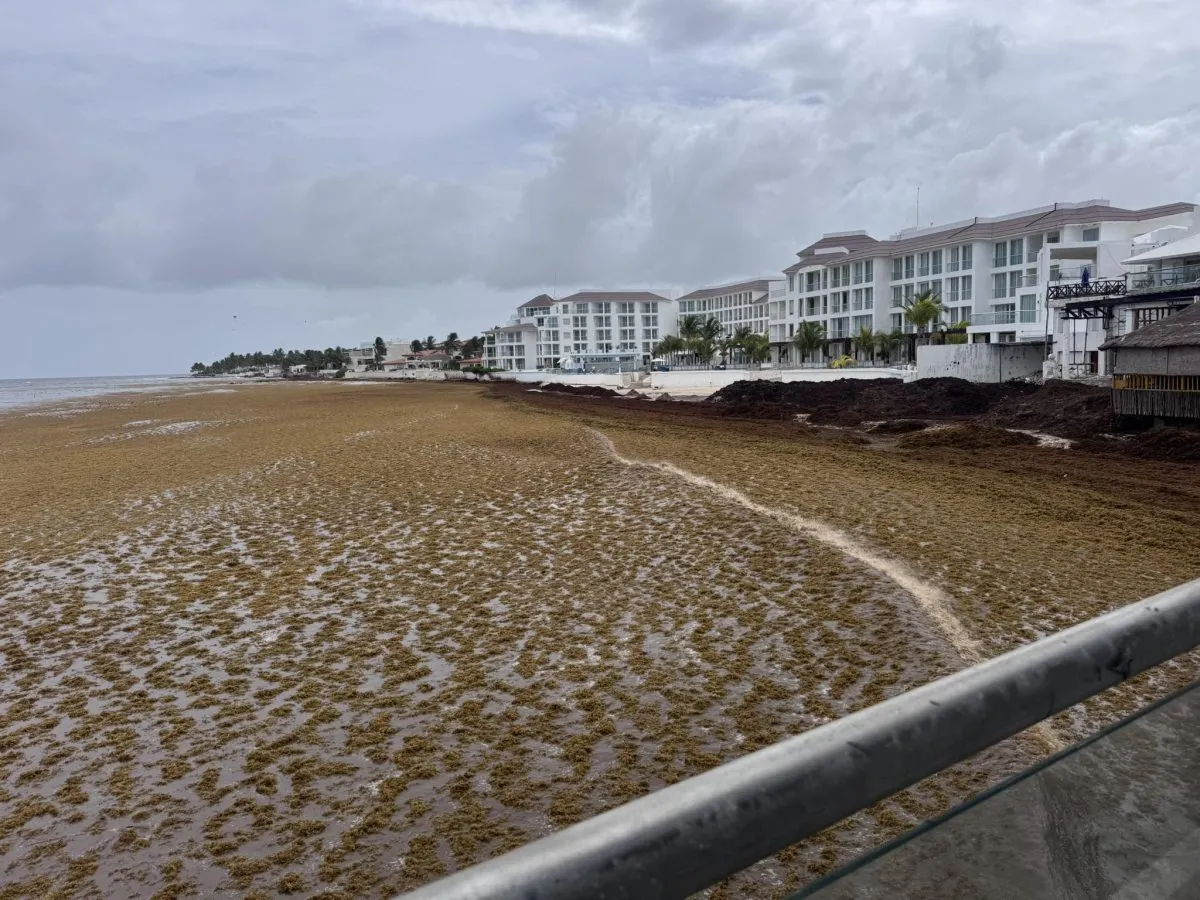
The turquoise waters of the Mexican Caribbean, a global crown jewel of the tourism industry, are currently under siege. A massive, relentless influx of sargassum—a brown, macro-algae that has transformed pristine white-sand beaches into decaying, pungent landscapes—has forced the Mexican government to commit a staggering $115 million in emergency funding.
While the government’s intervention is a significant financial acknowledgment of the problem, the crisis highlights a deepening environmental emergency that threatens the economic stability of the region and the delicate balance of the Mesoamerican Barrier Reef.
Main Facts: The Scope of the Algal Invasion
The current sargassum phenomenon is not merely an aesthetic nuisance; it is a complex ecological and economic catastrophe. The seaweed, which floats in massive, miles-long mats across the Atlantic, has been washing ashore in record-breaking quantities.
The Chemistry of Decay
While sargassum serves as a vital habitat for sea turtles, fish, and migratory birds when floating in the open ocean, its nature shifts dramatically upon reaching the shoreline. As the algae begins to decompose under the intense Caribbean sun, it undergoes a chemical process that releases hydrogen sulphide and ammonia. These gases create a distinctive “rotten-egg” odor that permeates luxury resorts, drives away tourists, and can cause respiratory irritation for beachgoers.
Furthermore, the physical presence of the algae on the sand creates a barrier that prevents sea turtles from nesting. In the water, the thick mats block sunlight from reaching shallow coral reefs and seagrass beds, effectively suffocating the very marine ecosystems that sustain the region’s biodiversity.
Chronology: From Occasional Visitor to Persistent Plague
To understand the current crisis, one must look back at the shift that occurred just over a decade ago.
2011: The Arrival
Prior to 2011, sargassum was generally found in the Sargasso Sea, a region in the North Atlantic defined by calm currents. However, in 2011, researchers began noting massive, unprecedented blooms originating in the tropical Atlantic, stretching from the coast of West Africa to the Gulf of Mexico. This shift is widely attributed to changes in ocean currents and nutrient-rich runoff.
2015–2018: The Normalization of Influx
By 2015, the “Great Atlantic Sargassum Belt” had become a permanent fixture in the seasonal cycle of the Caribbean. Mexico, alongside neighboring nations like Barbados and the Dominican Republic, began seeing annual surges. Governments initially treated these events as anomalous, hoping for a return to “normal” beach conditions.
2023–2024: The Worst on Record
The current year has shattered all historical records. Satellite imagery from NASA and regional monitoring groups indicates that the density and volume of sargassum currently navigating the Atlantic currents are higher than at any point since measurements began. The persistence of these blooms suggests that what was once a seasonal issue has become a year-round, systemic challenge for the tourism-dependent states of Quintana Roo.
Supporting Data: Climate Change and Nutrient Pollution
The primary drivers of this crisis are rooted in the intersection of anthropogenic climate change and industrial agricultural practices.
Warming Oceans
Algae thrive in warmer waters. As global ocean temperatures rise due to climate change, the Caribbean and the Atlantic have become increasingly hospitable environments for sargassum growth. The lack of cold-water upwelling, which once kept populations in check, has allowed the seaweed to proliferate with exponential efficiency.
The Nutrient Connection
The “fuel” for these massive blooms is nutrient pollution. Massive quantities of nitrogen and phosphorus—derived from synthetic fertilizers used in large-scale agriculture—wash down major river systems, including the Amazon and the Congo, and into the Atlantic. When these nutrients reach the ocean, they act as an uncontrolled fertilizer, triggering massive algae growth.
Economic Impact
For Mexico’s tourism industry, the numbers are sobering. Recent studies suggest that hotels in the Riviera Maya and Tulum have reported occupancy drops of up to 15% during peak seaweed season. Many resorts have resorted to slashing room rates by as much as 30% to attract guests willing to overlook the smell and the obstructed shoreline. The cost of manual labor to remove the seaweed—often involving thousands of workers—runs into the millions of dollars monthly, a cost that smaller hotels are struggling to absorb.
Official Responses: The $115 Million Strategy
The Mexican government’s pledge of $115 million represents a multi-pronged approach to mitigation. This funding is directed toward several critical areas of operations.
Deployment of Specialized Machinery
A significant portion of the budget is earmarked for the acquisition and maintenance of sargassum-harvesting vessels. These boats are designed to intercept the mats in the open water before they reach the fragile coastal ecosystems. However, the sheer volume of the seaweed has often overwhelmed these collection efforts.
Coastal Containment Barriers
The government has also invested in the installation of physical floating barriers, or “sea curtains,” designed to divert the seaweed away from public beaches. While effective in specific, high-traffic tourist zones, these barriers are prone to breaking during storms and require constant, expensive maintenance.
Manual Beach Cleaning
Despite technological investments, a large percentage of the funding is directed toward the labor-intensive process of manual removal. Thousands of municipal workers, assisted by the Mexican Navy, work daily to clear the beaches before sunrise to maintain the aesthetic appeal required by the tourism sector.
Implications: The Call for Long-Term Planning
While the tourism industry has welcomed the $115 million investment, stakeholders and environmentalists alike argue that the government’s current approach is reactive rather than proactive.
The Need for a Holistic Solution
"We are treating the symptom, not the disease," says Dr. Elena Ramirez, a marine biologist specializing in Caribbean coastal health. "Cleaning the beach is necessary for the hotel industry, but it does nothing to stop the massive influx of algae. We need international cooperation to address the source of the nutrient pollution in the Atlantic and to better understand the long-term impacts of climate change on ocean circulation."
Environmental Sustainability
There is a growing movement to find sustainable uses for the collected sargassum. Research into converting the harvested algae into fertilizer, biogas, or construction materials is ongoing. If Mexico can transition from viewing sargassum as waste to viewing it as a potential resource, the economic burden of the crisis could be partially offset.
The Future of Caribbean Tourism
The long-term viability of the Mexican Caribbean as a premier destination depends on the ability of the state to manage this environmental reality. If the “rotten-egg” smell and the loss of pristine beaches become a permanent, unmanaged feature of the region, the industry risks a fundamental shift in visitor demographics and a loss of prestige.
Conclusion
The $115 million commitment is a necessary bridge, but it is not a destination. The sargassum crisis is a stark reminder that the Caribbean’s natural beauty is not an inexhaustible resource. Without a coordinated international effort to reduce nutrient runoff and combat the broader impacts of climate change, the region will continue to face an uphill battle against a tide that shows no signs of receding. The path forward requires a shift from emergency containment to regional policy reform, ensuring that the turquoise waters of Mexico remain a destination for the world, rather than a graveyard for marine life.
