





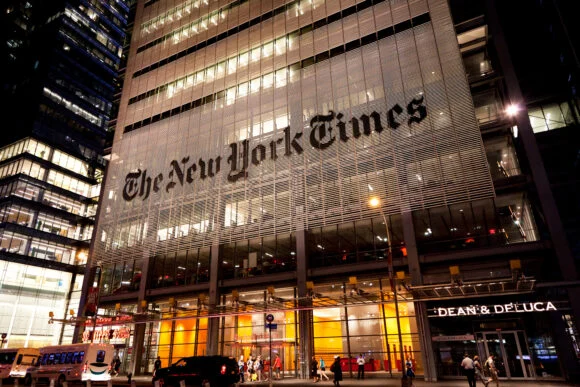
In a move that signals a decisive shift in the regulatory landscape surrounding artificial intelligence, the Trump administration has officially waded into the legal battlefield between Silicon Valley and the traditional publishing industry. On Tuesday, the U.S. government filed an amicus brief in Manhattan federal court, throwing its weight behind OpenAI in its ongoing litigation with The New York Times.
The filing, which argues that the practice of training Large Language Models (LLMs) on copyrighted datasets constitutes "fair use," marks the first time the U.S. government has formally weighed in on the wave of copyright infringement lawsuits currently threatening the foundation of the generative AI boom.
The Core Conflict: Innovation vs. Intellectual Property
The legal dispute, which first ignited in 2023, represents a collision course between two of the most powerful forces in the modern digital economy. The New York Times—along with a growing coalition of authors, music labels, and news publishers—alleges that OpenAI and its primary financial backer, Microsoft, have engaged in systemic copyright infringement. The core of their argument is that the ingestion of millions of copyrighted articles to "train" models like ChatGPT without authorization or compensation represents a massive theft of intellectual property.
Conversely, OpenAI and its peers, including Anthropic and Meta Platforms, argue that the transformative nature of AI training falls squarely under the "fair use" doctrine of U.S. copyright law. They contend that AI models do not simply reproduce the content they ingest; rather, they learn the statistical patterns of language to create entirely new, transformative outputs that do not compete directly with the original source material.
The Trump administration’s intervention has now elevated this debate from a civil dispute between private corporations to a matter of national policy.
Chronology of the Legal Stand-Off
- Late 2022: OpenAI releases ChatGPT to the public, sparking a global AI arms race and raising immediate questions about training data provenance.
- December 2023: The New York Times files its landmark lawsuit against OpenAI and Microsoft, alleging "unlawful use" of its journalism to train generative AI systems.
- Throughout 2024: Dozens of parallel lawsuits are filed by artists, novelists, and media outlets against various AI labs, alleging that their creative works were scraped without consent.
- Mid-2024: Two separate federal judges issue diverging rulings regarding the threshold for fair use in AI training, creating a fractured legal landscape that necessitates higher-level judicial or executive guidance.
- February 2025: The Trump administration files an amicus brief in Manhattan federal court, asserting that the government has a "strong interest" in preventing rulings that would hamper AI development.
- February 2025: U.S. Commerce Secretary Howard Lutnick addresses G20 officials in North Carolina, calling for a global consensus on fair use that protects creators while fostering AI growth.
The Government’s Position: National Security and Economic Dominance
The filing submitted by the government is unambiguous: it views the restriction of AI training as a direct threat to American interests. "AI dominance is critical to promote national security, prosperity, and economic mobility for all Americans," stated U.S. Associate Attorney General Stanley Woodward.
The brief characterizes the training process as "extraordinarily transformative," a legal term of art that is central to the fair use defense. By arguing that LLMs are helping researchers achieve breakthroughs in fields ranging from medicine to engineering, the government is attempting to frame AI development not as a copyright issue, but as an essential component of national progress.
"The United States has a strong interest in this court rejecting any argument that training LLMs on copyrighted texts violates copyright law," the brief reads. The administration’s rhetoric suggests a fear that if U.S. courts rule against AI companies, it would place the nation at a permanent disadvantage relative to foreign adversaries, such as China, who may not enforce similar copyright restrictions on their own domestic tech sectors.
Supporting Data and Technical Context
The controversy centers on the "black box" nature of AI training. To create a functioning LLM, companies use "web scraping" to harvest vast swaths of the public internet. This data is converted into mathematical vectors that represent the relationships between words and concepts.
The publishers argue that this process essentially creates a "derivative work," as the model’s ability to generate human-like prose is fundamentally dependent on the copyrighted journalism it consumed. However, the tech sector’s data suggests that these models do not "copy" articles in a traditional sense; instead, they learn to predict the next token in a sequence.
While the courts have yet to reach a definitive consensus, the government’s brief attempts to provide a "north star" for judges to follow:
- Scientific Advancement: The government emphasizes that LLMs are currently being used to accelerate drug discovery and climate modeling.
- Economic Mobility: AI is viewed as an "engine of prosperity" that, if throttled, would lead to stagnant wage growth and a loss of global market share.
- National Security: The administration is explicitly framing AI as a strategic asset, placing the legal dispute in the same category as defense procurement or telecommunications infrastructure.
Official Responses and Diplomatic Efforts
The response from the affected parties has been notably cautious. As of Wednesday, spokespeople for both The New York Times and OpenAI had not issued formal responses to the filing. The silence from The Times is perhaps indicative of the delicate position they now occupy, as they must balance their role as a standard-bearer for intellectual property rights with the reality that they are now arguing against the stated policy goals of the sitting U.S. government.
Meanwhile, Commerce Secretary Howard Lutnick has taken the message to the international stage. During a meeting of G20 officials in North Carolina, Lutnick urged a pragmatic approach to the global AI regulatory framework. He advocated for a model that "embraces fair use" to allow for the continued training of AI models, while simultaneously exploring mechanisms to "protect artists."
This dual-track approach—supporting broad access for AI labs while acknowledging the need for a compensatory framework—hints that the administration may eventually push for a legislative solution, such as a compulsory licensing system, should the courts prove too slow or too rigid in their interpretation of current law.
Implications: A New Era for Intellectual Property?
The administration’s intervention is likely to have profound implications for the dozens of other copyright cases currently winding through the federal court system. While an amicus brief does not carry the weight of binding law, it serves as a powerful signal to the judiciary. Judges, who are often wary of creating rulings that could inadvertently cripple a critical industry, may now find it easier to side with AI companies under the banner of "national interest."
The "Chilling Effect" Argument
The government’s brief warns of a "chilling effect." If companies are required to license every piece of copyrighted text used in their models, the cost of entry into the AI market would become prohibitively high, effectively solidifying a monopoly for the largest tech giants who can afford the licensing fees. By supporting OpenAI, the administration is arguing that a broad interpretation of fair use is actually a pro-competition stance, preventing a "pay-to-play" barrier to innovation.
The Future of Journalism
For news organizations like The New York Times, the government’s stance represents a significant hurdle. If the courts accept the administration’s argument that AI training is inherently transformative and necessary for national security, publishers may find their leverage in private negotiations with tech giants significantly diminished.
Ultimately, this case is about the definition of authorship in the 21st century. As the judiciary weighs the evidence, they are not just deciding the fate of OpenAI or The Times; they are defining the rules of engagement for the digital age. The Trump administration has made its choice clear: in the race for technological supremacy, the preservation of the current AI training status quo is a top priority. Whether the courts will follow that lead remains the most significant unanswered question in American technology law.
