


The global manufacturing landscape is undergoing a profound metamorphosis, driven by the convergence of high-fidelity simulation, the maturation of physical artificial intelligence, and a strategic pivot in how corporations justify automation investments. These themes took center stage at the Automate 2024 conference, held in Chicago from June 22 to June 25. Hosted by the Association for Advancing Automation (A3), the event served as a definitive pulse-check for an industry rapidly moving away from "pilot-project" skepticism toward full-scale, AI-integrated operational deployment.
Main Facts: The Intersection of Digital and Physical Reality
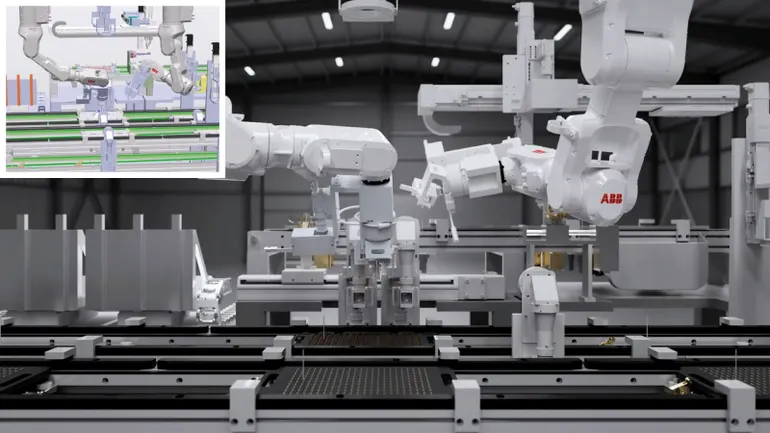
At its core, Automate 2024 highlighted that the barrier between virtual design and physical execution is collapsing. The most significant shift observed this year is the democratization of Digital Twin technology. Once the exclusive domain of aerospace and automotive giants, digital simulation is now becoming accessible to mid-market manufacturers, thanks to the integration of generative AI and standardized data protocols.
The conference underscored that "Physical AI"—the ability for robots to perceive, reason, and act within unstructured environments—is no longer a speculative concept. Industry leaders are moving beyond the "buzzword" phase, focusing instead on the rigorous, incremental work required to make these systems reliable for 24/7 manufacturing environments. Furthermore, a clear consensus emerged among speakers: labor displacement is a secondary, often counterproductive, metric for automation. Instead, the industry is realigning its value proposition around "quality, throughput, and risk resilience."
Chronology of the Shift: From Prototype to Production
The evolution discussed in Chicago did not happen overnight. To understand where the industry stands, one must look at the progression of the last decade:
- 2014–2018: The Era of Fixed Automation. Robotics were largely programmed for repetitive, static tasks. If a component changed by a millimeter, the line required manual recalibration.
- 2019–2022: The "Pilot" Purgatory. Companies experimented with AI, but most projects remained in the "proof of concept" phase, rarely scaling to full production due to high costs and the "black box" nature of early machine learning models.
- 2023–Present: The Integration Phase. The current period is defined by the interoperability of software and hardware. Engineers are now utilizing the Model Context Protocol (MCP) to allow simulation tools to "talk" to external large language models (LLMs), effectively automating the rigging and programming of machine parts.
Digital Twin Experimentation: The "First-Time Right" Goal
Perhaps the most significant technical leap showcased at the conference was the use of AI to accelerate Digital Twin development. Brendan Sterne, chief product officer at Vention, articulated the industry’s new North Star: "We’ll be able to do iterations in the digital world, so that the first time we assemble it, it’s right and it works."
Historically, simulation software was notoriously difficult to master, requiring specialized engineers and massive upfront costs. Today, that narrative is shifting. Simulation vendors are now partnering with giants like Nvidia, ABB, and Fanuc to create a unified ecosystem. By leveraging LLMs like Claude, engineers can now feed technical specifications and RFQs (Requests for Quotations) directly into simulation environments. This allows for "smarter rigging," where the software interprets the physical requirements of a task and translates them into motion parameters automatically.
The "rush for MCP support," as Sterne noted, signifies a industry-wide pivot toward open-source protocols that allow different software tools to share context. This interoperability is what will ultimately bring the cost of Digital Twin adoption down, making it a standard tool for small-to-medium enterprises (SMEs) rather than a luxury for the Fortune 500.
Physical AI and the Maturity of Robotics
If Digital Twins are the "brain" of the new factory, Physical AI is the "nervous system." Josh Leath, senior product manager for thermal automation at Yaskawa Motoman, emphasized that the industry is finally transitioning from "tried and tested" to "mature and scalable."
The Task vs. Skill Paradigm
A crucial takeaway from the technical sessions was the distinction between tasks and skills.
- Tasks represent the high-level business goal, such as "assemble this circuit board."
- Skills are the foundational capabilities, such as "grasp," "orient," or "detect."
By shifting the programming paradigm from hard-coding specific movements to training robots on discrete, reusable skills, developers are enabling machines to handle "variable" environments—the holy grail of robotics. When a robot possesses the skill to "grasp," it can be deployed on a variety of objects without needing a complete software overhaul.
However, industry veterans offered a necessary reality check. Patrick O’Neil, director of sales engineering at Acme Manufacturing, reminded attendees that AI is not a magic bullet. "AI is not ‘all that’ for automation yet," O’Neil warned. "It requires configuration for each individual process. It’s going to get better, but it does take a considerable amount of work. We’re not done."
Supporting Data: The Software-Hardware Convergence
The data coming out of the conference sessions pointed to a massive shift in capital expenditure. Hardware-focused companies are aggressively hiring software talent, recognizing that a robot is only as capable as the data it processes.
Mikell Taylor, director of robotics strategy at General Motors, highlighted that software provides the "flexibility" to handle edge cases that traditional, rules-based programming simply cannot account for. The trend is clear: manufacturers are moving toward a "multimodal" data approach. As Justin Brown, chief commercial officer at Teradyne, explained, physical data is the lifeblood of modern robotics. This includes sensor fusion, computer vision, and real-time telemetry, all of which must be processed through a unified software layer to be actionable.
Official Responses and Strategic Implications
The most provocative session of the week came from Marc Fuentes, VP of commercial growth at Eclipse Automation, who challenged the traditional financial justification for automation.
The Labor Fallacy
Fuentes argued that "labor savings" is a poor metric for long-term digital transformation. "Most finance committees are just not going to go for labor savings," he noted. Instead, he urged manufacturers to pitch automation based on:
- Quality: Reducing defect rates through consistent, machine-led precision.
- Throughput: Increasing volume without increasing the physical footprint of the factory.
- Risk Resilience: Ensuring the supply chain remains functional during labor shortages or global disruptions.
The "Pilot" Myth
Perhaps the most biting critique delivered at Automate 2024 was regarding the "pilot project" culture. Fuentes characterized the tendency to run small, safe, and reversible pilots as the "single biggest reason" the industry is lagging behind broader tech trends. "That consistent move of stepping and tiptoeing into the actual technology that’s proven is what’s holding us back," he said.
Future Implications: What Comes Next?
The implications of Automate 2024 are clear: the manufacturing industry is moving toward a highly integrated, data-driven model where the physical and digital worlds are indistinguishable.
For stakeholders, the road ahead involves three specific actions:
- Prioritize Interoperability: When choosing vendors, prioritize those that support the Model Context Protocol (MCP) or similar open standards. Avoiding vendor lock-in is essential for long-term scalability.
- Redefine ROI: Shift internal financial models away from labor-hour reduction and toward "resilience metrics." If a project cannot improve quality or reduce downtime risk, it may not be worth the investment, regardless of the labor savings.
- Invest in Data Infrastructure: Hardware is increasingly becoming a commodity; the true competitive advantage lies in the software stack that collects and interprets data from sensors and vision systems.
As the conference concluded on June 25, the overriding sentiment was one of cautious optimism. The tools for a revolution are present, the protocols are being written, and the workforce is beginning to adapt. The challenge for the next two years will be moving from these high-level architectural shifts to the "considerable amount of work" required to implement them on the factory floor. The era of the "smart" factory has arrived, but it is being built one skill, one sensor, and one digital twin at a time.
