




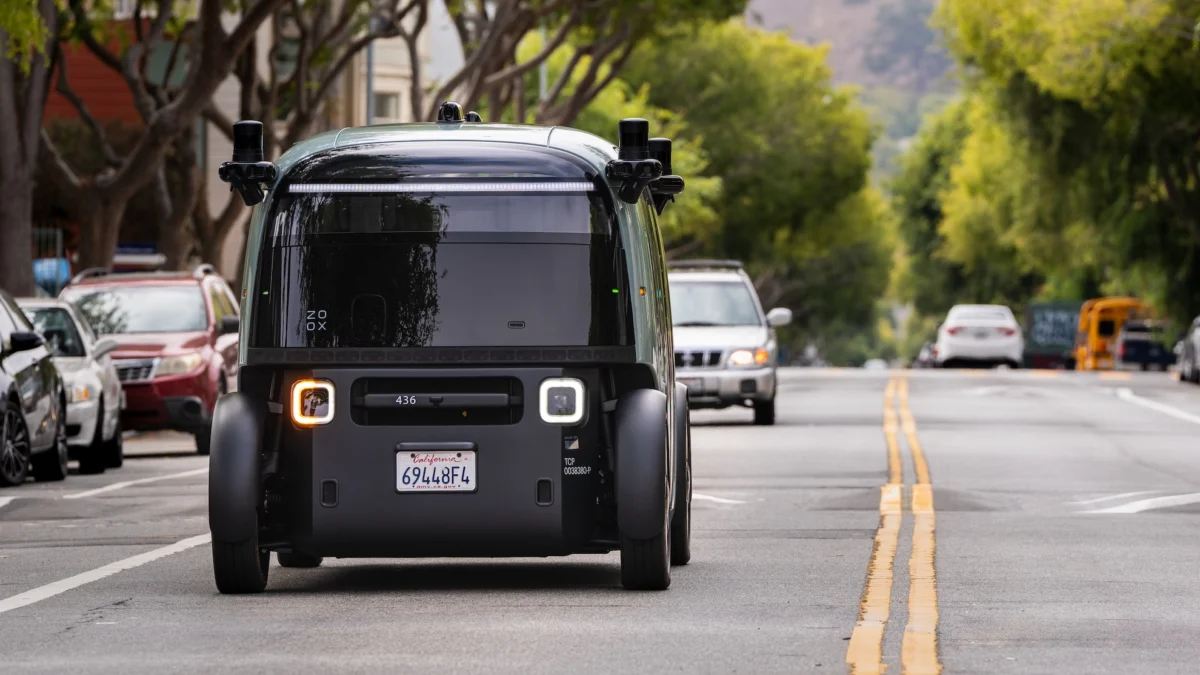
The autonomous vehicle (AV) industry is facing renewed scrutiny as Zoox, the self-driving subsidiary owned by Amazon, issued a voluntary software recall for its entire fleet of 105 purpose-built robotaxis. The safety recall, registered with the National Highway Traffic Safety Administration (NHTSA), was triggered by an incident in June 2026 where a Zoox vehicle struggled to safely navigate an active, smoke-filled emergency fire scene.
While no injuries were reported, the incident has reignited a fierce debate between federal regulators and AV developers over how self-driving cars interact with first responders. For Zoox, a company preparing for a highly anticipated commercial launch of its steering-wheel-free robotaxis, the recall represents both a technical hurdle and a regulatory challenge. It underscores the ongoing difficulty autonomous systems face when encountering unpredictable, chaotic real-world environments—scenarios that federal regulators insist must no longer be treated as mere "edge cases."
Chronology of the Incident and the Recall Decision
The events leading to the software recall unfolded over several weeks in early summer 2026, culminating in a swift series of discussions between Zoox and federal safety regulators.
[June 20, 2026] --------> [Late June - Early July] --------> [July 7, 2026] --------> [July 8, 2026]
Robotaxi encounters      Zoox & NHTSA hold multiple        Zoox decides to          NHTSA Administrator
heavy smoke at fire      discussions on root causes        issue a voluntary        issues industry-wide
scene; brakes hard.      and event severity.               software recall.         warning letter.
The June 20 Incident
On June 20, 2026, an unoccupied Zoox robotaxi was navigating an undisclosed urban area when it encountered an active emergency fire scene. The scene was not cordoned off with traditional traffic cones, and heavy, billowing smoke obscured the roadway.
According to the NHTSA incident report, the Zoox vehicle’s perception system struggled to interpret the dense smoke. The vehicle "braked hard" as it attempted to steer away from the obscured hazard before coming to a complete stop in a manner that could have impeded emergency operations. Ultimately, a remote Zoox teleoperator had to intervene, manually reversing the vehicle away from the active scene. This intervention cleared the path, allowing first responders to secure the area and place traffic cones to redirect traffic.
The Investigation and Regulatory Dialogue
Following the incident, Zoox initiated an internal investigation to identify the root cause of the system’s failure to handle the smoke. Throughout late June and early July, Zoox executives and safety engineers engaged in multiple consultative sessions with the NHTSA to discuss:
- The technical severity of the sensor obscuration.
- The frequency of similar environmental encounters.
- Sensor-fusion failure points regarding smoke, steam, and airborne particulates.
Zoox maintained that this was an isolated event, stating to the NHTSA that "this is the only event of this kind that Zoox has experienced." Despite the uniqueness of the event, the potential hazard of an AV blocking an emergency scene prompted Zoox to formally decide on a voluntary recall on July 7, 2026.
The company immediately began developing and deploying an over-the-air (OTA) software patch. By mid-July, the update had been successfully shipped to its active fleet of 105 vehicles. According to a statement provided by Zoox, the update "enhances the existing capability of detecting active [emergency] scenes by adding the ability to detect and respond to heavy smoke in certain situations."
Technical and Operational Context: The "Smoke" Problem
The June 20 incident highlights a persistent technical vulnerability in autonomous vehicle perception suites: the difficulty of distinguishing between solid obstacles, transient environmental hazards, and harmless airborne particulates.
How AV Sensors Process Smoke
Most modern robotaxis, including Zoox’s custom-built carriage-style vehicles, rely on a sensor-fusion approach combining three primary technologies:
| Sensor Type | Strengths | Vulnerability to Smoke/Particulates |
|---|---|---|
| Lidar (Light Detection and Ranging) | High-resolution 3D mapping; precise distance tracking. | High. Lidar beams can reflect off dense smoke particles, registering them as a solid wall and triggering abrupt, hard-braking maneuvers. |
| Cameras | Visual recognition (signs, lane markings, emergency lights). | High. Smoke severely reduces visibility, rendering optical classification algorithms ineffective. |
| Radar | Penetrates fog, rain, and smoke; tracks moving objects. | Low. However, radar lacks the semantic resolution to understand the context of an emergency scene on its own. |
When a vehicle encounters heavy, localized smoke from a structure or vehicle fire, these sensors can produce conflicting data. If the Lidar registers a solid barrier while the radar indicates an open road, the vehicle’s safety path-planner may default to a conservative, abrupt stop. This "fail-safe" behavior, while preventing a collision, can create dangerous obstructions for emergency vehicles.
Supporting Data: Zoox’s Recall History and Industry-Wide Challenges
This software recall is not an isolated setback for Zoox, nor is it unique to the Amazon-owned company. The broader autonomous vehicle sector has struggled to maintain seamless coexistence with public emergency services.
Zoox’s Recall History
Zoox has faced several regulatory interventions over the past year, reflecting the teething pain of its scaling operations:
- March 2025: Zoox voluntarily recalled the software on 258 self-driving vehicles to resolve an unexpected hard-braking issue. This recall was the result of an active NHTSA investigation initiated in 2024 following rear-end collisions.
- May 2025: The company issued two subsequent software recalls in a single month. One followed a collision with a passenger car, while the other was triggered by an incident in which a Zoox vehicle was struck by an e-scooter rider.
- July 2026: The current recall of 105 vehicles, addressing emergency scene and smoke detection capabilities.
Industry-Wide First Responder Conflicts
Zoox’s competitors have faced similar operational hurdles. Alphabet’s Waymo has had repeated, highly publicized run-ins with emergency personnel.
Documented reports show that as of March 2026, Waymo vehicles were involved in at least six distinct incidents where first responders had to physically move or manually override robotaxis that had entered active emergency scenes, blocked fire engines, or crossed active fire hose lines. These recurring disruptions have drawn sharp criticism from local fire departments, particularly in dense urban environments like San Francisco and Phoenix.
Official Responses and Regulatory Stance
The timing of Zoox’s recall is highly significant. It occurred just one day before a major regulatory shot across the bow from the federal government.
The NHTSA Warning
On July 8, 2026, NHTSA Administrator Jonathan Morrison sent an industry-wide letter to all self-driving car companies, demanding an immediate halt to any behavior that interferes with first responders. Morrison rejected the industry’s historical defense that these complex scenarios represent rare "edge cases" that are difficult to program against.
"Let me be clear: the inability to detect and appropriately respond to such situations represents a functional insufficiency. Emergency scenes are not rare or extreme ‘edge cases.’ As such, NHTSA is today issuing a call to action for AV developers and operators to immediately focus their resources on fixing this issue."
— Jonathan Morrison, NHTSA Administrator
Morrison’s letter signaled a shift in federal oversight, moving from a relatively permissive posture focused on technology incubation to a more aggressive enforcement stance prioritizing public safety and civic infrastructure integration.
Zoox’s Position
In response to the regulatory push, Zoox has emphasized its proactive collaboration with federal authorities and its commitment to iterative safety improvements. The company’s quick turnaround of the software patch was presented as a validation of its over-the-air update capabilities. By deploying the fix to its 105-vehicle fleet within weeks of the incident, Zoox sought to demonstrate that its platform can rapidly adapt to newly identified real-world hazards.
Implications for Commercialization and Vehicle Design
The ongoing friction between AVs and emergency services has direct consequences for the commercial viability of driverless ride-hailing.
                   [Regulatory Approvals]
                             │
            ┌────────────────┴────────────────┐
            ▼                                 ▼
[NHTSA Safety Exemptions]           [Public Trust & Municipal Support]
  - Required for pedal-less,          - Crucial for local permits
    steering-wheel-free designs         and smooth deployment
  - Delayed by emergency scene        - Threatened by high-profile
    navigation failures                 first responder conflicts
The Path to Commercial Launch
Zoox is currently expanding its testing operations, offering free rides to select testers in Las Vegas and San Francisco as it prepares for a commercial, revenue-generating launch. However, unlike competitors who retrofitted existing passenger cars (such as the Jaguar I-PACEs used by Waymo), Zoox’s business model relies on a bespoke vehicle built from the ground up without traditional controls:
- No steering wheel
- No accelerator or brake pedals
- Bi-directional driving capabilities
- Carriage-style passenger seating
Because these vehicles lack conventional human controls, Zoox cannot legally deploy them at scale without receiving specific exemptions from the Federal Motor Vehicle Safety Standards (FMVSS). Software failures—particularly those that require physical intervention or remote teleoperation to resolve—give regulators pause when reviewing these exemption requests.
Political and Regulatory Headwinds
The regulatory environment remains fluid. Recently, federal authorities proposed removing the brake-pedal requirement for fully autonomous vehicles built without manual controls. This proposal was seen as a major policy victory for companies like Zoox and Tesla, which are betting heavily on custom, pedal-less vehicle architectures.
However, the relaxation of hardware design standards is likely to be paired with much stricter operational software standards. As the NHTSA makes it easier for companies to build unconventional vehicles, it is simultaneously raising the bar for how those vehicles behave in complex, real-world environments. If robotaxis continue to struggle with common urban scenarios like smoke, construction zones, and emergency detours, the transition from experimental fleets to profitable, widespread commercial networks could face significant delays.
