





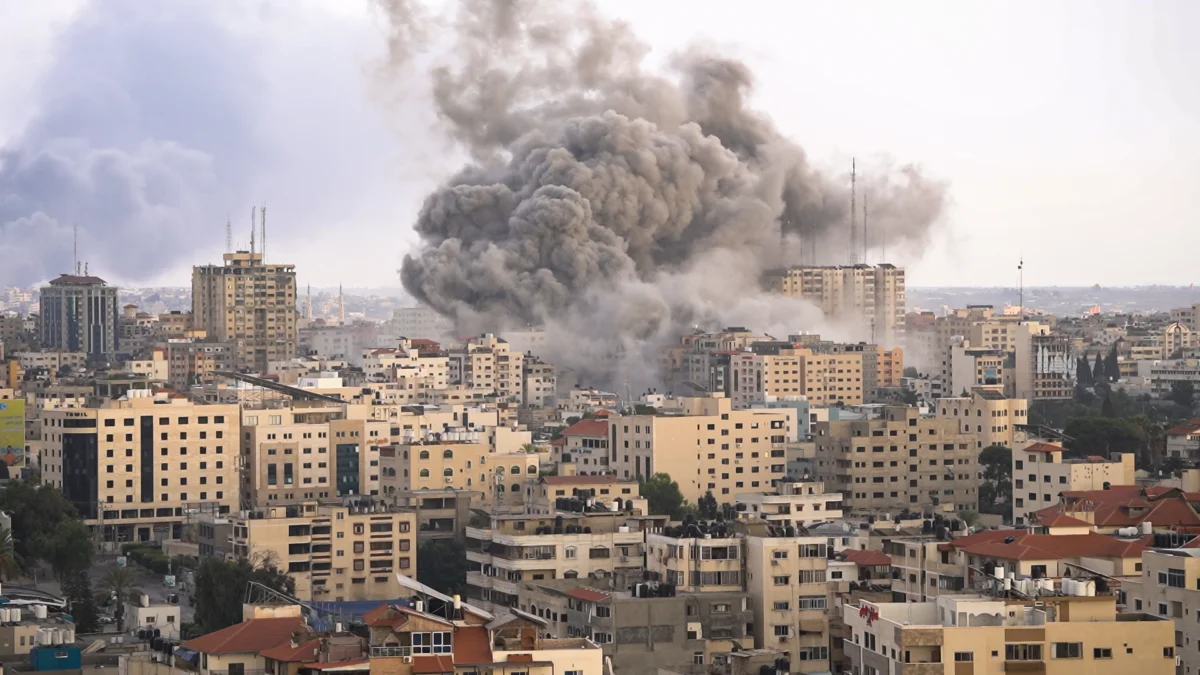
Executive Summary: A Diplomatic and Humanitarian Impasse
United Nations Secretary-General António Guterres issued a sharp rebuke to the Israeli government this week, characterizing the state’s decision to accelerate the authorization of settlement outposts in the occupied West Bank as a "flagrant violation" of international law. The condemnation follows a weekend of intense violence that has further destabilized the region, raising fears of an irreversible escalation in the ongoing territorial conflict.
The Secretary-General’s statement underscores a deepening rift between Israel’s domestic legislative agenda—which seeks to formalize the status of existing farm outposts—and the consensus of the international legal community. As the UN, the International Court of Justice (ICJ), and various human rights organizations reiterate the illegality of the settlements under the Fourth Geneva Convention, the Israeli government maintains that its actions are consistent with its own domestic legal framework.
Chronology of the Current Escalation
The recent spike in tensions was triggered by a specific, lethal confrontation that occurred late last week.
- Thursday-Friday: A violent clash resulted in the deaths of two Israelis and four Palestinians. In the immediate aftermath, Israeli Prime Minister Benjamin Netanyahu announced a multi-pronged response. This included the formal authorization of new settler outposts and a directive to expedite the legalization of existing, previously "unauthorized" farm outposts.
- Saturday: The human cost of the preceding 48 hours became clearer as reports from the UN Office for the Coordination of Humanitarian Affairs (OCHA) confirmed that at least eight Palestinians, including a child, had been killed since the initial outbreak of violence.
- Monday: Secretary-General Guterres delivered his formal condemnation, framing the Israeli government’s policy not merely as a local security measure, but as a systematic impediment to the two-state solution and regional peace.
This sequence of events is not isolated. It represents the latest chapter in a year of historically high tension. Earlier this year, in February, the UN issued a similar warning regarding the expansion of Israeli authority in the West Bank, including the resumption of land registration processes.
Supporting Data: The Humanitarian Toll
The humanitarian situation on the ground, as documented by OCHA and international monitors, is increasingly dire. The violence has moved beyond isolated clashes to affect the fabric of daily life for Palestinians in the West Bank.
Displacement and Property Destruction
The cycle of violence has resulted in the destruction of vital infrastructure. Homes, mosques, ancient olive groves, and agricultural buildings have been burned or leveled. OCHA reported that at least 10 Palestinian families have been displaced in the most recent flare-up alone.
Movement Restrictions and Access to Services
Israeli security forces have significantly tightened restrictions on movement across the West Bank. These measures, often described by Israel as necessary for security, have prevented thousands of Palestinians from accessing essential services, including emergency medical care, pharmacies, and food supplies.
Statistical Trends of 2026
The year 2026 has been marked by a relentless accumulation of casualties. According to OCHA records:
- Total Casualties: As of Saturday, 77 Palestinians had been killed by Israeli forces or settlers, including 18 children.
- Israeli Casualties: In the same timeframe, three Israelis have lost their lives in incidents involving Palestinians.
- Settler-Related Violence: Since January, the UN has documented over 1,330 incidents involving Israeli settlers that resulted in either physical casualties or property damage.
Legal Analysis: International Law vs. Domestic Policy
The core of the dispute lies in the irreconcilable definitions of "legality."
The International Perspective
The UN and the International Court of Justice (ICJ) maintain that all settlements, including outposts, are illegal. The ICJ’s landmark July 2024 advisory opinion solidified this position, declaring that Israel’s presence in the occupied Palestinian territory constitutes an unlawful occupation. Under the Fourth Geneva Convention, an occupying power is prohibited from transferring its own population into the territory it occupies.
The Israeli Stance
The Israeli government consistently rejects the application of the Fourth Geneva Convention to the West Bank. Israeli officials argue that the territory is "disputed" rather than "occupied" and that the expansion of outposts is a matter of internal governance. By bringing these outposts under the umbrella of Israeli domestic law, the government seeks to provide them with municipal services and security protections, effectively normalizing their existence despite international outcry.
Official Responses and Diplomatic Fallout
The international community has begun to move beyond rhetoric toward tangible, albeit limited, punitive measures.
Sanctions and International Pressure
In June 2026, a coalition of six governments took the unprecedented step of imposing sanctions on individuals identified as primary enablers of settler violence. This signaled a shift in diplomatic strategy, moving from broad condemnations to targeted accountability.
The Role of Human Rights Organizations
Rights groups have been instrumental in documenting the phenomenon of "reprisal violence," where settler groups launch attacks on Palestinian villages in response to clashes. These organizations have called for the urgent protection of civilians and the implementation of international humanitarian law, arguing that the current trajectory will lead to a total breakdown of civil order in the West Bank.
Broader Implications for the Two-State Solution
The acceleration of outpost legalization is viewed by analysts as a strategic move to create "facts on the ground" that make the eventual creation of a contiguous, sovereign Palestinian state physically impossible.
The Obstacle of Fragmentation
By carving out small, state-sanctioned outposts throughout the West Bank, the Israeli government creates a patchwork of jurisdiction that segments Palestinian territory. This fragmentation prevents the development of a unified Palestinian economy and administration, effectively rendering the two-state solution a theoretical concept rather than a practical reality.
Long-term Regional Stability
The Secretary-General’s warning highlights the danger of the "normalization of illegality." When international norms are consistently bypassed in favor of domestic political mandates, the framework for global conflict resolution is weakened. If the current trend continues, the West Bank risks falling into a state of permanent low-intensity conflict, characterized by cycles of revenge, displacement, and economic stagnation.
Call for Accountability
The UN and its humanitarian partners continue to press for:
- Strict Adherence to International Law: A cessation of all settlement activity as mandated by international treaty obligations.
- Protection of Civilians: Immediate measures to safeguard Palestinian and Israeli civilians from the growing wave of reprisal violence.
- Accountability: A transparent legal process to ensure that perpetrators of violence—whether settlers or combatants—are held to account, ending the culture of impunity that has fueled the latest surge in death and destruction.
As the international community watches, the situation remains a litmus test for the effectiveness of global institutions in curbing the unilateral actions of sovereign states. With no immediate end to the policy of expansion in sight, the path to a "just, lasting, and comprehensive peace" appears more obstructed than at any point in the recent decade.
