




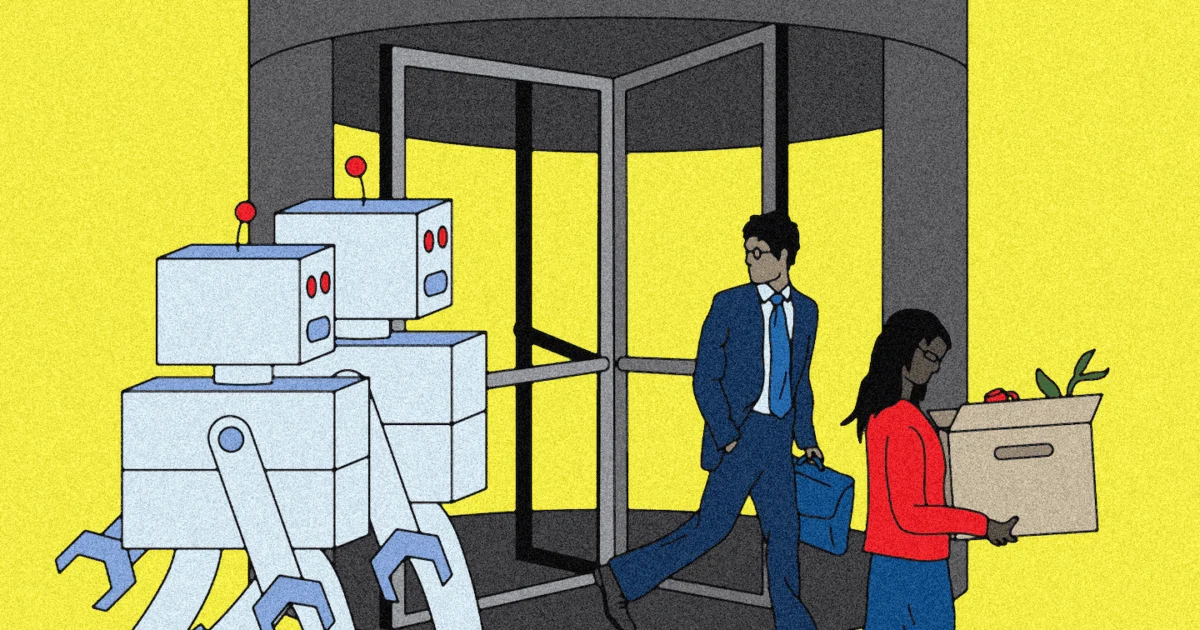
As artificial intelligence continues its rapid integration into the American economy, the specter of widespread job displacement has shifted from a theoretical concern to a tangible reality. While the technology promises unprecedented productivity gains, labor advocates are sounding the alarm that the nation’s unemployment insurance (UI) system—a relic of the post-Depression era—is fundamentally ill-equipped to handle a modern, AI-driven labor crisis.
Rebecca Dixon, CEO of the National Employment Law Project (NELP), has emerged as a leading voice in this debate. She argues that the current structure of unemployment benefits is dangerously "stingy," particularly as the threat of automation expands to include white-collar workers—a demographic previously considered insulated from such volatility.
Main Facts: A System Strained by Obsolescence
The core of the issue lies in the profound disparities of the American unemployment landscape. Because UI is managed largely at the state level, the support an unemployed worker receives is dictated more by geography than by economic necessity.
Currently, the maximum weekly payout for an unemployed worker ranges from a meager $235 in Mississippi to a more robust $1,105 in Massachusetts. These figures, which have failed to keep pace with the cost of living or the rising wages of professional sectors, leave many Americans facing an immediate financial cliff upon termination.
Dixon emphasizes that the eligibility requirements are equally archaic. In most states, part-time workers, independent contractors, and recent college graduates—all of whom are increasingly susceptible to AI-driven displacement—are frequently excluded from the system entirely. As the nature of work becomes more fragmented and precarious, the "standard employee" model upon which UI was built is rapidly vanishing.
Chronology: The Evolution of a Policy Crisis
The current tension is not merely a product of the recent AI surge; it is the culmination of decades of systematic underfunding and policy erosion.
- 1935: The Social Security Act establishes the federal-state unemployment insurance system, designed for a manufacturing-heavy economy where workers held long-term, full-time roles.
- 1980s–2000s: A period of "administrative burden" begins, where states increasingly tightened eligibility requirements and reduced the duration of benefits to incentivize faster re-employment, often ignoring the nuances of structural economic shifts.
- 2020: The COVID-19 pandemic exposes the fragility of the system. The government is forced to implement the Pandemic Unemployment Assistance (PUA) program to cover gig workers and others typically excluded, proving that a more inclusive system is administratively possible.
- 2023–2025: Generative AI enters the mainstream. Professional roles in law, marketing, software engineering, and finance begin to see significant integration of AI tools, leading to the first waves of "white-collar" layoffs.
- 2026 (Present): NELP and other advocacy groups intensify calls for federal reform, arguing that without a fundamental overhaul, the next recession could be catastrophic for the middle class.
Supporting Data: The Disparity of Coverage
The disparity in state-level support creates a "lottery of geography." A displaced software engineer in a low-benefit state faces a significantly higher risk of bankruptcy than a counterpart in a high-benefit state, despite contributing the same federal taxes.
Furthermore, data from the Bureau of Labor Statistics suggests that the "AI-affected" workforce is skewing younger and more educated. Recent graduates, who often enter the workforce through contract or temporary roles, are consistently blocked from the UI system. Because they haven’t hit the required "base period" of earnings or hours in traditional W-2 employment, they are often left with no safety net during their critical early-career years.
NELP’s recent efforts, including the appointment of new senior policy experts to address these systemic gaps, underscore the urgency of the moment. The organization is advocating for a "portable benefits" model that follows the worker rather than the specific job, ensuring that coverage is not tethered to a single employer who might replace them with an algorithm overnight.
Official Responses and Policy Perspectives
The policy response to these concerns remains divided.

Proponents of Reform: Advocacy groups like NELP argue that the government must modernize the definition of "employee" to include the gig economy and protect those in the "knowledge economy." They advocate for a federal floor on benefits, suggesting that no state should be allowed to provide a benefit level that falls below a certain percentage of the local median wage.
The Fiscal Conservative Perspective: Conversely, many state legislatures argue that increasing benefits will discourage re-employment and place an undue burden on employers, who pay the taxes that fund the UI trust funds. They argue that the focus should be on "upskilling" and "reskilling" the workforce rather than extending the duration or scope of cash assistance.
The Middle Ground: Some labor economists suggest a hybrid approach: "Unemployment Insurance 2.0." This would involve not just cash assistance, but a federally funded, AI-focused training stipend that allows workers to transition into new roles while they remain supported by a reformed UI system.
Implications: The Social Contract at a Crossroads
The integration of AI into the workplace is not just an industrial revolution; it is a social one. The implications of maintaining the status quo are profound:
- Rising Income Inequality: If only those in high-benefit, traditional roles have a safety net, the gap between the protected and the unprotected will widen.
- Loss of Human Capital: When skilled workers are left to fend for themselves without support, they often accept "survival jobs" far below their skill level, leading to a permanent degradation of their career trajectory and a loss of productivity for the national economy.
- Political Instability: Economic anxiety is a powerful driver of political volatility. If the middle class feels that the "AI revolution" is being built at the expense of their security, the resulting social friction could lead to increased polarization and a backlash against technological progress.
Conclusion: A Call for Modernization
The call to action from leaders like Rebecca Dixon is clear: the safety net must be as dynamic as the technology it aims to mitigate. To prepare for an era where AI can perform tasks once thought to be the sole domain of human cognition, the United States must move toward a more inclusive, robust, and geographically equitable unemployment insurance system.

As the news cycle continues to report on companies adopting AI to streamline operations, the question is no longer if jobs will be displaced, but how the American social contract will protect the people behind those jobs. Without meaningful policy shifts—incorporating part-time workers, broadening eligibility for graduates, and raising the floor on benefit payouts—the nation risks entering an era of technological prosperity that leaves its own workforce behind.
For now, the policy debate rages on, with organizations like NELP continuing to push for a future where economic innovation does not necessitate individual ruin. The next legislative session may well determine whether the American worker is treated as a partner in the AI transition or as its primary casualty.
