

Introduction: A Strategic Partnership in a Warming World
As geopolitical tensions reconfigure global alliances and the existential threat of climate change accelerates, India and Germany have emerged as pivotal partners in the transition to a sustainable global economy. Recognizing the critical need for nuanced, high-quality reportage on these developments, Clean Energy Wire (CLEW) and The Migration Story, in partnership with the Heinrich Böll Foundation, have launched an ambitious collaborative journalism program.
The initiative aims to pair fourteen journalists—seven from India and seven from Germany—to foster cross-border investigative reporting. By equipping these professionals with specialized training and financial support, the program seeks to demystify the complex intersection of green technology, labor mobility, and critical mineral supply chains that now define the Indo-German climate agenda.
Main Facts: The Anatomy of the Initiative
The program is designed as a bridge between two of the world’s most influential economies. Its core objective is to move beyond superficial reporting and into the granular, systemic realities of the Indo-German climate partnership.
- Target Audience: Mid-career journalists based in India and Germany with a proven interest in climate, energy, or environmental policy.
- Program Components: The curriculum includes intensive online training sessions led by subject matter experts, providing journalists with a deep dive into the diplomatic, technical, and social aspects of the bilateral climate agenda.
- Grant Structure: Following the training phase, participants will be eligible for cross-border reporting grants. These grants are specifically designed to incentivize collaborative projects, requiring a journalist from India to work in tandem with a counterpart from Germany.
- Scope of Coverage: The program emphasizes four key pillars:
- Green Technology Transfer: Analyzing the efficacy of technology sharing in renewable energy sectors.
- Skilled Labor Migration: Examining how the movement of human capital supports the "Energiewende" (Germany’s energy transition) and India’s green industrialization.
- Critical Minerals: Investigating the supply chains of materials necessary for the transition to electric vehicles and energy storage.
- Diplomatic Alignment: Assessing the progress of the Indo-German Green and Sustainable Development Partnership.
Chronology: A Relationship in Motion
The current initiative is not an isolated effort but rather the latest development in a long-standing diplomatic trajectory.
- 2022: India and Germany sign the "Green and Sustainable Development Partnership" (GSDP), marking a paradigm shift in bilateral relations. This framework established the foundation for financial and technical cooperation to meet the goals of the Paris Agreement.
- 2023: Continued focus on the "Skill Mobility" initiative. Germany, facing a demographic crisis and a shortage of technical workers, began looking toward India’s vast pool of engineers and vocational experts to support its transition to a carbon-neutral economy.
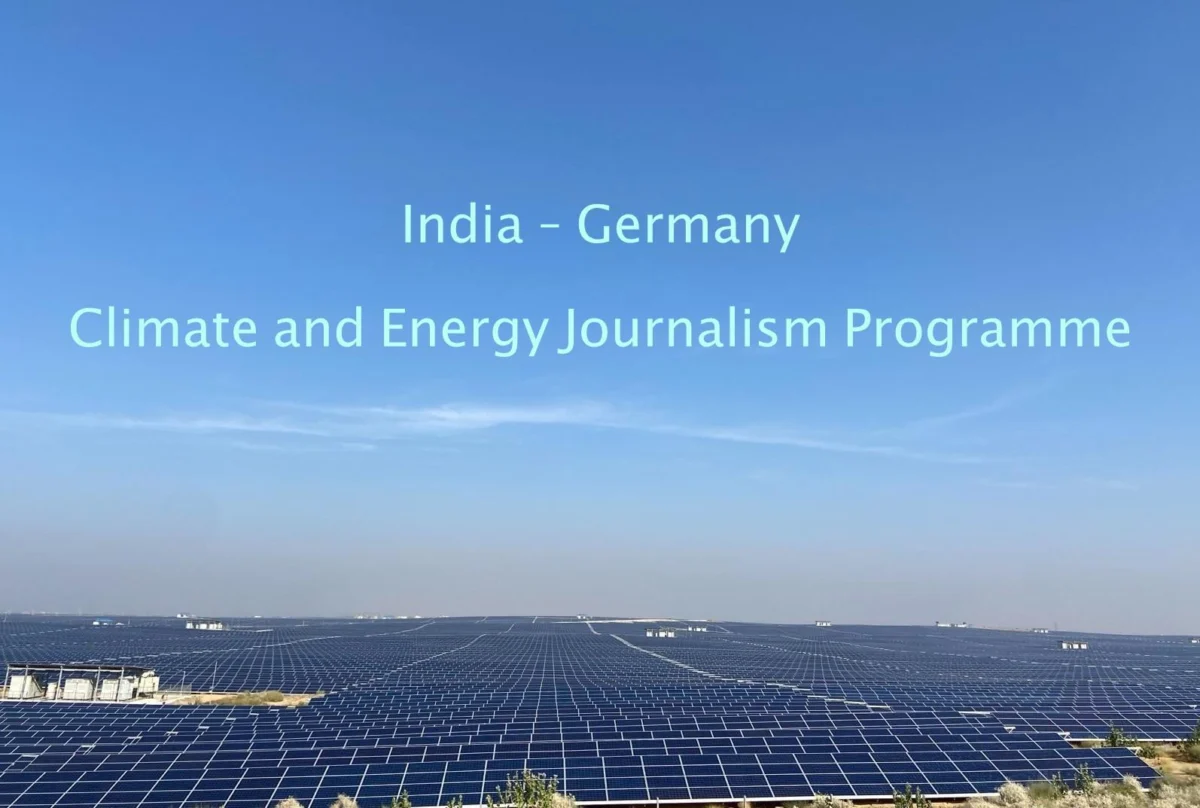
- January 2026: German Chancellor Olaf Scholz paid a high-level visit to India. This visit served as a catalyst for renewed cooperation, with specific attention paid to the energy transition and the security of supply chains. The Chancellor’s visit highlighted the urgent need to synchronize India’s massive solar capacity—exemplified by sites like the Bhadla Solar Park—with Germany’s industrial demand for green hydrogen and mineral resources.
- January 2027 (Current Phase): The call for applications for the new journalism program closed on January 27, signaling the commencement of the training phase. This reflects a shift toward "informed public discourse" as a necessary component of policy implementation.
Supporting Data: The Scale of the Transition
To understand the significance of this journalism program, one must look at the sheer scale of the energy infrastructure involved. The Bhadla Solar Park in Rajasthan, often cited in the context of this partnership, represents the scale of India’s ambition. Spanning over 14,000 acres, it is one of the largest solar power plants in the world.
For German observers, Bhadla is not merely an infrastructure project; it is a symbol of the global shift away from fossil fuels. However, data suggests that the transition is fraught with challenges:
- Investment Gaps: While billions of Euros have been pledged via the GSDP, the actual deployment of capital remains subject to regulatory bottlenecks in both jurisdictions.
- Labor Mobility: Estimates from the German Federal Employment Agency indicate that Germany requires hundreds of thousands of additional skilled workers annually. Indian professionals are increasingly filling these roles, particularly in the renewable energy and electrical engineering sectors, yet the process of credential recognition remains a point of friction.
- Critical Minerals: India’s recent efforts to auction critical mineral blocks are essential for the global battery market. The collaborative reporting program aims to track whether these minerals are being extracted with the social and environmental safeguards that European partners demand.
Official Responses: The Rationale for Collaborative Media
The decision to fund this program stems from a recognition that national media often lacks the context of the "other side."
A representative from Clean Energy Wire noted: "Climate change is a global systemic risk, but it is experienced locally. By pairing an Indian journalist who understands the socioeconomic pressures of a developing economy with a German journalist who understands the regulatory and technological landscape of the EU, we create a lens that is far sharper than any single reporter could achieve alone."
The Heinrich Böll Foundation has emphasized that media independence is crucial for accountability. "Public-private partnerships like the GSDP involve vast sums of taxpayer money," a foundation spokesperson stated. "It is the role of the Fourth Estate to scrutinize whether these projects lead to real decarbonization or if they are merely exercises in diplomatic signaling."
Implications: Why This Matters for the Future
The implications of this initiative extend far beyond the immediate output of the fourteen selected journalists.
1. Shaping the Narrative of the Global South-North Dialogue
For decades, the narrative surrounding the climate crisis has been dominated by a North-South dichotomy, often characterized by finger-pointing regarding carbon emissions. This program forces a shift toward "partnership-based journalism." By documenting shared challenges—such as the integration of intermittent renewable energy into national grids—the participants are helping to build a narrative of mutual dependence rather than unilateral assistance.
2. Highlighting the Human Dimension of the Green Transition
Climate change is often discussed in terms of gigawatts, carbon prices, and GDP growth. This program encourages reporters to look at the human cost and the human opportunity. Whether it is a solar worker in Rajasthan or a mechanical engineer in Bavaria, the green transition is fundamentally a story about people. By highlighting these stories, the program ensures that the transition is socially sustainable.
3. Setting a Standard for Investigative Rigor
In an era of disinformation and polarized media, the focus on "cross-border collaboration" acts as a form of peer review. When a German journalist and an Indian journalist co-author a report, they must reconcile different cultural perspectives and political biases. This process inherently results in a more rigorous and balanced product, setting a new benchmark for international environmental reporting.
Conclusion: The Road Ahead
As the world enters the late 2020s, the Indo-German partnership will likely serve as a blueprint for other cross-continental climate alliances. The journalists selected for this program are entering a field that is as challenging as it is consequential. Their work will provide the evidence base for how democratic nations can navigate the most difficult transformation in human history: moving from a carbon-dependent industrial model to one that is resilient, sustainable, and equitable.
While the application window has closed, the impact of the program is only beginning. Over the coming months, the public can expect a series of in-depth reports that will peel back the layers of the Indo-German climate agenda, providing the transparency and depth required to hold stakeholders accountable in a rapidly warming world.
The success of this experiment—the marriage of international reporting, professional training, and collaborative investigation—may well dictate how the media covers the climate crisis for years to come. In the heart of Rajasthan’s sun-drenched plains and the high-tech laboratories of Germany, the story of the future is being written, and through this initiative, it will finally be told with the complexity it deserves.
