




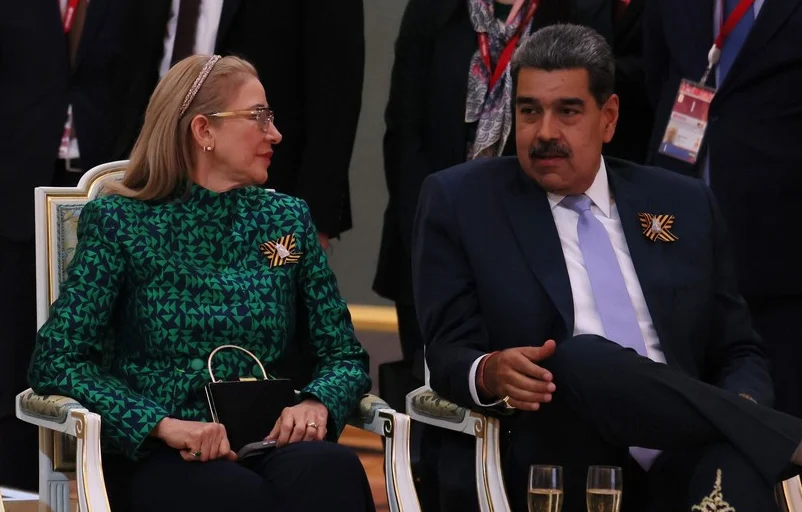
NEW YORK — In a high-stakes legal confrontation that pits the principles of international diplomacy against the long reach of American federal criminal law, former Venezuelan President Nicolás Maduro and his wife, Cilia Flores, have formally moved to dismiss the sweeping drug trafficking indictment pending against them. The motions, filed Wednesday in the U.S. District Court for the Southern District of New York, represent a sophisticated—albeit uphill—legal strategy aimed at leveraging the doctrine of sovereign immunity to secure an acquittal before their scheduled trial in June 2027.
The defendants, who have been held in federal custody in Brooklyn since their high-profile seizure by U.S. forces in Caracas in January 2026, are challenging the jurisdictional legitimacy of the charges. Their legal team, led by attorney Barry Pollack, argues that the U.S. government is attempting to criminalize the official functions of a sovereign state, an act they claim violates established international law.
The Core Arguments: Status vs. Conduct-Based Immunity
The defense strategy hinges on two distinct but complementary interpretations of international law: status-based immunity and conduct-based immunity.
Status-Based Immunity
Maduro’s defense rests heavily on the assertion that he remains the legitimate head of state for the purposes of international immunity. Citing the International Court of Justice’s (ICJ) landmark Arrest Warrant case (Democratic Republic of the Congo v. Belgium), the defense argues that incumbent heads of state enjoy absolute immunity from the criminal jurisdiction of foreign courts. Maduro’s counsel contends that regardless of the U.S. government’s refusal to recognize his administration, he maintained control over the Venezuelan state apparatus, deployed military assets, and directed foreign policy, thereby meeting the functional requirements of a head of state.
Cilia Flores has joined this effort, filing a separate motion that asserts her own derivative immunity. Her counsel argues that as the spouse of a sitting head of state, she is entitled to the same protections, asserting that sovereign immunity is an attribute of the state of Venezuela itself, rather than a personal privilege that the U.S. can selectively strip away through non-recognition.
Conduct-Based Immunity
Alternatively, the defense argues that even if the court rejects the claim of status-based immunity, the specific actions cited in the indictment—such as the issuance of diplomatic passports and the coordination of state military activities—constitute "official acts." Under this theory, acts performed in an official capacity are attributable to the state, not the individual, and are therefore shielded from the reach of U.S. prosecutors.
A Chronology of the Crisis
To understand the gravity of the current proceedings, one must view the legal filings against the backdrop of a decade of deteriorating U.S.-Venezuela relations:
- 2019: The United States government formally ceases recognition of Nicolás Maduro as the legitimate president of Venezuela, throwing its support behind opposition figures and citing irregularities in the electoral process.
- 2024: Following the disputed 2024 Venezuelan presidential election, the U.S. officially rejects Maduro’s claim of victory, further insulating the American legal stance from his claims of sovereign status.
- January 3, 2026: In a decisive shift in regional policy, U.S. forces execute an operation in Caracas to seize Maduro and Flores, bringing them into U.S. custody.
- January 5, 2026: The couple is arraigned in Manhattan federal court, where both enter pleas of not guilty to charges of narco-terrorism and cocaine-importation conspiracy.
- July 2026: The court establishes a firm trial date of June 1, 2027.
- September 2026: The defense files motions to dismiss based on the grounds of sovereign immunity, challenging the jurisdiction of the court.
- November 17, 2026: Oral arguments are scheduled to address the defense’s motion to dismiss the Fourth Superseding Indictment.
Supporting Data and Indictment Details
The "Fourth Superseding Indictment" paints a picture of a state-sponsored criminal enterprise. Prosecutors allege that Maduro and Flores utilized the highest levels of the Venezuelan government and military to facilitate the transit of massive quantities of cocaine through Venezuelan territory, destined for the United States.
Specifically, the charges against the couple include:
- Narco-terrorism conspiracy: A violation of 21 U.S.C. § 960a, which carries severe sentencing implications.
- Cocaine-importation conspiracy: Allegations that the defendants provided "protection" for drug shipments, utilizing government institutions to shield illicit cargo from interdiction.
- Weapons-related offenses: Linked to the alleged protection and enforcement of these trafficking networks.
Maduro’s second motion focuses on a technical challenge to the narco-terrorism charge. His attorneys argue that the indictment lacks a sufficient "nexus" to the United States. They posit that the alleged conduct occurred entirely within foreign borders and that the U.S. statute is being applied extraterritorially in a manner that exceeds the court’s jurisdictional mandate.
Official Responses and Judicial Precedents
The prosecution’s path to trial faces significant, albeit established, hurdles. The primary obstacle for the defense is the precedent set in United States v. Noriega. In that case, the U.S. courts famously denied former Panamanian leader Manuel Noriega’s claim of head-of-state immunity, largely because the United States did not recognize him as the legitimate ruler of Panama at the time of the proceedings.
The Department of Justice is expected to rely heavily on this precedent, arguing that the Executive Branch’s refusal to recognize Maduro as president is a "political question" that the courts must defer to. If the court follows the Noriega logic, the immunity argument will likely be dismissed, as the U.S. government’s non-recognition of Maduro serves as an absolute bar to status-based claims.
However, legal analysts from the Due Process of Law Foundation have noted that the Maduro case is distinct. Unlike Noriega, Maduro exercised actual, continuous control over the state apparatus, creating a tension between customary international law and the U.S. policy of non-recognition. The court must now decide whether U.S. recognition policy can unilaterally override the protections traditionally afforded to heads of state under international custom.
Implications for International Law
The outcome of this case will have profound implications for global jurisprudence. Should the court grant the motion to dismiss, it would set a significant precedent that a head of state’s immunity is objective and inherent, regardless of the diplomatic recognition afforded by the United States. Such a ruling would fundamentally constrain the ability of U.S. prosecutors to bring charges against foreign leaders for actions taken while in office.
Conversely, if Judge Alvin K. Hellerstein rejects the motions—as is widely expected by legal scholars—it will reinforce the power of the U.S. Executive Branch to define the boundaries of international immunity through the lens of diplomatic recognition. This would confirm that for the purposes of the U.S. judiciary, a foreign leader is only a "head of state" if the State Department says they are.
As the November 17 oral arguments approach, the eyes of the international legal community remain fixed on Manhattan. The case has evolved into more than a criminal trial; it is a test of whether the traditional shields of sovereignty can withstand the aggressive application of U.S. anti-narcotics and national security laws. With the trial date set for June 2027, the coming months will determine whether this unprecedented legal saga reaches a courtroom conclusion or is derailed by the complexities of international diplomatic status.
