





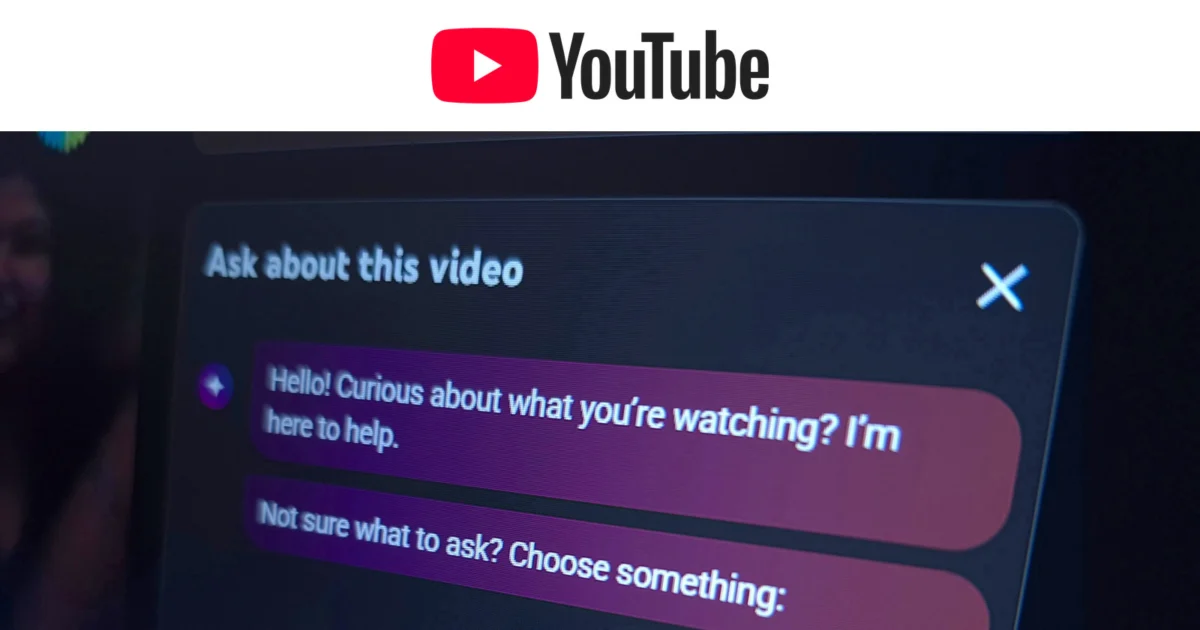
In a significant leap forward for artificial intelligence, Google has unveiled a sophisticated new approach to video comprehension dubbed “agentic video understanding.” This development is set to fundamentally alter how users interact with content on YouTube, moving away from blunt, static analysis toward a nuanced, intelligent inquiry process. By integrating this technology into the “Ask YouTube” feature, Google aims to provide viewers with high-precision, context-aware answers derived directly from the visuals, audio, and transcripts of the videos they are currently watching.
The Evolution of Video Interaction: Main Facts
For years, artificial intelligence models have struggled with the sheer volume of data contained in long-form video content. Traditional methods, known as “static processing,” typically involve sampling frames at a fixed, predetermined rate—often one frame per second—and feeding that data into a model. While effective for basic tasks, this approach is resource-heavy, inefficient, and often misses the subtle, fleeting details that define a high-quality user query.
Google’s new agentic video understanding model changes this paradigm. Instead of processing a video in a linear, brute-force manner, the model acts as an active agent. It selectively loads specific segments of a video, dynamically adjusts frame rates based on the complexity of the visual data, and intelligently decides whether to prioritize audio, visual, or textual (transcript) data to answer a user’s question.
This capability is currently rolling out to developers via the Gemini API in Google AI Studio and the Gemini Enterprise Agent Platform. For the average consumer, this means that in the "coming months," the Ask YouTube button—found directly on the video watch page—will gain the ability to provide hyper-accurate, grounded insights that are far more sophisticated than previous iterations.
A Chronology of YouTube’s AI Integration
The journey toward a conversational, AI-driven YouTube has been rapid and iterative.
- April 2024: Industry observers began noticing Google testing “Ask YouTube” as a conversational search experiment. This early iteration focused on providing summaries of videos via the platform’s search bar, often citing multiple sources.
- May 2024: During the Google I/O conference, the company officially showcased its commitment to AI-powered creation and search tools, emphasizing the role of Gemini Omni and conversational interfaces in enhancing user experience.
- July 2024: Alphabet CEO Sundar Pichai reported staggering engagement numbers, revealing that over 140 million users had interacted with the watch-page Ask YouTube feature during the month of June. This milestone solidified the feature as a cornerstone of YouTube’s long-term strategy.
- September 2024: Google officially announced the integration of agentic video understanding into the broader Gemini ecosystem, signaling a shift toward more complex, "agentic" capabilities for both the YouTube watch page and the standalone Gemini application.
This timeline reflects a deliberate strategy: start with limited experiments for a small subset of U.S.-based English speakers, gather massive amounts of user feedback, and then scale the technology globally.
The Technical Edge: Data and Performance Metrics
The shift to agentic processing is not merely a feature update; it is a fundamental optimization of computational efficiency. According to Google’s internal testing on standardized video benchmarks, the transition from static to agentic processing yields impressive results:
- Efficiency Gains: The system reduces token usage by up to 88%, a critical factor for managing the heavy data loads associated with video analysis.
- Cost Reduction: Businesses and developers leveraging the Gemini API can see analysis costs drop by up to 66%.
- Accuracy Improvements: Perhaps most importantly for the end user, accuracy in answering specific queries improves by approximately 7%.
The model excels particularly with long-form content. By deciding what to look at, the AI avoids the "noise" of repetitive frames in hours-long footage. While the API documentation notes a slight increase in latency for videos under five minutes—due to the overhead of the agentic "thought process"—the trade-off is significantly higher for longer, more complex content, where the model can pinpoint split-second visual anomalies or track objects through multi-hour sessions.
Official Stance and Strategic Implications
Google has maintained a relatively tight-lipped approach regarding the specific rollout schedule for the watch-page update, citing only the "coming months" as the target window. Despite the lack of a firm date, the company has been clear about its intent: to leverage Gemini to provide answers that are "grounded in the visuals."
The "Ask YouTube" Dichotomy
It is crucial to distinguish between the two ways users encounter AI on YouTube. First, there is the Search Bar integration, which acts as a discovery tool, pulling summaries from across the platform to answer broad queries. Second, there is the Watch-Page integration, which is a contextual assistant for a single video. The upcoming update focuses primarily on the latter, effectively turning a static video player into a searchable database.
Ranking and Transparency
As of early September, the mechanisms governing how YouTube ranks these AI responses remain somewhat opaque. While official help pages state that the system prioritizes "relevance, engagement, and quality," there remains a lack of granular detail regarding how specific videos are chosen for citation or why some are omitted. For creators, this raises questions about "AI optimization"—the need to structure video content in a way that makes it more digestible for these emerging agentic systems.
Implications for Creators, Users, and Industry
The integration of agentic video understanding holds profound implications for the digital landscape.
For the Content Creator
The "black box" nature of AI citation is a primary concern. If an AI agent can summarize a 30-minute tutorial into a 30-second text answer, how does that impact the creator’s ad revenue and watch time? While Google has not yet provided specific guidance on how creators can "optimize" for these AI models, the shift toward visual-centric AI means that high-quality, clear, and descriptive visual content will likely be favored by the model’s indexing logic. Creators who provide chapters, clear visual demonstrations, and accurate transcripts are positioning themselves to be the "primary sources" for these new AI-driven answers.
For the User Experience
The promise of this technology is a frictionless discovery of information. Instead of scrubbing through a one-hour podcast or a technical teardown, a user can simply ask: "At what point does the host discuss the battery capacity?" or "What specific tool was used in this step?" The agentic model will parse the video, find the exact frame or segment, and deliver the answer. This reduces the cognitive load on the user and increases the utility of YouTube as an educational resource.
The Broader AI Industry
By proving that agentic models can outperform static ones in video analysis, Google is setting a new benchmark for the industry. This is not just about YouTube; it is about how autonomous agents interact with the world. Whether it is security camera footage, medical imaging, or architectural design reviews, the ability for an AI to "watch" and "think" about what it is seeing—rather than just recording it—will likely define the next decade of computer vision research.
Looking Ahead: The Future of the "Ask" Interface
As we look toward the end of 2024 and beyond, the "Ask" button is poised to become as ubiquitous as the "Like" or "Subscribe" buttons. The success of this feature will depend on three factors: accuracy, speed, and trust.
Google must navigate the thin line between providing helpful summaries and cannibalizing the viewership of the very content that fuels its AI. Furthermore, as the system rolls out globally, the challenges of multilingual support and cultural nuance will require even more sophisticated versions of the current agentic loop.
For now, the recommendation for power users and developers is to monitor the official YouTube help pages and the Google AI Studio documentation. The shift toward agentic understanding is a clear signal that Google is moving toward an era of "intelligent consumption," where the video is no longer a passive medium, but a live, interactive, and deeply searchable repository of human knowledge. As this technology matures, the definition of "watching" a video will be rewritten, transforming the platform into an active, collaborative space between the viewer, the creator, and the AI agent.
