




By Editorial Staff
August 28, 2026
As the American labor market faces a historic transition—defined by the rapid integration of artificial intelligence, the green energy revolution, and shifting paradigms in collective bargaining—the National Employment Law Project (NELP) has announced a significant expansion of its leadership team. This strategic move, announced by President and CEO Rebecca Dixon, positions the organization to spearhead the next generation of labor rights advocacy. By bringing four of the nation’s most prominent policy architects into its fold, NELP aims to turn the conceptual "Good Jobs Economy" into a systemic reality for workers across the United States.
The Mandate for Change
For over seven decades, NELP has served as the intellectual engine of the American workers’ rights movement. In an era where the divide between corporate profits and worker compensation has grown increasingly stark, the organization is doubling down on its commitment to policy transformation.
"Creating a Good Jobs Economy for all workers—where every job is a good job—requires leaders with deep policy expertise and a clear vision to achieve bold, lasting change," said Rebecca Dixon in a formal statement. The appointment of four new high-profile fellows is not merely a staffing decision; it is a signal of NELP’s intent to influence the federal and state regulatory landscape as the country navigates the late 2020s.
The New Leadership Nucleus: Profiles in Advocacy
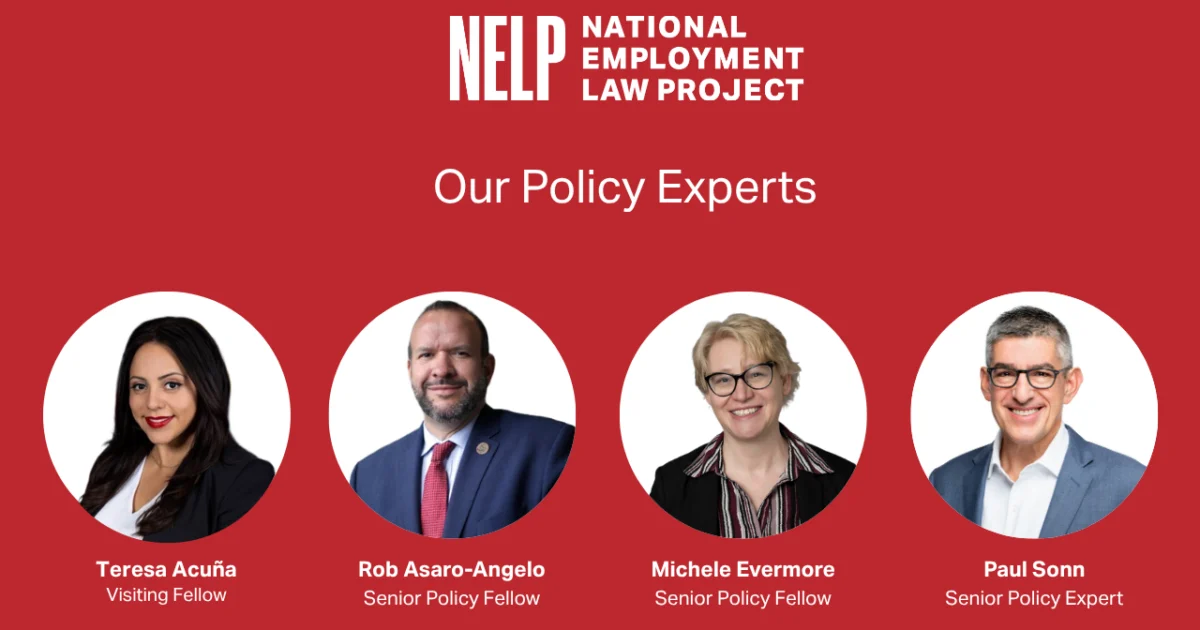
The newly appointed team brings a blend of federal administrative experience, state-level governance, and decades of grassroots activism.
Teresa Acuña: Championing Good Jobs Democracy
Teresa Acuña joins NELP as the Visiting Fellow for Good Jobs Democracy. Her appointment is particularly timely as the U.S. government continues to deploy massive federal investments into infrastructure, clean energy, and domestic manufacturing. As the former director of the Good Jobs Initiative at the U.S. Department of Labor under the Biden-Harris administration, Acuña was a primary architect of policies designed to ensure that public investment produces high-quality, sustainable employment. Her expertise will be critical as NELP seeks to ensure that these massive capital injections translate into tangible benefits for workers in both urban and rural communities.
Rob Asaro-Angelo: Architect of Worker-First Protections
As the new Senior Policy Fellow for Worker-First Protections, Rob Asaro-Angelo brings a wealth of executive experience. Serving as Commissioner of the New Jersey Department of Labor and Workforce Development from 2018 to 2026, Asaro-Angelo was at the helm during one of the most volatile periods in labor history. His tenure in New Jersey saw the modernization of complex workforce protections and a proactive approach to managing state labor services. His transition to NELP suggests an effort to scale successful state-level labor protections to a national model.
Michele Evermore: Modernizing Economic Security
The return of Michele Evermore to NELP as Senior Policy Fellow for Economic Security and Worker Transitions is a strategic "homecoming." Evermore played a pivotal role in the organization’s previous work, specifically during the COVID-19 pandemic, where her advocacy led to historic expansions of Unemployment Insurance (UI). Her subsequent role as Deputy Director for Policy in the Office of Unemployment Insurance Modernization at the U.S. Department of Labor provides her with an insider’s understanding of how federal bureaucracies can be restructured to better serve the unemployed during economic transitions.
Paul Sonn: Sustaining Wage Growth
Paul Sonn, a veteran of NELP’s state policy program, assumes the role of Senior Policy Expert for Wages and Affordability. Sonn’s resume reads like a roadmap of modern labor success stories; he was a leading advisor to the Fight for $15 movement and a key architect behind the nation’s first municipal minimum wage laws. As the cost of living continues to fluctuate, Sonn’s focus will shift toward innovative wage and affordability policies that prevent the erosion of worker purchasing power.
A Chronology of Labor Advocacy
The evolution of NELP’s strategy can be understood through the lens of recent American economic history:
- 2010–2015: NELP establishes itself as the intellectual architect of the "Fight for $15," successfully shifting the national discourse from poverty-level wages to a living wage standard.
- 2020–2022: The COVID-19 pandemic forces a total overhaul of the social safety net. NELP’s expertise on Unemployment Insurance becomes the benchmark for federal policy, leading to the temporary but essential expansion of benefits.
- 2023–2025: The federal government pivots toward "industrial policy," pouring billions into domestic semiconductor manufacturing and green energy. NELP begins focusing on the "Good Jobs Initiative," ensuring that federal subsidies come with strings attached regarding worker rights and labor standards.
- 2026: NELP consolidates this expertise, formalizing the leadership structure announced this week to influence the next decade of American labor policy.
Supporting Data: The Case for Targeted Policy
Data supporting the need for this leadership expansion is robust. According to recent Bureau of Labor Statistics (BLS) reports and NELP’s own internal analysis, the "Good Jobs" gap remains a primary driver of income inequality.
- The Infrastructure Effect: With trillions of dollars in federal investments currently moving through the economy, the risk of "low-road" contracting—where companies take federal money but suppress wages—is high.
- Unemployment Vulnerability: While the unemployment rate has remained relatively stable, the quality of employment in the service sector has stagnated, with real wages often failing to keep pace with housing and healthcare inflation.
- The Automation Gap: As AI adoption accelerates, the workforce requires a transition strategy that does not simply replace workers, but facilitates their move into higher-value roles, a key focus for Michele Evermore’s new portfolio.
Implications for the Future of Labor
The appointment of these four leaders signals that NELP is shifting from a defensive posture—fighting against wage theft and benefit cuts—to a proactive, design-oriented approach.
Shaping Federal Legislation
By placing individuals who have actually written and implemented federal policy into advocacy roles, NELP is effectively creating a "shadow cabinet" of labor policy. This will likely result in more sophisticated legislative drafting that is harder for opposition groups to dismantle.
Bridging the Urban-Rural Divide
A key challenge for the modern labor movement has been the disconnect between urban activism and rural labor needs. With Teresa Acuña’s background in federal infrastructure, there is a clear intent to tailor labor policies that benefit the manufacturing-heavy economies of the American heartland as much as the tech-heavy hubs of the coasts.
The Return of Collective Power
Paul Sonn’s leadership in wage and affordability suggests that NELP will continue to advocate for mechanisms that go beyond simple statutory minimums, exploring sector-wide bargaining and wage-setting boards. These models have been successful in Europe and are increasingly being viewed as the necessary next step for the U.S. labor market.
Conclusion: A Sharpened Strategic Focus
Rebecca Dixon’s tenure as President and CEO has been characterized by a move toward intersectional advocacy—connecting labor rights to racial, gender, and economic justice. This latest expansion is the manifestation of that philosophy.
As NELP looks toward the remainder of the 2020s, the organization is clearly betting that policy expertise, combined with a deep understanding of administrative mechanics, is the only way to deliver the "Good Jobs Economy." With this new nucleus of leadership, the organization is well-equipped to turn that vision into a reality, ensuring that the next generation of American workers finds not just employment, but security, dignity, and a fair share of the prosperity they help create.
"Onward!" Dixon concluded in her announcement. For the labor movement, the message is clear: the work of building a more equitable economy is far from finished, but it has now been significantly strengthened.
