





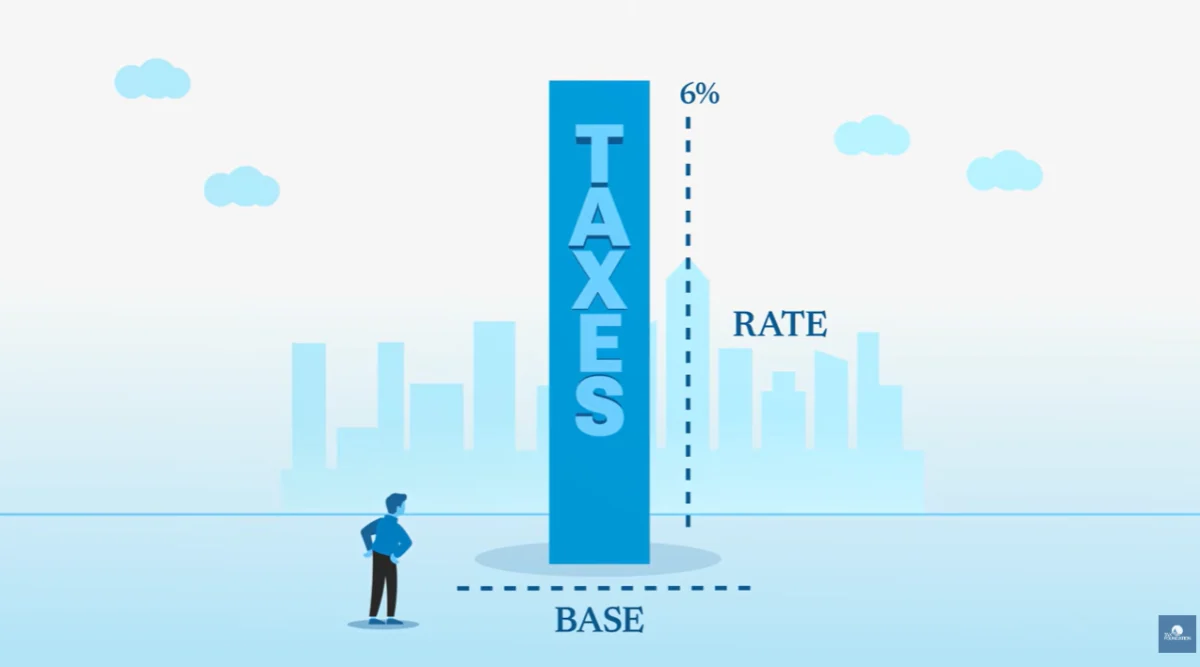
When taxpayers discuss their financial burden, the conversation almost invariably gravitates toward the "tax rate." Whether it is the marginal income tax bracket, a corporate tax percentage, or the local sales tax at a register, the rate is the most visible metric of fiscal policy. However, economists and policy analysts argue that focusing exclusively on the rate is akin to looking at only half of an equation.
The hidden driver of economic efficiency—or dysfunction—is the tax base. Understanding the interaction between the rate and the base is essential for grasping why certain tax systems stifle economic growth while others foster stability.
The Fundamentals: What is a Tax Base?
At its core, a tax system is defined by two primary components: the rate and the base. While the rate determines how much is taken, the base defines what is being taxed. Common tax bases include personal income, corporate profits, real estate property, and retail consumption.
A "broad" tax base is one that covers a wide array of economic activities with few exemptions, exclusions, or credits. Conversely, a "narrow" tax base is riddled with carve-outs, subsidies, and special treatments that exempt large swaths of economic activity from taxation.
The central thesis of modern public finance is that a broad base allows for a lower rate. When a government attempts to fund public services using a narrow base, it is forced to artificially inflate the tax rate to compensate for the missing revenue, creating a phenomenon known as "tax distortion."
Chronology of Tax Policy Evolution
The debate over the tax base is not new, but it has intensified as the global economy has shifted from physical goods to services and digital commerce.
- The Early 20th Century: Tax systems were primarily designed around tangible assets—land, property, and physical goods. Because these were easy to track and quantify, the "base" was naturally broad.
- The Mid-20th Century Rise of Exemptions: As governments began using the tax code to incentivize social behavior (e.g., homeownership, charitable giving, employer-provided healthcare), the tax base began to narrow. Each exemption was intended to help a specific group, but cumulatively, they began to hollow out the revenue potential.
- The Digital Transformation (2000s–Present): The rise of the digital economy presented a significant challenge to the tax base. Many state sales tax systems were built for a world of physical retail. When citizens shifted spending toward streaming services, digital downloads, and subscription-based software, many of these transactions fell outside the traditional tax base, causing revenue leakage.
- The Current Policy Wave: Today, state legislatures across the United States are grappling with the "Broaden the Base, Lower the Rate" movement. Lawmakers are increasingly evaluating whether it is more efficient to tax a wider variety of services at a lower rate rather than clinging to a narrow base that requires high, prohibitive rates on a shrinking pool of goods.
Supporting Data: The Impact of Narrow Bases
The economic implications of a narrow base are not merely theoretical; they are reflected in productivity data and market behavior.
1. The Cost of Distortions
When a tax base is narrow, the government often selects specific items to tax at high rates. This creates a "distortionary effect." If a state taxes physical goods at 9% but leaves digital services and professional consulting entirely untaxed, businesses and consumers will naturally pivot their behavior to avoid the taxed activity. This is known as "tax-motivated decision making."
2. The Multiplier Effect of Rates
Data from the Tax Foundation and various economic think tanks suggest that high marginal tax rates—often necessitated by a narrow base—act as a deterrent to investment. For instance, if a corporation is considering opening a new facility, a state with a 10% tax rate on a narrow base is often less attractive than a state with a 4% tax rate on a broad base. The latter is viewed as "neutral," meaning it does not penalize specific economic choices.
3. Stability and Revenue Volatility
A narrow base is inherently more volatile. If a state relies heavily on tax revenue from a single industry—such as oil, luxury goods, or high-end real estate—the state budget becomes susceptible to market shocks. A broad base, which encompasses a wide variety of daily economic transactions, provides a more stable, predictable stream of revenue that is less prone to sudden dips during economic downturns.
Official Responses and Expert Perspectives
Economists generally favor "tax neutrality," the principle that taxes should interfere as little as possible with market decisions.
"When we talk about a neutral tax system, we are talking about a system that doesn’t pick winners and losers," says a leading policy analyst at a non-partisan economic institute. "When you exempt groceries, streaming services, or haircuts, you aren’t just giving a break to consumers; you are forcing the government to hike the tax rate on the remaining items to stay afloat. This creates a cascade of unintended consequences where capital and labor move to avoid the high rates, rather than moving to where they are most productive."
On the other side of the aisle, some policymakers argue that narrow bases are a vital tool for social equity. "Exempting essentials like groceries or medicine is a way to ensure that lower-income households are not disproportionately burdened by sales taxes," argues a state legislative advocate.
However, many economists counter that if the goal is to protect low-income individuals, it is more efficient to provide direct, targeted assistance (like tax credits or cash transfers) rather than distorting the entire tax base, which creates economic inefficiencies that ultimately hurt the same people the exemptions were meant to protect.
Implications: The Path Toward Reform
The path to a more efficient tax system involves difficult political choices. Expanding the tax base means eliminating popular exemptions. For a politician, "broadening the base" often sounds like "raising taxes on new things," which can be a difficult sell to voters.
However, the implications of maintaining a narrow base are clear:
- Economic Stagnation: High rates on a narrow base discourage hiring and capital investment. When businesses make decisions based on tax avoidance rather than operational efficiency, the entire economy loses productivity.
- Increased Compliance Costs: Complex tax codes with hundreds of exemptions require more administrative oversight, higher compliance costs for businesses, and more opportunities for legal maneuvering and tax avoidance.
- Fiscal Fragility: As noted previously, governments with narrow bases are more likely to face budget shortfalls during recessions.
The Strategy for Change
The most successful tax reforms follow a simple, albeit politically challenging, playbook:
- Identify Exemptions: Audit the current tax code to identify which goods and services are excluded from taxation without a clear, evidence-based economic justification.
- Eliminate Distortions: Gradually sunset these exemptions to broaden the base.
- Lower Rates: Simultaneously reduce the statutory tax rate.
- Maintain Neutrality: Ensure that the new, lower rate applies to as much of the economy as possible, minimizing the incentive for businesses to move or change their behavior purely for tax reasons.
Conclusion
The debate over tax rates is only half the story. While rates capture the public’s attention, the base is the foundation upon which the entire fiscal structure sits. A narrow, exemption-heavy base forces governments into a corner, necessitating high rates that inhibit growth, distort market incentives, and introduce instability.
As the economy continues to evolve, the necessity for a "broad and low" approach becomes increasingly apparent. By shifting the focus from protecting specific exemptions to fostering a neutral, efficient, and stable tax environment, policymakers can create a system that serves the needs of the government while empowering—rather than hindering—the private sector. The future of economic competitiveness depends not on how high the rate is, but on how intelligently the base is designed.
