





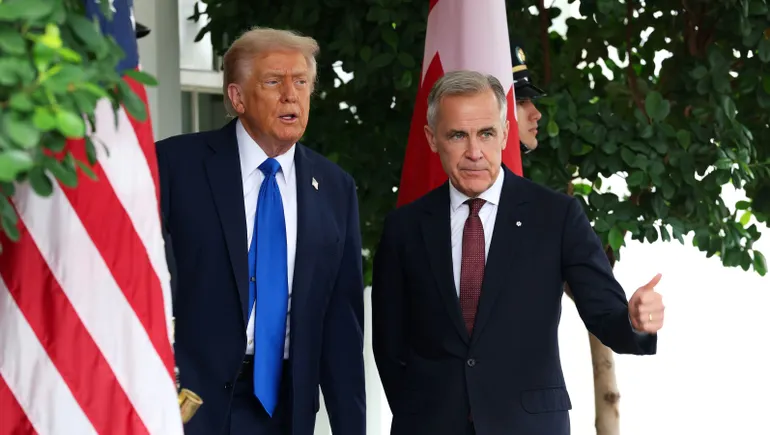
The economic landscape of North America is facing its most significant period of instability in decades as the trade relationship between the United States and Canada continues its rapid deterioration. In a move that has sent shockwaves through the automotive and manufacturing sectors, U.S. President Donald Trump announced on Monday a new, aggressive round of tariffs targeting Canada’s primary industrial exports.
The announcement, delivered via social media, mandates a 50% tariff on all cars, trucks, automotive parts, and steel imports originating from Canada. Scheduled to take effect on January 1, this latest measure represents a dramatic escalation in a conflict that has already disrupted cross-border supply chains and pushed the trilateral United States-Mexico-Canada Agreement (USMCA) to the brink of collapse.
The Chronology of a Breakdown
To understand the current volatility, one must look at the rapid succession of failed negotiations and broken deadlines that have defined the last two months.
- Mid-2025: Tensions began to simmer as the U.S. implemented broad-based levies, prompting Canada to respond with retaliatory tariffs on approximately $60 billion of U.S. goods. While Canada later rescinded some of these duties in an attempt to stabilize relations, the underlying friction remained.
- August 2026: President Trump signaled his intent to impose a 50% tariff on a wide array of Canadian imports. Originally slated for implementation mid-month, the order was delayed by three days as negotiators from both nations attempted to bridge the divide.
- Friday, August 21, 2026: Despite late-stage optimism that a compromise was within reach, Prime Minister Mark Carney abruptly suspended trade discussions. The move allowed the initial wave of tariffs, impacting $20 billion worth of Canadian goods, to take effect.
- Saturday, August 22, 2026: Prime Minister Carney addressed the nation, characterizing the U.S. proposals as "uneconomic and unfair," and signaling that Canada would move to a posture of active retaliation.
- Monday, August 24, 2026: President Trump announced the new 50% tariff on automotive and steel products, citing a desire to stop Canada from "ripping off" the U.S. economy.
Official Responses: A Clash of Narratives
The rhetoric surrounding these negotiations reveals two diametrically opposed views of the trade impasse.
The Canadian Perspective: Defending Sovereignty
Prime Minister Mark Carney has framed the Canadian government’s refusal to accept U.S. terms as an act of economic self-defense. In his address on Saturday, Carney noted that while the two nations appeared to be moving toward a mutually beneficial agreement early in the week, the U.S. eventually introduced new, punitive terms.
"In short, they asked too much and offered too little," Carney stated. He emphasized that the Canadian response—which includes "dollar-for-dollar" retaliatory tariffs set to launch by September 8—is a "focused response to protect and defend our industries." Canada’s planned retaliation is set to target a broad spectrum of U.S. exports, including steel, dairy products, household appliances, agricultural machinery, and pulp and paper, as well as high-tech electronics.
The U.S. Perspective: Seeking "Fairness"
Conversely, the Trump administration has characterized the breakdown as a failure of Canadian cooperation. U.S. Trade Representative Jamieson Greer, speaking on CNBC, pushed back against the narrative that the U.S. was being unreasonable.
Greer stated that the U.S. delegation had offered significant concessions, including cutting existing tariffs on steel and aluminum in half and reducing levies on lumber and automobiles. "They wanted more," Greer said, suggesting that the Canadian government walked away from a deal that was nearly finalized. For the White House, the tariffs are a necessary mechanism to correct what they view as a fundamentally unbalanced trading relationship.
Supporting Data and Technical Ambiguity
Despite the severity of the announcements, there remains a notable lack of administrative clarity. The White House has yet to publish an official tariff order, leaving analysts and industry leaders to speculate on how these new 50% duties will interact with existing Section 232 levies.
The uncertainty is compounded by the ongoing 10-year review of the USMCA. The pact, which governs the rules of origin for the very vehicles and parts now under threat, is currently in a state of administrative limbo. Last month, the U.S. declined to extend the agreement’s procedural timeline, effectively forcing a formal review process. While Mexico has engaged in productive bilateral discussions with the U.S. regarding the future of the trade bloc, Canada has been largely sidelined, creating a bifurcated North American trade policy.
The Economic and Geopolitical Implications
The implications of this trade war extend far beyond the immediate financial impact on the $20 billion in goods already affected.
Supply Chain Disruptions
The automotive industry is perhaps the most vulnerable sector. Because Canadian and U.S. auto supply chains are deeply integrated—with parts often crossing the border multiple times before a vehicle is fully assembled—the 50% tariff effectively renders many existing cross-border production models non-viable. Manufacturers are now forced to consider relocating production facilities or absorbing massive cost increases that will inevitably be passed on to the consumer.
The Retaliatory Spiral
Canada’s plan to target U.S. agricultural equipment and dairy is a calculated move designed to put pressure on specific U.S. political constituencies. By hitting these sectors, Canada is signaling that it intends to make the trade war "felt" by the American voter base, rather than just the industrial sector. This "tit-for-tat" cycle risks becoming a permanent fixture of North American commerce, potentially undoing years of market integration.
The Future of the USMCA
Perhaps the most concerning implication is the potential erosion of the USMCA. If the U.S. continues to ignore the dispute-resolution mechanisms outlined in the agreement in favor of unilateral tariff threats, the pact risks becoming irrelevant. If the U.S. treats Canada differently than it treats Mexico—or vice versa—the trilateral nature of the agreement will likely collapse, leaving Canada in an isolated position that could necessitate a fundamental pivot in its foreign trade policy, possibly toward deeper engagement with European or Asian markets.
A Path Forward?
As of now, there is no clear path to de-escalation. Both the U.S. and Canada have adopted entrenched positions that appear to be as much about domestic political optics as they are about economic policy.
For the U.S., the tariffs are framed as a "win" for the American worker, fulfilling campaign promises to protect domestic manufacturing. For Canada, standing up to the U.S. is a matter of national economic sovereignty. As the January 1 implementation date for the latest round of tariffs approaches, the business community remains on edge, bracing for what could be the most disruptive period in North American trade history.
Observers note that without a major diplomatic intervention or a significant shift in the rhetoric from either Washington or Ottawa, the cycle of tariffs and counter-tariffs will likely continue, further straining a relationship that has served as the backbone of the global economy for decades.
This is a developing story. Updates will follow as official tariff orders are published and further statements are issued by both the White House and the Office of the Prime Minister.
