





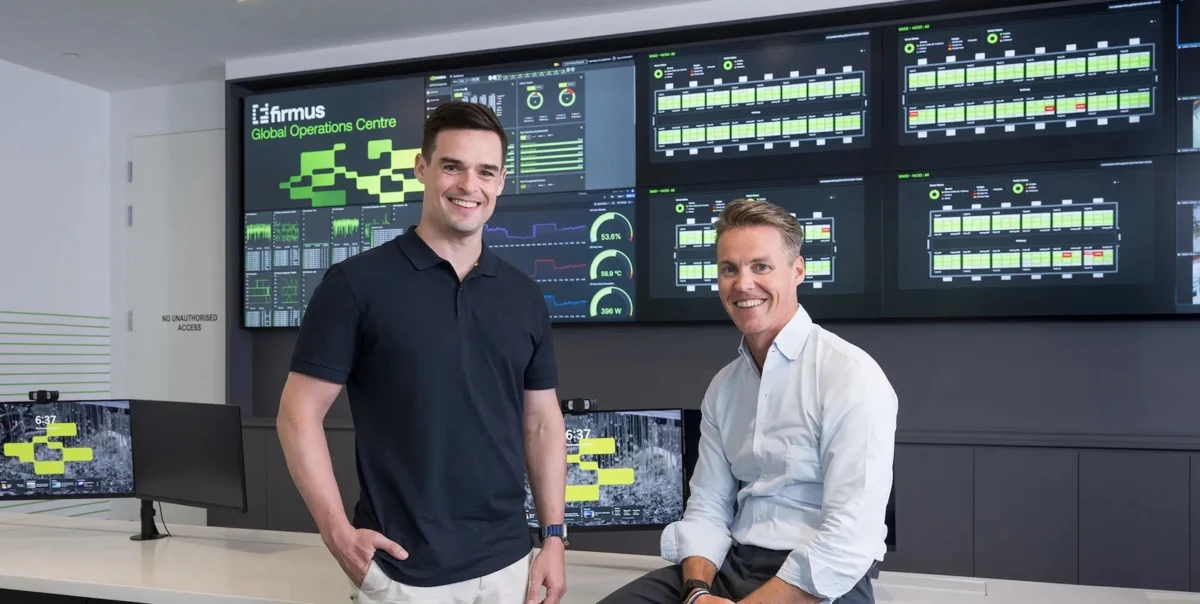
In a display of unprecedented momentum within the Australian technology sector, Firmus Technologies has surged to a staggering $15 billion (US$10.5 billion) valuation. The Sydney-headquartered AI infrastructure firm successfully closed a US$2 billion (A$2.85 billion) funding round this week, marking a meteoric rise that has sent shockwaves through the local and international investment communities. This capital infusion is earmarked to accelerate "Project Southgate," a $73 billion national rollout of energy-efficient, AI-ready data centres.
The latest capital injection saw a high-profile lineup of backers. Existing powerhouse investors, including Coatue and Nvidia, reinforced their commitment to the firm, while new equity was secured from funds managed by Blackstone Tactical Opportunities and additional Blackstone vehicles. The round was further bolstered by participation from the renowned US quantitative trading firm Jane Street, underscoring the strategic importance of Firmus’s physical infrastructure to the global financial and technological elite.
A Chronology of Hyper-Growth: From Bitcoin to AI Hegemony
To understand the scale of Firmus’s current valuation, one must look at the compressed timeline of its evolution. Founded in Sydney in 2019 by Oliver Curtis, Tim Rosenfield, and Jonathan Levee, the company began as a boutique bitcoin mining operation. However, the founders quickly pivoted, identifying that the real value in the burgeoning AI era would not lie in the algorithms themselves, but in the physical, energy-hungry infrastructure required to train and deploy them.
The company’s trajectory over the last 12 months alone is a masterclass in aggressive scaling:
- September 2025: Firmus reached a valuation of $1.85 billion following a $330 million investment led by Nvidia, intended for the development of its initial Tasmanian data centre.
- March 2026: The company banked $100 million in a follow-up round, pushing its valuation to $6 billion.
- April 2026: Momentum accelerated with a massive US$505 million (A$725 million) raise, driving the valuation to $8 billion.
- Present Day: With the latest US$2 billion round, the company has officially reached a $15 billion valuation, having raised a cumulative total exceeding US$3 billion (A$4.25 billion) in just one year.
This rapid expansion has paved the way for Project Southgate, an ambitious plan to establish a network of "AI factories" across four Australian capital cities, effectively positioning the country as a critical hub in the global AI supply chain.
Project Southgate and the "Green" AI Mandate
At the heart of Firmus’s success is its "green" positioning—a strategic alignment with the federal government’s increasing pressure on data centre operators to incorporate renewable energy. As the energy consumption of AI training clusters continues to climb, policymakers have begun to scrutinize the environmental impact of large-scale server farms.
Firmus has distinguished itself by integrating proprietary IP and manufacturing innovation, which they claim reduces the thermal and electrical load compared to traditional legacy data centres. This "repeatable deployment model" has caught the eye of investors who recognize that the scarcity of energy-efficient, high-density compute space is currently the primary bottleneck for the AI industry.
However, the path to national implementation has not been without its challenges. The company has faced vocal resistance from local residents in Tasmania and South Australia, who have raised concerns regarding land use, the impact on local power grids, and the overall footprint of these industrial-scale facilities. Despite these local headwinds, the federal government—under Prime Minister Anthony Albanese—remains keen to foster a domestic AI ecosystem, viewing Firmus as a cornerstone for Australia’s long-term digital sovereignty.
Global Implications: The Asia-Pacific Expansion
Firmus is no longer merely an Australian player; it is rapidly transforming into an Asia-Pacific infrastructure giant. In June 2026, the company announced a monumental US$30 billion (A$43 billion) deal with Nvidia to construct one of the region’s most powerful AI data centres in Batam, Indonesia.
The 360-megawatt "AI Factory," developed in collaboration with digital infrastructure firm DayOne, is strategically located just 26km from Singapore, providing a high-capacity gateway for data traffic between the island nation and the rapidly growing Indonesian market.
Oliver Curtis, co-CEO of Firmus, emphasized that the recent funding allows the company to operate on multiple fronts simultaneously. "We’re scaling across Australia while fast-tracking our capacity to expand into the wider Asia-Pacific region," Curtis stated. "We are building one of the world’s leading AI infrastructure platforms right here, starting from our base in Australia."
Expert and Investor Perspectives
The sustained confidence from global institutional investors speaks volumes about Firmus’s perceived long-term value. Robert Yin, a senior figure at Coatue, highlighted that the firm’s success is rooted in its unique operational philosophy.
"Firmus represents a differentiated approach to AI infrastructure," Yin noted. "Its combination of proprietary IP, manufacturing innovation, and a repeatable deployment model creates a compelling platform to serve the growing needs of both AI-native companies and enterprise customers as demand for AI infrastructure continues to accelerate."
From the perspective of high-frequency trading and algorithmic intelligence, the backing from Jane Street is particularly telling. Daniel Pontecorvo, Head of Physical Engineering at Jane Street, commented on the necessity of this infrastructure: "As AI models become larger and more capable, access to reliable, high-performance compute becomes increasingly important. Firmus is helping build the infrastructure needed to support that next generation of AI."
The Path to the ASX and Beyond
With its valuation now sitting at $15 billion, speculation regarding a potential Initial Public Offering (IPO) on the Australian Securities Exchange (ASX) has intensified. Having touted an IPO since early 2026, the company has seen its expected valuation climb by $3 billion in the months leading up to this latest round.
The list of investors backing this journey is a "who’s who" of both local and international finance, including:
- Institutional Giants: Blackstone, Coatue, and Nvidia.
- Trading Firms: Jane Street.
- Australian Investment Houses: Regal Funds Management, Ellerston Capital, and Archibald Capital.
- Private Capital: Melbourne billionaire Alex Waislitz and the Pratt family.
As the company prepares to roll out its infrastructure across the nation, all eyes will be on its ability to navigate the complex regulatory and environmental landscapes of the regions in which it operates.
Strategic Challenges and Future Outlook
While the financial metrics are stellar, the road ahead involves significant execution risk. Building physical infrastructure at the scale of Project Southgate requires managing complex supply chains, securing stable and renewable energy access, and maintaining local "social license" in communities sensitive to rapid industrialization.
Furthermore, the competition for AI compute is global. Firmus is competing against established colocation giants and cloud hyperscalers who are also pouring tens of billions into similar infrastructure. To maintain its $15 billion valuation and beyond, Firmus must prove that its proprietary, "green" approach is not just a marketing narrative, but a sustainable competitive advantage that can outperform the established giants of the data centre industry.
For now, the combination of a $43 billion Indonesian deal and the $73 billion Australian rollout suggests that Firmus has secured the necessary momentum to become a global leader in the physical architecture of the AI age. As the world watches the, the company’s ability to turn its "AI factories" into the backbone of the Pacific’s digital future will be the ultimate test of its ambition.
