




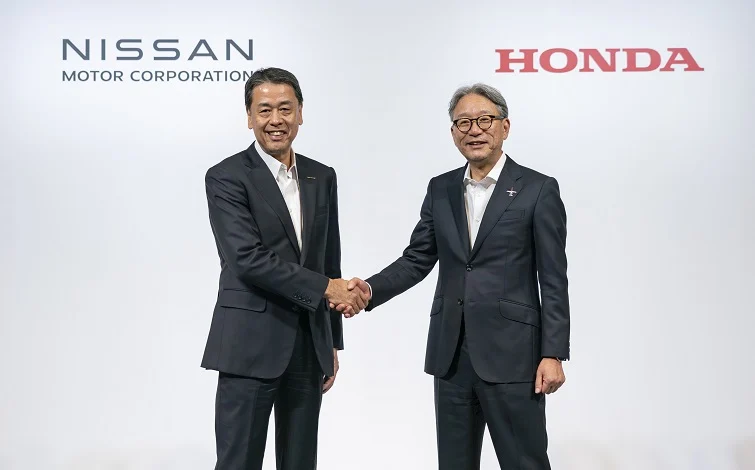
In a landmark move that signals a seismic shift in the global automotive landscape, Japanese titans Nissan Motor Co., Ltd. and Honda Motor Co., Ltd. have officially entered into a definitive joint development agreement. This partnership is designed to architect the foundation for the next generation of software-defined vehicles (SDVs), a move that underscores the industry’s desperate pivot toward intelligence and electrification.
By standardizing the "brains" of their future fleets—specifically the electronic control units (ECUs) and the underlying software stacks—the two automakers aim to combat the encroaching dominance of tech-native competitors and the rising costs of R&D. The collaboration, slated to debut in vehicles starting in fiscal year 2029, represents a fundamental restructuring of how legacy manufacturers approach vehicle architecture.
The Core Mandate: Standardizing the Digital Backbone
At the heart of this agreement lies a commitment to shared specifications for high-performance ECUs, the in-vehicle operating system (OS), middleware, and advanced vehicle control software. For decades, automakers operated on a siloed model, where proprietary hardware and software were tightly coupled to individual vehicle platforms. However, the rise of the SDV—where a vehicle’s features and capabilities are defined primarily by software rather than mechanical hardware—has rendered that model increasingly inefficient.
The scope of this partnership is comprehensive. By aligning on a common software domain, Nissan and Honda are essentially creating a shared digital ecosystem. This reduces the fragmentation that has historically plagued the Japanese automotive sector, allowing both firms to pool resources in areas where competitive differentiation is no longer the primary driver of market share. Instead, the "differentiation" will occur at the application and user-experience layer, while the "foundation"—the ECU architecture and operating system—will benefit from the economies of scale and shared technical rigor of both companies.
Chronology: From Preliminary Studies to Strategic Integration
The path to this alliance was not instantaneous. It is the result of months of intensive internal review and cross-corporate dialogue aimed at identifying where the two companies could achieve maximum synergy.
- Early 2024: The Exploratory Phase: Nissan and Honda initiated high-level discussions to evaluate the feasibility of a strategic partnership. Faced with the rapid electrification of the Chinese market and the aggressive software-first approach of companies like Tesla and BYD, both Japanese giants recognized that individual development cycles were becoming unsustainable.
- March 2024: Memorandum of Understanding: The companies signed an initial memorandum of understanding (MoU) to begin a feasibility study. This period was characterized by rigorous technical assessments to determine if their disparate engineering philosophies could be harmonized.
- Mid-2024: Scope Definition: Technical teams worked to define the "software domain," identifying that the most critical areas for standardization were the OS and high-performance computing platforms.
- Late 2024: Definitive Agreement: With the studies confirming that shared development would significantly reduce investment burdens and accelerate time-to-market, the companies formalized their joint development agreement.
- Fiscal Year 2029 (Target): The first vehicles utilizing the standardized ECU architecture and shared software platform are scheduled to roll off production lines, marking the beginning of a new era for both brands.
Supporting Data: The Economic Imperative
The impetus for this partnership is rooted in cold, hard economic realities. As vehicles evolve into "smartphones on wheels," the cost of software development has skyrocketed. Industry analysts estimate that the lines of code required for a modern vehicle now number in the hundreds of millions—far exceeding the requirements of advanced fighter jets.
The Cost-Efficiency Equation
Developing a proprietary software stack from scratch requires an astronomical capital expenditure. By sharing the costs of R&D for foundational software, Nissan and Honda can effectively halve their individual investment requirements for these core components. This capital can then be redirected toward consumer-facing innovations, such as autonomous driving features, artificial intelligence integration, and digital cockpit experiences.
Speed as a Competitive Advantage
In the software world, the "time-to-market" is the primary metric of success. Traditional automotive development cycles, which often spanned five to seven years, are becoming obsolete. The SDV model demands continuous updates (Over-the-Air, or OTA) and rapid iteration. By standardizing the underlying ECU architecture, Nissan and Honda are essentially building a modular system that allows them to plug in new software updates more frequently, shortening the development cycle for new models and features significantly.
Official Responses: Aligning for the Future
The leadership at both companies has framed this partnership as a necessary evolution rather than a concession.
"The software domain has become the central nervous system of the vehicle," a spokesperson for the partnership noted during the announcement. "To remain competitive, we must look beyond our own borders. Our collaboration is not merely about sharing costs; it is about building a robust, high-performance platform that can evolve at the speed of the digital age."
Honda’s executive team highlighted that the partnership allows the company to focus its specialized engineering talent on the specific attributes that define the "Honda experience," while offloading the heavy lifting of base-level software infrastructure to a shared framework. Similarly, Nissan leadership emphasized that the agreement provides a critical pathway to achieving the necessary scale to compete with global tech-heavy players, ensuring that the company’s vision for mobility is underpinned by a stable and scalable software environment.
Implications: A New Era for the Japanese Auto Industry
The ramifications of the Nissan-Honda alliance extend far beyond the two companies themselves. It serves as a bellwether for the Japanese automotive industry at large.
1. The End of "Not Invented Here" Syndrome
For decades, Japanese automakers were defined by their intense focus on vertical integration—the philosophy that every component, from the engine block to the ECU, should be developed in-house. This culture of "Not Invented Here" served them well during the era of mechanical excellence but has proven to be a liability in the software-defined era. The Nissan-Honda deal effectively signals the end of this isolationist approach, suggesting that horizontal collaboration is now a prerequisite for survival.
2. Strengthening the Domestic Supply Chain
By standardizing their software requirements, Nissan and Honda are also providing their Tier 1 and Tier 2 suppliers with a clearer, more predictable roadmap. Suppliers no longer need to develop separate software solutions for different automakers; they can focus on delivering high-quality, standardized components that meet the requirements of a larger, unified market. This will likely lead to greater efficiency across the Japanese automotive supply chain, making it more resilient against global shocks.
3. A Bulwark Against Global Disruptors
The global automotive market is currently being reshaped by the influx of software-first vehicles from China and the established dominance of US-based tech-centric automakers. For Nissan and Honda, this alliance is a defensive measure intended to protect their market share. By pooling their intellectual property and engineering expertise, they are building a "digital moat" that will allow them to match the feature sets and update capabilities of their international rivals.
4. Future Expansion
The joint announcement explicitly left the door open for further collaboration. While the current focus is on ECUs and software, analysts expect the partnership to eventually expand into other domains, such as battery chemistry, autonomous driving sensor arrays, and potentially even shared vehicle platforms. The companies are currently exploring these additional areas, signaling that this is merely the first chapter in a much longer narrative of cooperation.
Conclusion
The joint development agreement between Nissan and Honda represents one of the most significant strategic pivots in the history of the Japanese automotive industry. By recognizing that the future of mobility will be written in code, these two giants have chosen to set aside their historical rivalry in favor of collective innovation.
As they move toward the 2029 launch of their first shared-software vehicles, the eyes of the global industry will be fixed on their progress. If successful, this partnership could provide a blueprint for other legacy automakers struggling to navigate the transition from mechanical manufacturing to software-defined mobility. It is a bold, necessary move that ensures the names Nissan and Honda remain at the forefront of the automotive conversation for decades to come.
