





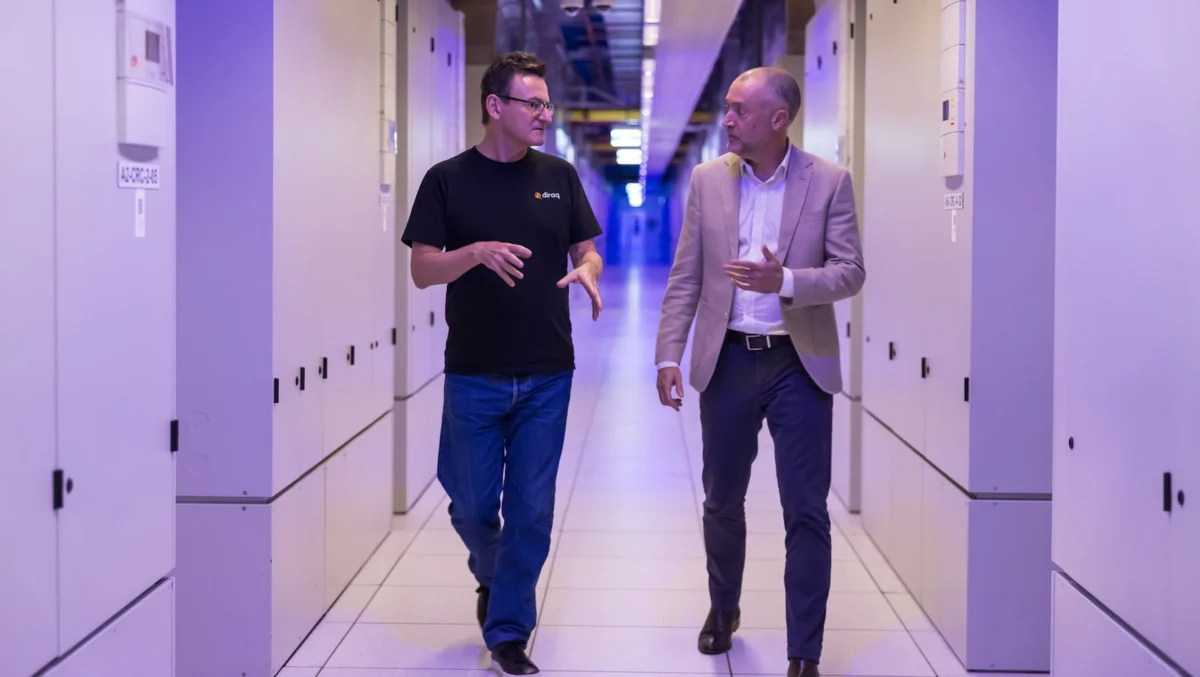
In a development that marks a watershed moment for the global technology sector, data centre colocation giant Equinix has announced a landmark partnership with Australian quantum pioneer Diraq. The collaboration will see the deployment of a modular, silicon-based quantum computer within an Equinix International Business Exchange™ (IBX®) data centre in Sydney. This world-first integration represents more than a simple hardware installation; it is the first time a commercial-grade quantum processor has been seamlessly integrated into a standard data centre environment alongside conventional high-performance computing (HPC) infrastructure.
By bridging the gap between delicate laboratory-grade quantum experiments and the rugged, scalable requirements of modern enterprise data centres, this deployment promises to accelerate the commercial viability of quantum computing.
The Architecture of Innovation: Silicon Spin Technology
At the heart of this deployment is Diraq’s proprietary silicon spin quantum computing architecture. Unlike other quantum approaches that rely on exotic materials or superconducting circuits, Diraq utilizes the existing semiconductor manufacturing ecosystem. By leveraging the same silicon processes used to manufacture standard computer chips, Diraq’s technology stores information based on the rotation—or "spin"—of individual electrons.
The system is debuting with eight qubits. While eight qubits may appear modest compared to the theoretical thousands sought by industry leaders, the significance lies in the architecture’s scalability and the environment in which it operates. This deployment serves as a "proof of concept" for hybrid computing, where classical CPUs and GPUs work in tandem with quantum processors to solve specific, highly complex mathematical problems—such as molecular modeling, financial risk analysis, and advanced logistics optimization—that are currently intractable for classical systems.
Chronology: From Lab Bench to Data Centre Floor
The path to this Sydney deployment has been years in the making, tracing back to the foundational research conducted at the University of New South Wales (UNSW).
- 2014–2018: Foundational Breakthroughs: Researchers at UNSW, led by industry veterans, achieved the first demonstration of single-atom spin qubits in silicon, proving that existing CMOS (Complementary Metal-Oxide-Semiconductor) fabrication techniques could be used for quantum logic gates.
- 2022: The Birth of Diraq: Diraq was formally established as a spin-out from the university to commercialize this silicon-spin research, securing significant venture capital and government backing.
- 2023: Engineering the "Fridge-in-a-Rack": Diraq focused on solving the "cryogenic problem." Traditionally, quantum computers required room-sized dilution refrigerators. Diraq’s engineers developed a modular cooling system capable of maintaining the near-absolute-zero temperatures (-273°C) required for quantum stability within a standard server form factor.
- Early 2024: Strategic Alliance: Equinix identified Diraq as a key partner to test the feasibility of "Quantum-as-a-Service" (QaaS) models.
- Mid-2024 (Present): The final stages of site preparation in Sydney are underway, with the hardware slated for installation and integration into the Equinix fabric.
Supporting Data: Efficiency and Integration
One of the most compelling arguments for the Diraq-Equinix partnership is the power profile of the new system. Critics of quantum computing have long pointed to the immense power requirements and infrastructure overhead as major barriers to adoption. Diraq has effectively challenged this narrative.
Comparative Power Consumption Metrics
- Standard Server Rack: 5kW to 15kW.
- Diraq Modular Quantum Unit: Under 20kW.
- Dense AI Server Rack (e.g., NVIDIA H100 clusters): 40kW to 60kW+.
By consuming less than half the power of a high-density AI rack, the Diraq system fits comfortably within the power and cooling envelopes of modern data centres. This eliminates the need for massive, specialized facility upgrades, allowing the system to be deployed in existing white space. The inclusion of integrated control electronics and cryogenics within the unit allows it to be treated as a "plug-and-play" asset, marking a departure from the traditional paradigm where the data centre had to be built around the computer.
The Quantum-Classical Hybrid: Implications for Industry
The implications of this deployment are profound, particularly for the Australian digital economy and the global push toward quantum utility.
Accelerating Hybrid Computing
The future of computing is not quantum versus classical; it is quantum and classical. By placing the Diraq unit inside an Equinix IBX centre, users can leverage the low-latency connectivity to existing cloud services and high-performance classical clusters. A user can run a simulation on a conventional cloud instance, offload the specific quantum-mechanical sub-problem to the Diraq unit, and receive the result back within the same network fabric. This reduces latency and simplifies data workflows significantly.
Democratizing Access
Currently, accessing quantum hardware is largely the preserve of elite research institutions and government labs. Equinix’s infrastructure-neutral approach aims to change this. By providing a platform where enterprises can experiment with quantum algorithms in a secure, carrier-neutral facility, the barrier to entry for banks, pharmaceutical researchers, and logistics firms is lowered substantially.
Sovereign Tech Capabilities
For Australia, this project is a validation of its position as a global leader in quantum research. By transitioning from academic research to a commercial deployment with a global partner like Equinix, Australia is effectively "exporting" the quantum stack. It proves that the nation’s expertise in silicon manufacturing and quantum physics can be translated into marketable, industrial-grade hardware.
Official Responses and Industry Sentiment
Equinix’s leadership has been vocal about the strategic necessity of this partnership. Executives note that as customers face increasingly complex computational challenges, the "quantum-ready" data centre will become a competitive differentiator.
"We are essentially building the plumbing for the next era of computing," a spokesperson for Equinix noted. "By housing Diraq’s technology, we are allowing our customers to begin their journey toward quantum-classical integration without needing to build their own cryogenic facilities or quantum labs."
Diraq’s founders have emphasized that the partnership is focused on "real-world utility." In a statement, Diraq noted: "The goal isn’t just to build a bigger quantum computer; it’s to build a useful one. By integrating our system into the Equinix ecosystem, we are showing the world that quantum computing is ready to leave the laboratory and enter the server room."
Industry analysts have praised the move, noting that while the eight-qubit system is currently small, it serves as a crucial milestone. "The industry has been waiting for a bridge between the ‘science project’ phase and the ‘utility’ phase," said one prominent analyst. "This installation in Sydney is that bridge."
Challenges and Future Outlook
Despite the enthusiasm, significant hurdles remain. The stability of silicon-spin qubits at scale is still being perfected, and error correction—a massive challenge for all quantum hardware providers—remains an ongoing focus for the Diraq team. Furthermore, the software ecosystem for quantum computing is still in its infancy, with few developers equipped to write algorithms that can effectively leverage both classical and quantum processors.
However, the trajectory is clear. As Diraq iterates on its modular design, the qubit count is expected to grow, and the cooling systems will likely become even more efficient. If the Sydney pilot proves successful, Equinix and Diraq are expected to expand the deployment to other key hubs, including North America and Europe, effectively building a global network of quantum-capable data centres.
Conclusion: A New Standard
The installation of a Diraq quantum computer in a Sydney data centre is a testament to the maturation of quantum technology. By shifting the focus from "how many qubits can we fit in a lab?" to "how can we integrate quantum power into a standard enterprise workflow?", the partnership has provided a blueprint for the future of the IT industry.
As we look toward the next decade, the integration of quantum systems into the fabric of the internet—housed within the very data centres that define our modern existence—will likely be viewed as the moment the quantum revolution truly began. For businesses, researchers, and policymakers, the message is clear: the quantum era is no longer a distant theoretical prospect. It is currently being plugged into a rack in Sydney, ready to be put to work.
