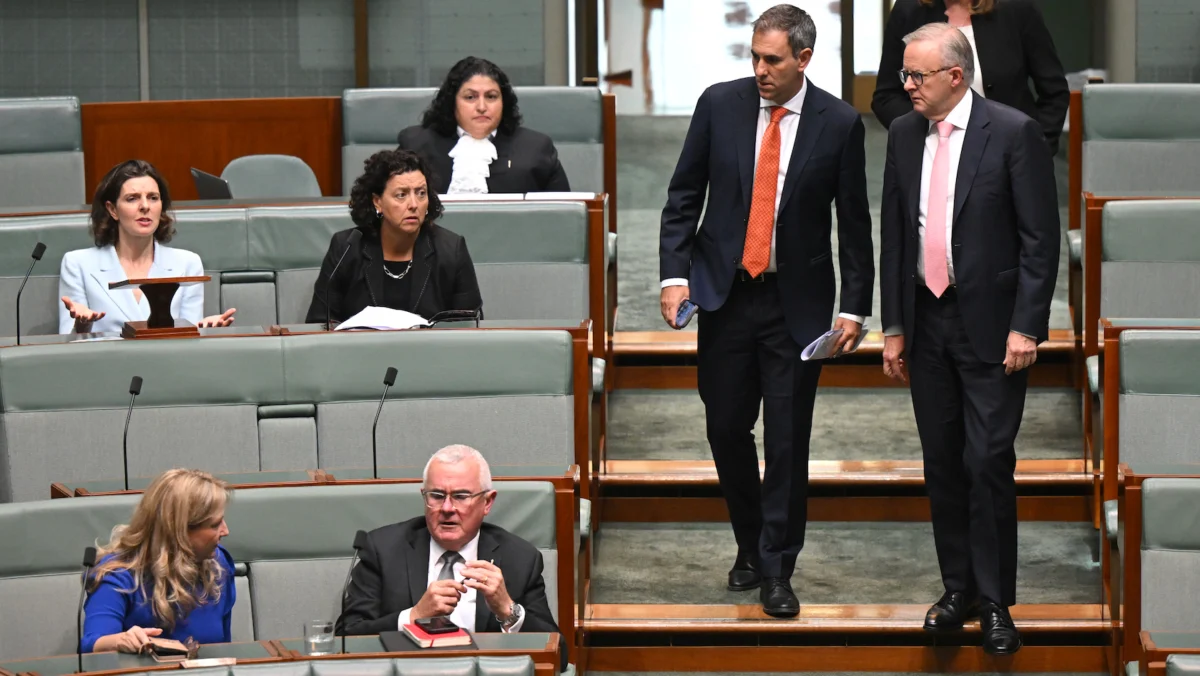





In a high-stakes standoff within the House of Representatives, Independent MP for Wentworth, Allegra Spender, has launched a scathing critique of the federal government’s proposed amendments to Capital Gains Tax (CGT) rules for startups. Describing the Labor government’s latest legislative push as a “Kafkaesque maze,” Spender is championing a radical simplification of the tax code, proposing a blanket 40% active-asset discount to replace the current, increasingly convoluted framework.
The debate centers on the legislative entrails of a new amendment bill introduced by Treasurer Jim Chalmers, which aims to recalibrate how startup investments are treated under Australian tax law. However, as the bill moves through Parliament, it faces mounting pressure from both the startup ecosystem and the crossbench, with critics arguing that the government’s approach sacrifices efficiency for bureaucratic complexity.
The Roots of the Dispute: A Legislative Maze
At the heart of the controversy is the “innovation test”—a set of criteria designed to determine which startups qualify for specific CGT concessions. For years, founders and investors have complained that these rules are opaque, subjective, and overly burdensome.
David Burt, the Director of Entrepreneurship at UNSW, has been one of the most vocal critics of the status quo, famously labeling the current innovation test as an “unhelpful Kafkaesque maze.” The term, referencing the works of Franz Kafka, implies a system characterized by senseless, complex, and nightmarish bureaucratic processes that leave the individual—in this case, the entrepreneur—trapped in a cycle of uncertainty and compliance costs.
The government’s latest bill, while ostensibly an attempt to streamline these rules, has been met with skepticism. Critics argue that instead of untangling the web, the amendments add layers of eligibility thresholds, company age limits, and technical caveats that make it harder, not easier, for early-stage companies to attract the capital they need to survive the “valley of death.”
Chronology of the CGT Reform Debate
The road to the current legislative impasse has been paved with years of lobbying and economic frustration.
- Pre-2024: The startup sector consistently lobbied for broader tax incentives, arguing that Australia’s venture capital environment remained uncompetitive compared to the US and UK.
- Early 2025: The federal government signaled its intent to reform startup taxation as part of a broader economic package aimed at boosting national productivity and innovation.
- Mid-2025: Drafts of the CGT amendment bill circulated. Industry bodies raised immediate concerns about the complexity of the “innovation test” and the narrowness of the proposed exemptions.
- Late 2025: Tensions reached a boiling point as the government solidified its position, ignoring calls for a more broad-based, asset-focused approach.
- October 2026: Treasurer Jim Chalmers formally presented the amendment bill to Parliament. Within days, Allegra Spender publicly rejected the proposal, offering her alternative 40% active-asset discount model.
The Spender Proposal: A Paradigm Shift
Allegra Spender, a former business executive turned politician, argues that the government’s approach fundamentally misunderstands the nature of entrepreneurial risk. Under her proposed model, the focus would shift from the “type” of company or the specific nature of its “innovation” to the nature of the asset itself.
“The core principles of any good tax reform are certainty, simplicity, fairness, and driving prosperity,” Spender stated during her address to Parliament. Her proposal for a 40% active-asset discount aims to achieve this by:
- Eliminating Arbitrary Thresholds: By removing caps on company age and size, the policy ensures that tax treatment is consistent across the lifecycle of a business, rather than creating “cliffs” where a company suddenly loses eligibility.
- Broadening Eligibility: The discount would apply to qualifying business assets, shares, and share options, ensuring that employees—who are often compensated with equity in lieu of high salaries—are not unfairly penalized when they eventually realize gains.
- Reducing Compliance Burden: By replacing subjective “innovation tests” with a clear-cut 40% discount on active business assets, the cost of tax compliance for small firms would drop precipitously.
Spender cites analysis from the Parliamentary Budget Office (PBO) to support her position. According to her findings, her simplified model would generate revenue outcomes comparable to the government’s plan, effectively proving that simplicity does not have to come at the cost of the national bottom line.
Supporting Data: Why Complexity Kills Innovation
The economic argument against the government’s bill is rooted in the cost of capital. Startups are, by definition, high-risk ventures. When the tax treatment of the returns on that risk is uncertain or requires expensive legal and accounting expertise to verify, investors look elsewhere.
Data suggests that Australia’s startup ecosystem is disproportionately reliant on a small pool of sophisticated investors who have the resources to navigate the current maze. By making the tax system simpler, Spender argues that the government could democratize investment, encouraging a broader range of Australians to participate in the growth of the nation’s innovation economy.
Furthermore, the “innovation test” has historically acted as a gatekeeper. By requiring companies to prove they are “innovative enough” to qualify for tax breaks, the government inadvertently forces firms to spend time and money on compliance rather than R&D or market expansion.
Official Responses and Political Implications
The government’s response to Spender’s proposal has been muted, with Treasury officials emphasizing the need for “targeted” incentives. Treasurer Jim Chalmers has maintained that the government’s bill is designed to ensure that taxpayer-funded concessions are directed precisely toward those companies that drive genuine economic growth.
However, the political math is tightening. With the crossbench wielding significant influence, Labor may be forced to the negotiating table. Monique Ryan, the Independent MP for Kooyong, has echoed Spender’s sentiments, signaling a growing bloc of opposition to the current legislative framework.
Should the government refuse to budge, they risk the bill stalling in the Senate or facing public backlash from a tech sector that is increasingly vocal about its dissatisfaction. For Labor, the optics of being seen as the party of “bureaucratic red tape” in the innovation sector is a significant vulnerability, particularly as the next election cycle approaches.
Implications for the Australian Startup Ecosystem
If Spender’s proposal were to be adopted, the implications for the Australian startup ecosystem would be profound:
- Improved Capital Flows: Investors would have greater clarity regarding their tax liabilities, reducing the “risk premium” associated with Australian startups.
- Employee Retention: A simpler tax regime for share options makes it easier for startups to attract top-tier talent, who often weigh the tax implications of equity packages when considering job offers.
- Culture of Entrepreneurship: By removing the stigma and confusion surrounding tax incentives, the government would be sending a strong signal that it supports risk-takers rather than just established corporate entities.
Conversely, if the government pushes the current bill through as-is, the “Kafkaesque” environment is likely to persist. Founders will continue to spend a disproportionate amount of their time negotiating with the Australian Taxation Office (ATO) rather than scaling their businesses. In an increasingly globalized market, where capital can move across borders in seconds, Australia cannot afford to be a jurisdiction where tax law serves as an impediment to progress.
Conclusion: A Turning Point for Policy
The standoff between the Labor government and Allegra Spender represents more than just a disagreement over tax rates; it is a fundamental debate about the role of government in the economy. Is it the role of the state to pick winners through complex, labyrinthine tests, or should the government provide a stable, simple, and predictable environment that allows the market to decide?
As the debate moves into its next phase, the startup sector remains cautiously optimistic. Whether the result is a full pivot toward Spender’s 40% discount model or a compromise that strips back the most egregious parts of the current bill, one thing is certain: the current system is unsustainable.
For the thousands of founders, employees, and investors watching from the sidelines, the message is clear: Australia’s future prosperity depends on its ability to embrace a tax system that rewards those who dare to build, rather than those who excel at filling out forms. The “Kafkaesque maze” must be dismantled if Australia is to truly transition into a modern, innovation-driven economy.
