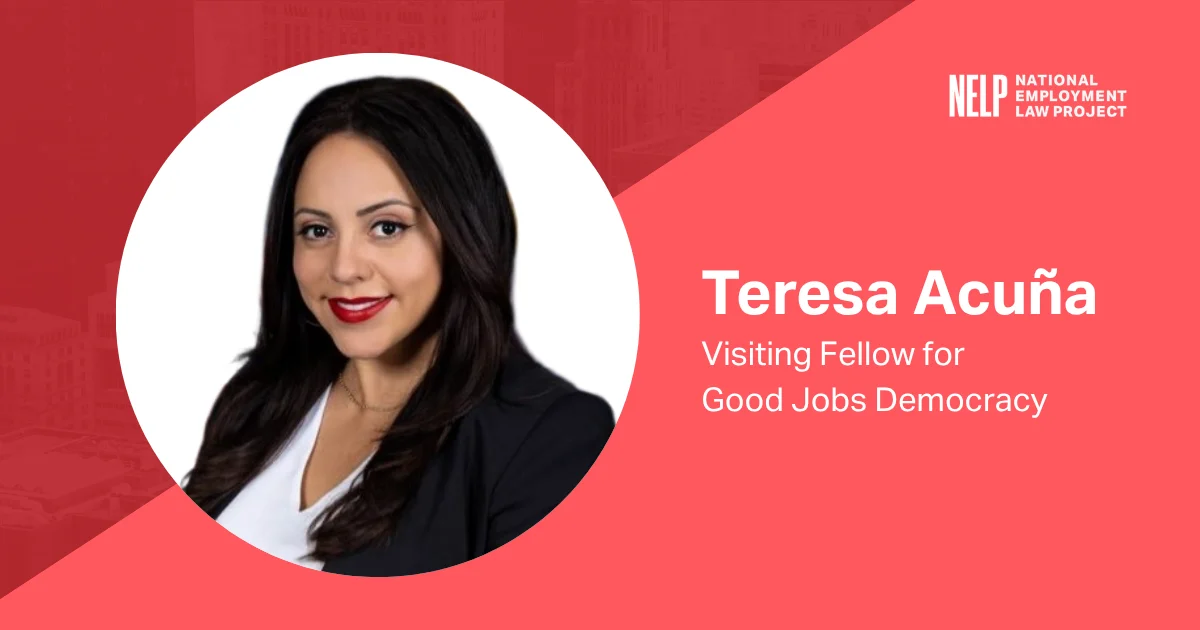





WASHINGTON, D.C. — In a significant move aimed at fortifying the nexus between federal policy and grassroots labor advocacy, the National Employment Law Project (NELP) announced on August 19, 2026, the appointment of Teresa Acuña as its new Visiting Fellow for Good Jobs Democracy.
This appointment marks a strategic pivot for the organization as it seeks to bridge the gap between high-level legislative development and the practical, day-to-day advocacy required to ensure that public investments translate into sustainable, high-quality employment for the American workforce. Acuña, a veteran of both Capitol Hill and the executive branch, brings a pedigree of policy design that NELP leadership expects will be instrumental in the coming years.
The Core Mandate: Bridging Policy and Advocacy
The role of "Visiting Fellow for Good Jobs Democracy" is a newly minted position designed to harmonize NELP’s extensive research archives with the volatile realities of modern labor politics. According to NELP’s official release, Acuña will work in tandem with the organization’s senior policy fellows to translate pioneering research into high-impact advocacy strategies.
At its core, the position is tasked with answering a fundamental question: How can the federal government’s massive injections of capital into infrastructure, green energy, and manufacturing be leveraged to build a more inclusive, pro-worker economy? Acuña’s mission is to ensure that the "Good Jobs" rhetoric becomes a measurable reality for millions of workers, shifting the needle from theoretical policy papers to enforceable labor standards and community-wide economic stability.
A Career Defined by Pro-Worker Policy: Chronology
Teresa Acuña’s career trajectory offers a roadmap of the shifting landscape of American labor policy over the last decade. Her transition into this fellowship is the culmination of years spent navigating the intricacies of both state and federal legislative processes.
Early Legislative Tenure
Acuña first made her mark as a legislative director within the California State Legislature. During this period, she was deeply involved in the state’s aggressive push to modernize labor protections, dealing with issues ranging from gig-economy classification to the strengthening of collective bargaining rights in the nation’s largest economy. Her work in California served as a testing ground for broader, national-level labor concepts.
Federal Service: The House of Representatives
Moving to the national stage, Acuña served as a legislative director for members of the U.S. House of Representatives. In the halls of Congress, she specialized in the delicate task of balancing partisan agendas with the practical needs of labor unions and low-wage worker coalitions. Her experience here gave her a nuanced understanding of how to craft language that can survive the legislative meat-grinder.
The Good Jobs Initiative
Her most recent and perhaps most impactful role was as the Director of the Good Jobs Initiative at the U.S. Department of Labor (DOL) during the Biden-Harris administration. Operating under the leadership of Acting Secretary Julie Su, Acuña was a key architect in the government’s effort to bake labor standards into the Infrastructure Investment and Jobs Act (IIJA) and the CHIPS and Science Act. Her tenure at the DOL was defined by a commitment to ensuring that federal tax dollars did not merely subsidize industry, but actively incentivized the creation of pathways to the middle class, specifically for underrepresented and marginalized demographics.
Supporting Data: The Landscape of Labor Advocacy
NELP’s decision to bring in a specialist of Acuña’s caliber comes at a critical juncture for the American labor movement. Recent data suggests that while employment numbers have remained resilient, the quality of jobs remains a point of intense contention.
- The Wage Gap: Despite record low unemployment rates in the mid-2020s, the "real wage" for the bottom quartile of earners has struggled to keep pace with the cost of living in urban centers.
- Infrastructure Impact: Independent studies of the federal infrastructure spending programs indicate that labor-intensive projects have the potential to add over 1.5 million jobs annually, but only if stringent "Good Jobs" principles—such as prevailing wage requirements and project labor agreements—are strictly enforced.
- Institutional Reach: Since its founding in 1969, NELP has been a central player in the labor space. The organization claims that its efforts—which include lobbying for minimum wage increases, worker safety standards, and protections against wage theft—have impacted the lives of an estimated 100 million workers over the last decade.
The addition of the Good Jobs Democracy fellowship signals that NELP is looking to institutionalize its influence within the executive branch, ensuring that the advocacy work done today creates lasting precedents for the next generation of labor law.
Official Responses: A Vision for an Inclusive Democracy
The appointment has been met with enthusiasm from within the labor advocacy community, with NELP leadership framing the hire as a direct response to the needs of a modern, democratic society.
Rebecca Dixon, CEO of NELP, emphasized the ideological significance of the appointment:
"Teresa’s experience in translating policy ideas into tangible wins for workers and their communities is critical to advancing NELP’s vision of an inclusive democracy where all workers have the economic foundation to contribute to and share in progress. Good jobs enable people to be active citizens."
Dixon’s statement highlights a core belief at the heart of NELP’s strategy: that economic precarity is a direct threat to democratic participation. When workers are trapped in a cycle of low pay and insecure benefits, their ability to engage in civic life is severely diminished. By fostering an economy centered on "good jobs," NELP argues that they are not just improving balance sheets, but also strengthening the social contract.
Implications: The Road Ahead for NELP
The hiring of Teresa Acuña suggests that NELP is positioning itself for a long-term influence campaign that transcends individual election cycles. By focusing on the "Good Jobs" framework, the organization is aiming to normalize the expectation that taxpayer-funded investments must be accountable to the workforce.
1. Scaling Policy Solutions
Acuña is expected to focus on scaling successful state-level models—many of which she helped develop in California—to the national level. This includes standardized community benefit agreements (CBAs) that ensure developers and contractors provide local hiring incentives and fair compensation.
2. Strengthening Regulatory Enforcement
A significant portion of Acuña’s work will likely involve advocacy for the robust enforcement of existing labor laws. As the federal government continues to distribute grants for green energy and manufacturing, NELP will act as a watchdog, utilizing Acuña’s expertise to identify where federal agencies are failing to hold contractors accountable for labor violations.
3. A New Generation of Labor Advocacy
The "Visiting Fellow" model suggests that NELP is committed to bringing in practitioners who have "been in the room" where policies are made. This allows the organization to bypass the learning curve that often hampers nonprofit advocacy, enabling a more rapid response to legislative shifts in Washington.
4. Broadening the Coalition
The Good Jobs Democracy project is expected to build bridges between traditional labor unions and the growing movement of non-unionized workers, particularly in the tech, logistics, and care-economy sectors. By focusing on the shared goal of job quality, Acuña’s role will be to synthesize these disparate groups into a cohesive political block.
Conclusion
As the American economy continues to undergo a massive structural transformation, the role of organizations like the National Employment Law Project has never been more vital. The appointment of Teresa Acuña as Visiting Fellow for Good Jobs Democracy is a strategic declaration of intent. It signifies that for NELP, the fight for the future of the American worker is not just about legislative victories, but about the rigorous, detailed, and persistent application of those victories in the real world.
With her deep experience in the machinery of government and her clear-eyed focus on the needs of the working class, Acuña is poised to help NELP navigate the challenges ahead, ensuring that as the nation invests in its future, it does not leave behind the very people who power it. As the organization looks toward the remainder of the decade, the focus remains clear: to build an inclusive economy where "good jobs" are not the exception, but the standard.
