





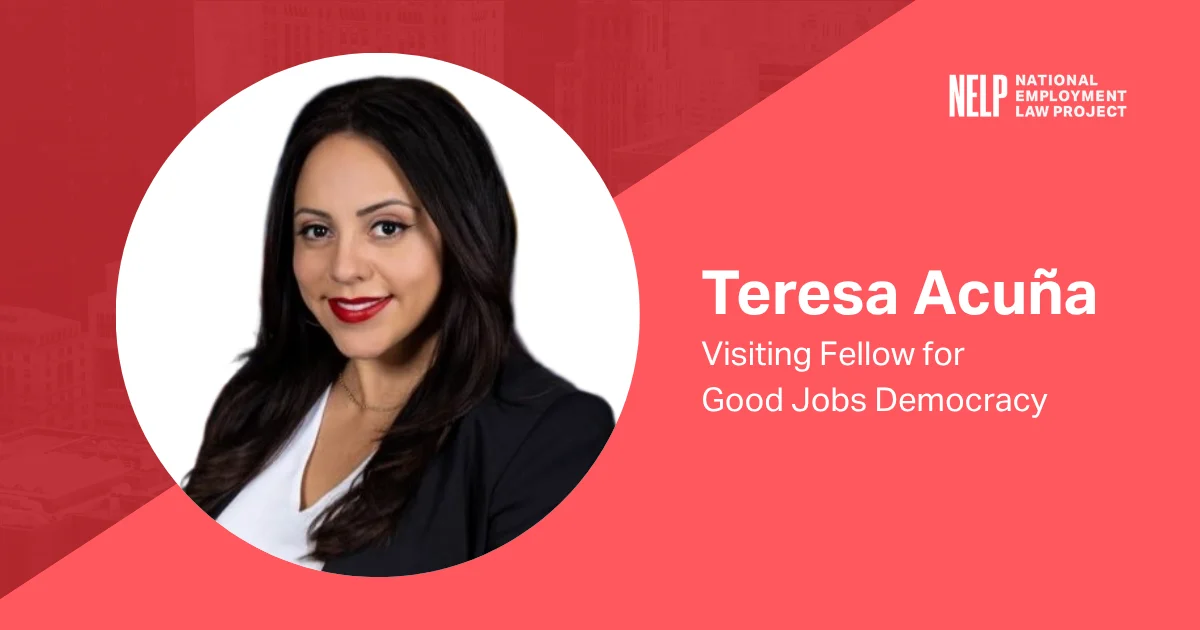
WASHINGTON, D.C. — On August 19, 2026, the National Employment Law Project (NELP) announced a significant strategic addition to its leadership team, appointing Teresa Acuña as the organization’s new Visiting Fellow for Good Jobs Democracy. This appointment signals a concerted effort by one of the nation’s most influential labor advocacy groups to bridge the gap between high-level economic policy and grassroots advocacy, aiming to codify "good jobs" as a cornerstone of a healthy, functioning democracy.
The Mandate: Linking Economic Security to Civic Participation
The core mission of Acuña’s new role is to translate NELP’s extensive body of pioneering research into actionable, high-impact policy advocacy. Working alongside NELP’s existing senior policy fellows, Acuña will focus on the nexus between labor rights and democratic stability.
The premise of the "Good Jobs Democracy" fellowship is rooted in a fundamental belief held by NELP leadership: that economic precarity is a primary driver of civic disengagement. By securing higher wages, safer working conditions, and consistent benefits, NELP argues that workers gain the stability required to participate fully in their communities and the democratic process.
A Career Dedicated to Pro-Worker Policy
Teresa Acuña joins NELP with a distinguished background in the corridors of power, having navigated both state and federal legislative arenas. Her career has been defined by a consistent focus on the material conditions of the American worker.
Legislative Roots
Before entering the federal executive branch, Acuña served as a legislative director in both the U.S. House of Representatives and the California State Legislature. These roles provided her with a granular understanding of how legislative language is crafted, negotiated, and ultimately translated into law. In the California State Legislature, she was instrumental in managing policy portfolios that addressed wage theft, worker safety, and collective bargaining rights—issues that remain central to the modern labor movement.
The Good Jobs Initiative
Most recently, Acuña served as the Director of the Good Jobs Initiative at the U.S. Department of Labor (DOL) during the Biden-Harris administration. Operating under the leadership of Acting Secretary Julie Su, Acuña was a pivotal figure in the federal government’s strategy to link public investment to labor standards.
During her tenure at the DOL, Acuña helped shape the framework for ensuring that the surge in federal funding for infrastructure, clean energy, and domestic manufacturing—channeled through the Bipartisan Infrastructure Law and the Inflation Reduction Act—resulted in the creation of high-quality jobs. This initiative was designed to ensure that the "green transition" and the "re-industrialization" of America were not merely economic successes on paper, but pathways to the middle class for millions of workers who had previously been left behind.
Official Responses and Strategic Vision
The appointment of Acuña has been framed by NELP as a vital step in evolving the organization’s advocacy strategy for the latter half of the 2020s.
"Teresa’s experience in translating policy ideas into tangible wins for workers and their communities is critical to advancing NELP’s vision of an inclusive democracy where all workers have the economic foundation to contribute to and share in progress," said NELP CEO Rebecca Dixon. "Good jobs enable people to be active citizens. When workers are economically secure, they are better equipped to advocate for themselves and their neighbors, creating a feedback loop that strengthens our democracy."
For her part, Acuña enters the role at a time when the labor movement is experiencing a resurgence in public favor, yet faces significant headwinds from technological disruption, gig-economy classification disputes, and shifting judicial interpretations of labor law.
Historical Context: NELP’s Legacy of Advocacy
Founded in 1969, the National Employment Law Project has spent over half a century operating at the intersection of law, economics, and social justice. As a nonprofit advocacy organization, NELP has historically operated as a "think-and-do" tank, providing the legal research necessary to underpin major policy shifts.
A Decade of Impact
Over the last ten years, NELP’s influence has been profound. According to the organization, their collaborative efforts with local, state, and national partners have impacted the lives of an estimated 100 million workers and their families. This impact is measured through:
- Wage Floors: Leading the charge in the "Fight for $15" and subsequent local efforts to raise the minimum wage across various municipalities and states.
- Worker Safety: Advocating for enhanced OSHA protections and safer workplace standards, particularly in high-risk sectors such as warehousing and meatpacking.
- Benefits Expansion: Championing the expansion of unemployment insurance, paid family leave, and portable benefits for independent contractors.
The Economic Landscape: Why "Good Jobs" Matter Now
To understand the necessity of the "Good Jobs Democracy" fellowship, one must look at the structural changes currently reshaping the U.S. economy.
1. The Infrastructure and Manufacturing Boom
With federal agencies deploying billions of dollars into construction and clean energy, the demand for skilled labor has spiked. However, the quality of these jobs—defined by access to unions, healthcare, retirement contributions, and consistent hours—is not guaranteed. Acuña’s work will focus on embedding labor standards into these federal grants, ensuring that taxpayers’ money does not subsidize low-wage, high-turnover employment.
2. The Gig Economy and Misclassification
The proliferation of app-based work and the expansion of the "1099" workforce continue to erode the traditional social contract. NELP has been at the forefront of the battle against worker misclassification, arguing that companies should not be allowed to strip employees of benefits by labeling them as independent contractors.
3. Democracy and Economic Inequality
Data consistently shows a correlation between income inequality and declining voter turnout. When individuals are forced to work multiple jobs to make ends meet, their capacity for civic engagement—attending school board meetings, volunteering, or even finding time to vote—diminishes. By focusing on "Good Jobs Democracy," NELP is positioning the labor movement as a primary defender of democratic institutions.
Implications for Future Policy
The appointment of a Visiting Fellow specifically tasked with "Good Jobs Democracy" suggests that NELP intends to broaden its scope beyond traditional labor law. We can expect this role to lead to:
- Policy Convergence: Creating a synthesis between environmental policy, infrastructure development, and labor rights.
- Enhanced Legislative Coalitions: Utilizing Acuña’s background to build bridges between labor organizers and state/federal legislators who may be unfamiliar with the complexities of worker-centered economic policy.
- Public Awareness Campaigns: Moving the conversation from "labor law" (which can sound technical and detached) to "economic citizenship" (which centers the dignity and agency of the worker).
Conclusion: The Road Ahead
As the United States faces a pivotal moment in its economic history, the role of organizations like NELP and the strategies brought by experts like Teresa Acuña will be tested. The transition from policy development to effective, widespread advocacy is often the most difficult hurdle in the legislative process.
By hiring a veteran of both the legislative and executive branches, NELP is signaling that it is prepared to engage in a sophisticated, multi-front campaign to redefine the American workplace. The "Good Jobs Democracy" fellowship is more than a title; it is an admission that in the modern era, the health of the economy and the health of the republic are inextricably linked. As Acuña begins her tenure, the labor community will be watching to see how these ambitious goals translate into new protections and greater economic power for the American worker.
For more information on the National Employment Law Project’s ongoing initiatives and to follow the work of the new Visiting Fellow, please visit their official website at www.nelp.org.
