



In the annals of automotive history, few vehicles cast a shadow as long as the Ford Model T. Introduced in 1908, the "Tin Lizzie" was the catalyst for the democratization of personal transportation, fundamentally altering the fabric of modern society. Conversely, the turbocharger represents the pinnacle of internal combustion efficiency, a technology that forces air into the engine to unlock power once thought impossible for a given displacement.
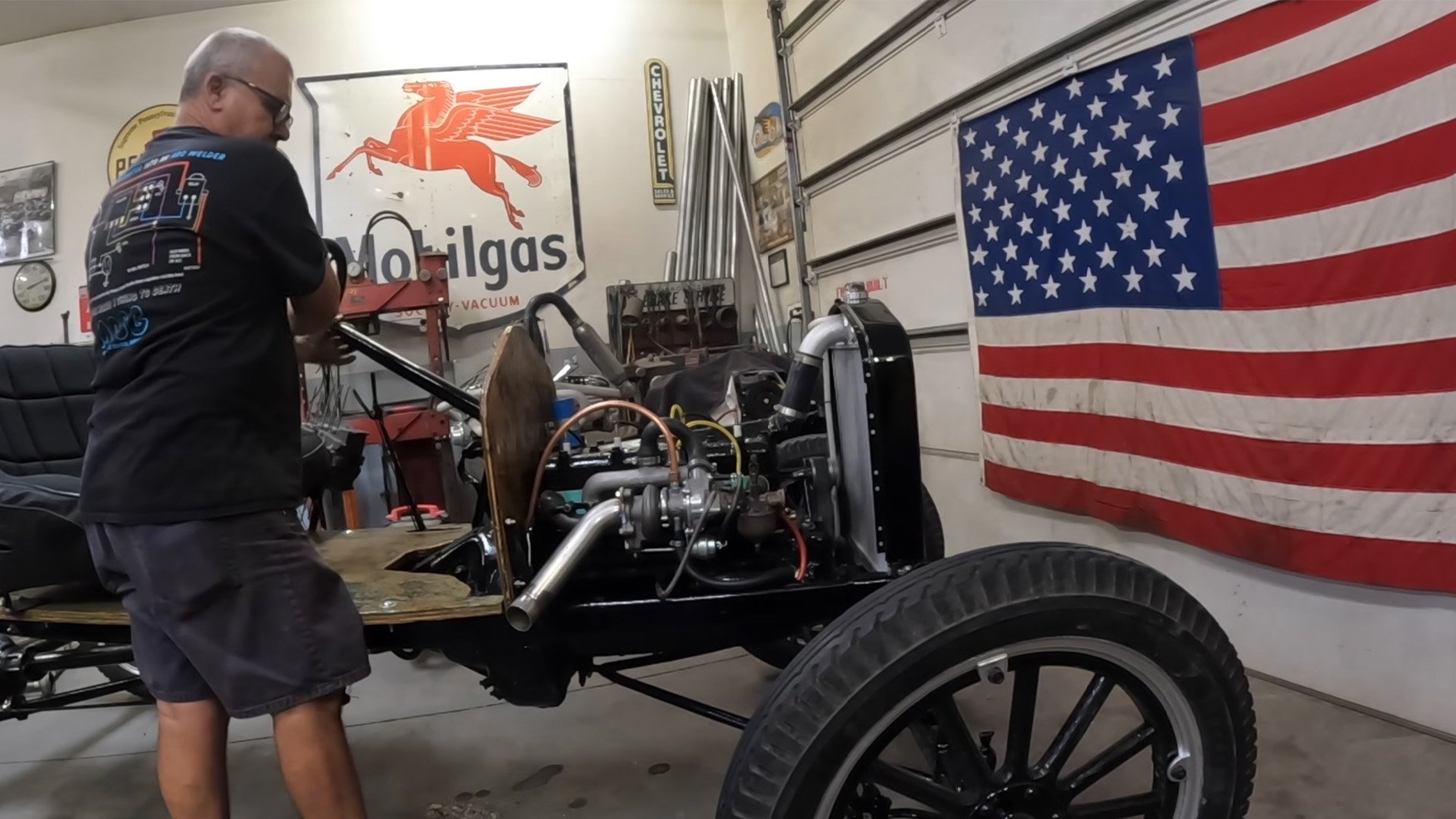
These two pillars of engineering—the mass-produced economy car and the sophisticated forced-induction device—are separated by a century of innovation and conflicting design philosophies. Yet, in a defiant display of mechanical ingenuity, Merlin Johnson of Merlin’s Old School Garage has bridged this 118-year gap, successfully retrofitting a turbocharger onto a vintage Ford Model T engine.
Main Facts: A Marriage of Eras
At the heart of this project lies the quintessential Model T powerplant: a 177-cubic-inch, four-cylinder sidevalve engine. In its original configuration, this engine was a marvel of durability and simplicity, though it was never intended for high-output performance. When new, it produced a modest 20 horsepower.
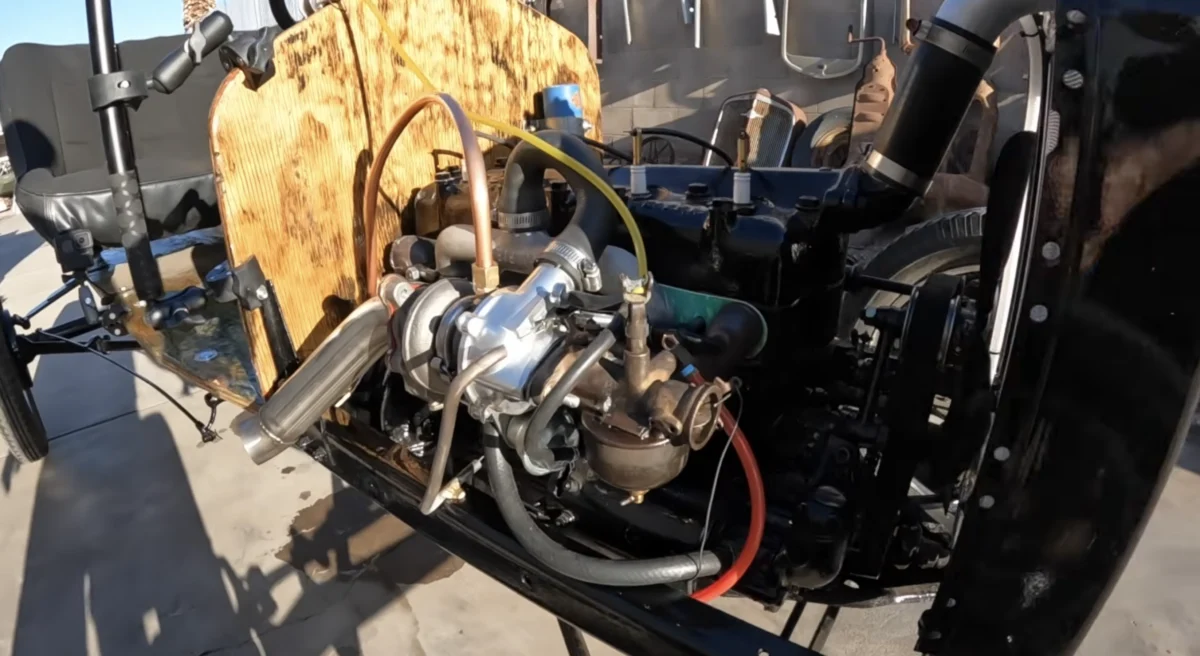
The turbocharger selected for this experiment was sourced from a modern compact Kubota tractor—a piece of hardware designed for diesel applications, now tasked with breathing life into an early 20th-century gasoline engine. The installation required significant ingenuity, most notably in the fabrication of a custom flange to mount the turbo to the stock cast-iron exhaust manifold.
The result is a surprising performance gain. During real-world testing, the turbocharged Model T achieved a top speed of 28 mph, representing a 25% increase over its factory-rated capabilities. Most impressively, the engine sustained six pounds of boost without suffering a catastrophic mechanical failure—a testament to the over-engineered nature of early automotive components.
Chronology: The Evolution of Forced Induction
To understand the audacity of Johnson’s project, one must look at the timeline of automotive development.
- 1905: Swiss engineer Alfred Büchi patents the design for an exhaust-driven "whirler." At this stage, the concept was primarily theoretical, intended for large marine and stationary power plants.
- 1908: Henry Ford releases the Model T. The vehicle is designed for reliability, repairability, and affordability, utilizing a "dipper slinger" oiling system that relies on gravity and splash lubrication rather than a pressurized pump.
- 1962: The industry marks a milestone with the introduction of the Oldsmobile Jetfire, the first passenger vehicle to feature a factory-installed turbocharger.
- 2026: Merlin Johnson successfully demonstrates that the 1908 engine block can withstand the pressures of modern forced induction, effectively compressing 118 years of automotive history into a single, functional test drive.
This chronology illustrates the "missing link" between the infancy of the automobile and the era of high-performance engines. While manufacturers spent decades refining fuel injection, variable valve timing, and forced induction, Johnson opted to bypass that evolution entirely, forcing the oldest technology to adopt the newest.
Supporting Data: The Physics of the Retrofit
The primary technical hurdle in this build was not the physical mounting of the turbo, but the lubrication. Modern turbochargers spin at tens of thousands of RPM and require a constant, pressurized flow of oil to keep the bearings from seizing.
The Model T, however, is a stranger to pressurized oil. Its lubrication system is primitive, utilizing a simple copper tube that directs oil from the front of the engine toward the transmission, relying on the rotation of the internal components to splash oil onto the crankshaft and connecting rods.
The Lubrication Solution
Johnson circumvented this limitation through a clever application of physics. By tapping into the rotation of the flywheel, he created a centrifugal pump system. This forces oil through a copper line, providing the necessary pressure to lubricate the turbocharger’s shaft. A secondary siphon drain then returns the oil to the crankcase, ensuring a closed-loop system.
The data from the test runs confirmed that the engine could maintain stability under this load. The six pounds of boost provided enough "pep" to demonstrate that the original internal components—specifically the connecting rods and crankshaft—possess a level of latent structural integrity that Henry Ford’s engineers likely never considered necessary.
Official Responses and Engineering Perspectives
Within the vintage car community, the project has garnered a mixture of skepticism and profound admiration. Professional engine builders and historians have noted that while the project is an "engineering curiosity," it highlights the robustness of the original design.
"The Model T was built during a time when engineers assumed the end-user would be a farmer in a field with nothing but a wrench and a prayer," says automotive historian Marcus Thorne. "Because they couldn’t guarantee consistent quality in materials, they built them with massive safety margins. That is exactly why this turbo build works; the engine block is essentially a solid chunk of iron that can handle the increased cylinder pressure, provided the user manages the ignition timing and fuel delivery correctly."
However, industry experts caution that this is not a template for reliable daily driving. The lack of modern engine management systems means the air-fuel mixture is largely unregulated, leaving the engine vulnerable to "knocking" or pre-ignition, which could shatter the cast-iron pistons in seconds.

Implications: Why We Modify the Past
Why go through the effort of turbocharging a car that was never meant to exceed 25 mph? The implications of Merlin Johnson’s build extend beyond the novelty of a fast Model T. It serves as a commentary on the "hot-rod" spirit that has defined the American automotive experience for over a century.
1. The democratization of performance
The project proves that the barrier to "performance engineering" is not just capital, but creativity. By repurposing tractor parts and utilizing basic physics, Johnson achieved a level of power that original owners could only dream of.
2. Longevity and Sustainability
In a modern context where vehicles are often treated as disposable appliances, this project emphasizes the repairability of vintage machinery. By maintaining the integrity of the original block and only adding bolt-on enhancements, Johnson demonstrates that old technology can be updated to remain relevant in a modern landscape.
3. Cultural Preservation
Hot-rodding is an essential component of automotive culture. By modifying these vehicles, enthusiasts ensure that they remain a part of the active car scene rather than static exhibits in a museum. Each time a Model T is pushed beyond its limits, it tells a story of innovation that connects the past to the future.
Conclusion
The turbocharged Model T is a reminder that the spirit of the internal combustion engine is far from dead. While the automotive industry pivots toward electrification and autonomous driving, there remains a dedicated cohort of enthusiasts who find joy in the mechanical dance of air, fuel, and fire.
Merlin Johnson’s build is more than just a viral video project; it is a successful experiment in bridging two distinct eras of human ingenuity. It proves that with enough determination, even the most "primitive" machines can be taught new tricks. As the sun sets on the era of the internal combustion engine, projects like this serve as a fitting, high-boosted tribute to the machines that paved the way for the modern world.
