





By a Correspondent in Mumbai
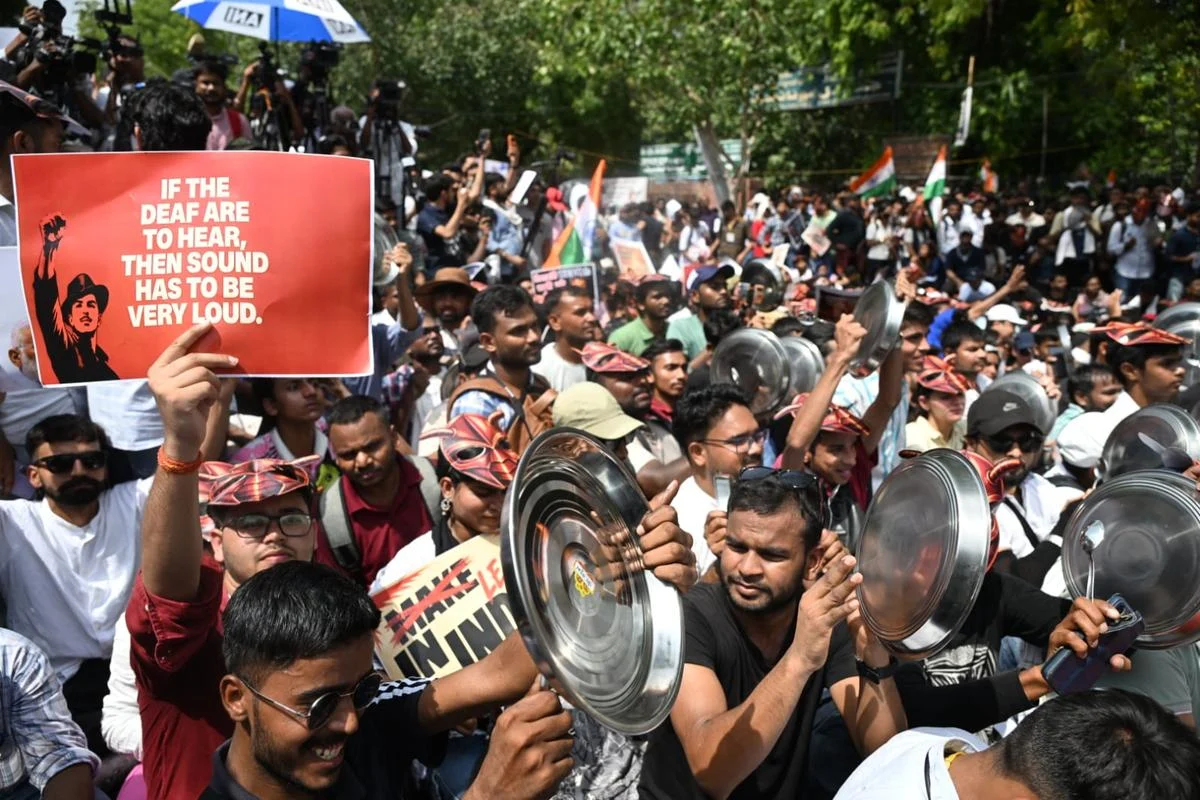
As the sun sets over the concrete expanse of the Indian capital, thousands of young protesters continue to hold their ground near Parliament. This "Chalo Sansad" (Let’s March to Parliament) movement has now entered its third consecutive day. For the casual observer, the scene is one of chaos—tear gas clouds drifting through the humid Delhi air, the rhythmic thud of wooden batons against pavement, and the desperate shouts of a generation feeling increasingly abandoned by the state. But for the thousands of young people gathered here, this is not merely a protest; it is a reclamation of identity.
They have dubbed themselves "cockroaches." It is a defiant appropriation of a derogatory slur leveled at them by the Chief Justice of India (CJI), Surya Kant. In recent remarks, the CJI characterized unemployed youths and activists who challenge the legal system as "cockroaches and parasites." What was intended as a judicial rebuke has instead acted as a catalyst for a nationwide movement, ignited by the catastrophic leak of the National Eligibility cum Entrance Test (NEET), which has left lakhs of medical aspirants in professional limbo.
The Genesis of the Movement
The current unrest finds its roots in the systemic failures surrounding the NEET exam—a gateway to undergraduate medical education in India. When news of the question paper leak broke, it was not merely a technical failure of an examination board; it was perceived as a betrayal of meritocracy.
The social media-driven response was instantaneous. Utilizing platforms like Instagram and X (formerly Twitter), students organized under the banner of the "Cockroach Janta Party." What began as digital outrage quickly transitioned into physical mobilization. By mid-week, Delhi and other major metropolitan hubs saw a surge of protesters, most of whom were students whose professional futures had been jeopardized by administrative apathy.
Chronology of the Clashes
The escalation of the conflict has been rapid and, for many, deeply traumatic.
- Day 1: Protests began as peaceful sit-ins near major educational administrative centers. The police response was initially cautious, involving standard crowd-control cordons.
- Day 2: As numbers swelled, the "Chalo Sansad" call prompted a march toward the Parliament building. Police deployed barricades to prevent access to the high-security zone. Tensions boiled over when demonstrators breached these lines, leading to the first significant use of tear gas and physical force.
- Day 3: The situation deteriorated further. Reports of police using lathis (wooden batons), and allegations of plainclothes officers operating without identification, led to widespread panic. Videos circulating on social media show students suffering from chemical exposure and injuries consistent with blunt force trauma.
Official Responses and Judicial Silence
The response from the state has been a masterclass in deflection. Delhi Police officials have maintained that their actions were strictly within the bounds of duty. In a series of official statements, they characterized the protesters as instigators who defied prohibitory orders and injured law enforcement personnel, thereby necessitating "proportionate" crowd-control measures. They have categorically denied allegations of brutality, labeling such reports as misleading.
The judicial response has been equally sobering. When the matter reached the Delhi High Court, the bench offered a dismissive obiter dictum, suggesting that parties should not "drag the Court into this matter." Despite the urgency, the hearing was deferred until September 2026, leaving protesters with no immediate legal protection.
Even more striking was the position taken by the Supreme Court. When a plea was moved for an urgent hearing, Justice Surya Kant—the same official whose remarks sparked the movement—declined to list the matter, dismissing it as a "waste of time." He stated that the Apex Constitutional Court, the self-proclaimed "Guardian of Fundamental Rights," had "no time to watch videos" of the clashes. This refusal to intervene has signaled a profound disconnect between the judiciary and the concerns of the youth.
The Anatomy of Excessive Force
The legality of the police response is increasingly under scrutiny. Indian constitutional jurisprudence, established through landmarks like Joginder Kumar v. State of Uttar Pradesh and D.K. Basu v. State of West Bengal, clearly dictates that state power is not an unrestricted license. The fundamental principle remains: the end does not justify the means, and the use of force must be the absolute last resort.
The Problem of Identification
A critical flashpoint in these protests has been the presence of plainclothes police officers. According to the Delhi Police’s own "Standing Order," personnel on duty must be in uniform, clearly displaying name plates and badges. The presence of unidentified officers, coupled with the use of lathis, has exacerbated the fear of custodial violence. While the Delhi Police has recently issued a directive mandating uniforms following public backlash, the damage to public trust is profound.
The "Lathi" as a Political Instrument
The lathi, a colonial-vintage weapon, remains the primary tool for domestic crowd control. While the Delhi High Court has ruled that lathis are only to be used to disperse unlawful assemblies, the line between dispersal and punishment is vanishing. Allegations that officers used electric batons and lathis fitted with nails against protesters suggest a punitive intent rather than a restorative one.
Chemical Agents and Constitutional Proportionality
The deployment of tear gas represents a significant escalation. In Ramlila Maidan Incident v. Home Secretary, Union of India, the Supreme Court held that the maintenance of public order must remain compatible with constitutional guarantees of liberty. The use of chemical dispersal methods necessitates a gravity that many legal experts argue was absent in the case of peaceful student protesters. By ignoring these standards, the state risks transforming a public order maintenance exercise into an assault on the very freedoms it is sworn to protect.
The Gendered Dimension of Policing
Particularly harrowing are the allegations concerning the treatment of female protesters. Indian law provides stringent procedural safeguards for women in custody, rooted in the constitutional guarantee of dignity under Article 21. Reports of male officers physically handling female demonstrators are not merely tactical failures; they are severe violations of these protections. Given Delhi’s high profile in the discourse surrounding gender-based violence, these reports have ignited a secondary, powerful wave of protest focusing on the lack of safety for women within the state’s own machinery.
Implications for Indian Democracy
The standoff between the "cockroaches" and the state is a microcosm of a larger struggle. It asks a fundamental question: what is the space for dissent in a modern democracy?
If the state views peaceful assembly as an inherent threat to public order, and if the judiciary is unwilling to provide an immediate check on executive excess, the constitutional guarantee of protest becomes a hollow promise. The current crisis suggests that we are witnessing an increasingly expansive definition of "public order"—one that encompasses any form of democratic participation that causes the state "inconvenience."
The Delhi Police is entrusted with a dual mandate: the maintenance of order and the protection of rights. When the former is pursued at the expense of the latter, the social contract is severely frayed. The youth of India, through this movement, are not merely demanding a re-examination of the NEET exam; they are asserting their right to be heard without being pathologized as "parasites."
As the protests continue, the international community and constitutional scholars alike are watching to see whether the Indian state will choose the path of dialogue or the path of the baton. The survival of democratic dissent in India may very well depend on the answer.
Disclaimer: The opinions expressed in this dispatch are solely those of the correspondent in the field and do not necessarily reflect the views of JURIST’s editors, staff, donors, or the University of Pittsburgh.
