





For most Americans, the price displayed on the digital signage at a local service station represents far more than the cost of fuel. It is a complex aggregate of federal and state excise taxes, local levies, environmental surcharges, and market-driven fluctuations. While traditionally viewed as a simple "user fee" to maintain the nation’s highways and bridges, the modern gas tax has morphed into a multifaceted fiscal instrument—and one that is increasingly struggling to keep pace with the realities of the 21st-century automotive landscape.
The Philosophical Foundation of the Gas Tax
At its core, the gas tax is designed to function as a user fee. The economic logic is straightforward: those who use the public road network should be the ones to pay for its construction and ongoing maintenance. By tethering revenue to the physical act of driving, governments can effectively attribute infrastructure costs to the beneficiaries, sparing non-drivers from subsidizing road projects through broad-based income or sales taxes.
However, the efficacy of this "pay-to-play" model is currently being tested by a perfect storm of technological innovation, shifting policy priorities, and geopolitical instability. As the U.S. shifts toward electric vehicles (EVs) and higher fuel efficiency standards, the traditional per-gallon excise tax—the bedrock of state transportation funding—is becoming a diminishing asset.
A Landscape of Disparity: The State-by-State Breakdown
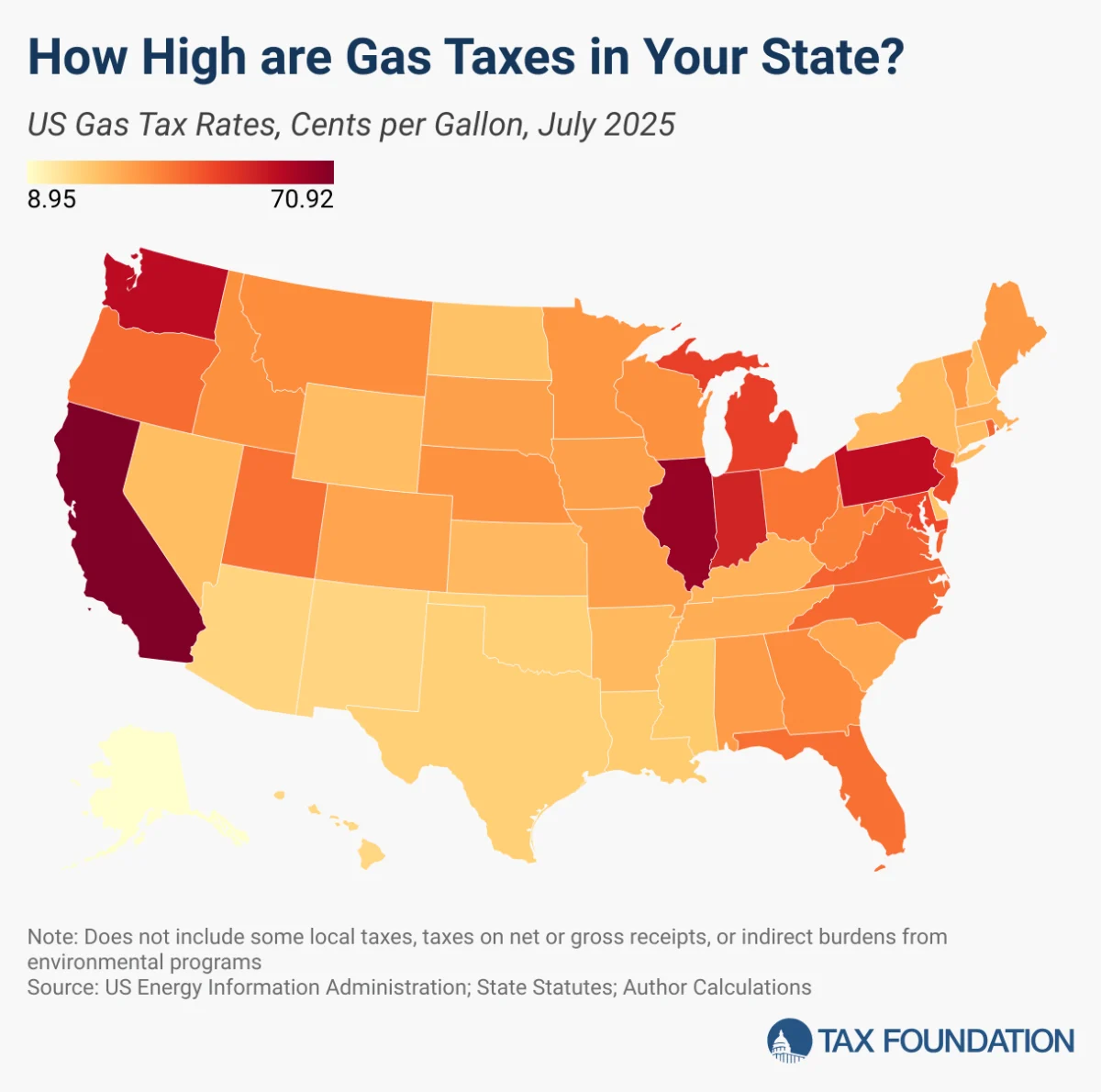
The tax burden on a single gallon of gasoline varies wildly across state lines, reflecting different approaches to infrastructure funding and environmental regulation.
High-Tax Leaders and Low-Tax Outliers
As of 2026, California leads the nation with the highest state-level gasoline tax burden, totaling 73.6 cents per gallon (cpg). This is closely followed by Illinois at 70.4 cpg and Indiana at 63.1 cpg. Conversely, Alaska offers the most relief to drivers with a nominal rate of 8.95 cpg, followed by Hawaii (18.5 cpg) and New Mexico (18.9 cpg).
These figures, however, provide only a partial picture. They often exclude local-level taxes that can drastically shift the reality for commuters. For instance, while Hawaii’s state tax is relatively low, local jurisdictions like Maui add up to 24 cpg in additional fees. Nevada presents an even more extreme case; due to "Fuel Revenue Indexing" and local levies, residents in Washoe County face a combined burden of 67.8 cpg, effectively pushing their local costs into the same tier as the most heavily taxed states in the country.
The New Frontier: Environmental Policy as an Indirect Tax
Perhaps the most significant change in the last few years has been the integration of environmental policy into the price at the pump. States are increasingly using fuel markets to drive decarbonization, employing cap-and-trade systems, Low Carbon Fuel Standards (LCFS), and climate-focused regulations.
The California and West Coast Model
California serves as the primary laboratory for these policies. Beyond its direct fuel taxes, the state’s cap-and-trade program is estimated by the Legislative Analyst’s Office to add roughly 23 cpg to the price of gas. Furthermore, the state’s aggressive LCFS, which underwent a stringent amendment in mid-2025, continues to exert upward pressure on prices. When accounting for direct taxes and the regulatory "hidden costs," the total burden on a California driver approaches $1.16 per gallon.
Washington and Oregon are following similar, albeit less predictable, trajectories. Washington’s Climate Commitment Act, which includes a cap-and-invest program, has seen fluctuating price impacts—ranging from 5 to 15 cpg according to state estimates, though earlier projections were significantly higher. Oregon’s Clean Fuels Program has similarly added to the price floor, and as the state navigates the legal hurdles surrounding its broader Climate Protection Program, the uncertainty remains a significant factor in regional pricing.
Chronology of Fiscal Shifting
- Pre-2020: The gas tax functioned primarily as a static, per-gallon fee, relatively insulated from aggressive environmental policy.
- 2022-2024: Geopolitical tensions, particularly involving Iran, led to supply-side shocks. This prompted several states to implement "gas tax holidays"—temporary suspensions of excise taxes designed to provide short-term relief.
- 2025: California enacts stricter Low Carbon Fuel Standards, signaling a pivot toward using fuel prices as a regulatory mechanism to force the transition to renewable energy.
- 2026: The implementation of New Mexico’s Clean Transportation Fuel Program marks the latest expansion of state-level environmental regulation, setting the stage for a new, more complex era of fuel pricing across the American Southwest.
The "Gas Tax Holiday" Fallacy
During periods of high inflation and supply-chain disruption, the concept of a "gas tax holiday" often gains political traction. However, economic analysis consistently highlights the flaws in this approach.
Tax holidays do not address the underlying supply constraints that drive prices upward. Instead, they act as an artificial subsidy for fuel consumption precisely when the market is attempting to balance supply and demand. Moreover, these gimmicks create a "funding gap" in transportation budgets. Because the cost of maintaining roads remains fixed, reducing the gas tax simply shifts the burden to more regressive sources, such as general sales or income taxes, which are not tied to road usage.
Implications: The Death of the Per-Gallon Model
The long-term viability of the gas tax is under existential threat. Three factors are driving this decline:
- Vehicle Efficiency: Modern combustion engines are significantly more efficient than those of twenty years ago, meaning drivers get more miles per gallon and pay less in tax per mile traveled.
- The Rise of EVs: Electric vehicles, which utilize the road network just as much as internal combustion vehicles, contribute zero dollars to the gas tax. This creates a structural inequity where traditional vehicle owners subsidize the infrastructure used by EV drivers.
- Inflationary Erosion: In states where gas tax rates are not automatically adjusted for inflation, the "real" value of the revenue collected declines every year, leading to deferred maintenance and decaying infrastructure.
Toward a Future of VMT Taxes
In response to these challenges, the conversation among policymakers has shifted toward the Vehicle Miles Traveled (VMT) tax. By replacing the per-gallon fee with a per-mile fee, states could ensure that every vehicle—regardless of whether it runs on gasoline, electricity, or hydrogen—pays its fair share for the infrastructure it utilizes.
While VMT systems raise valid concerns regarding privacy and the logistics of tracking mileage, they represent the most "neutral" path forward. If properly calibrated, a VMT tax would decouple infrastructure funding from the shifting sands of fuel policy and ensure that the "user fee" principle remains relevant in an era of rapidly changing automotive technology.
Conclusion: A Balancing Act
The American gas tax has evolved into an uneasy hybrid of a user fee and a tool for social engineering. As states like California, Washington, and New Mexico continue to experiment with environmental surcharges, the gap between the cost of the fuel and the cost of the tax will only grow.
Ultimately, the goal of transportation funding must be to provide a reliable, equitable, and sustainable stream of revenue for the nation’s infrastructure. As the era of the internal combustion engine begins its long sunset, policymakers must look beyond the pump, ensuring that the burden of maintaining our roads remains with those who use them, while navigating the complex intersection of climate policy and fiscal reality. The transition will be difficult, but for the sake of the nation’s crumbling highways, it is a transition that cannot be delayed.
