





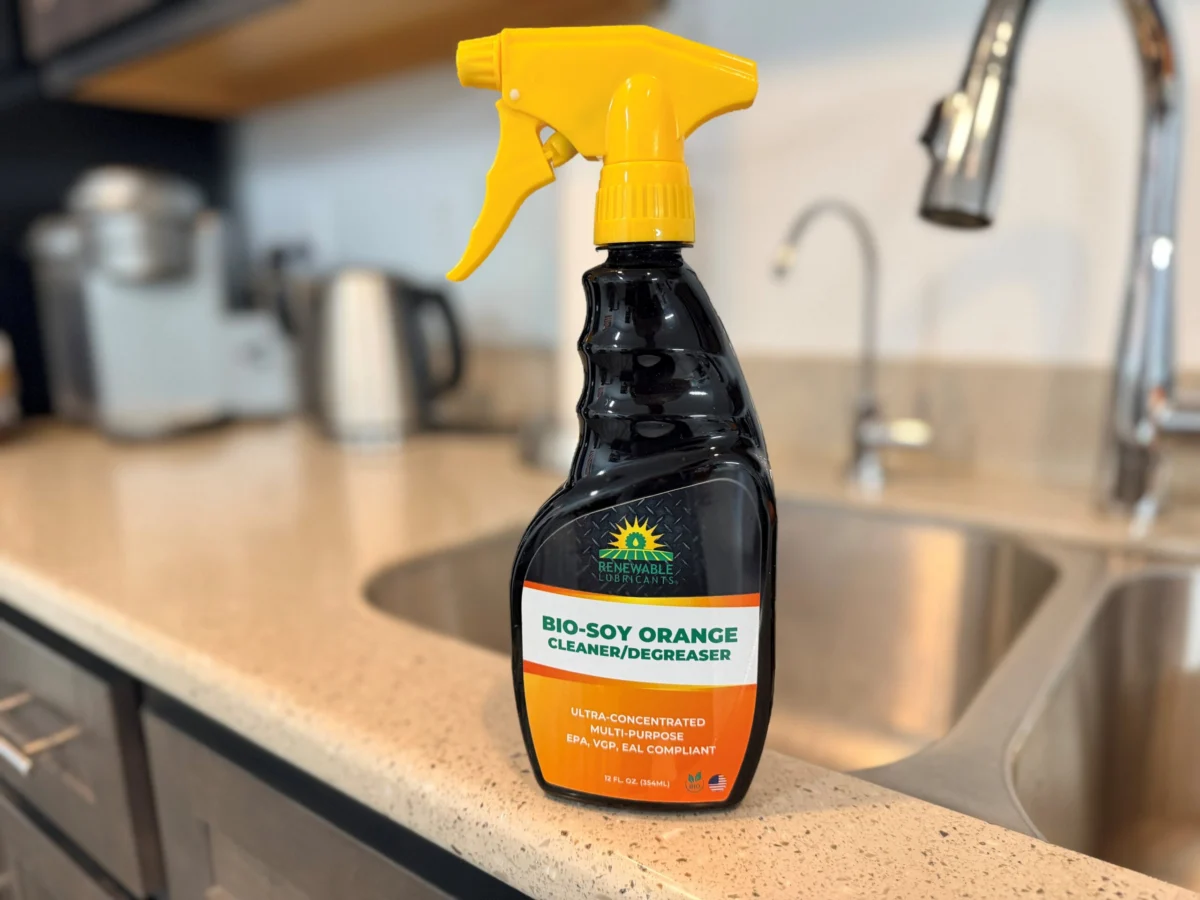
Main Facts: A Sustainable Breakthrough in Surface Care
In a significant move toward greener industrial operations, Renewable Lubricants has officially unveiled its latest innovation: the Bio-Soy Orange All-Purpose Cleaner/Degreaser. This new product represents a departure from traditional, petroleum-heavy chemical solutions, opting instead for a bio-based architecture that leverages the natural solvency of soy and citrus extracts.
The cleaner is engineered to address one of the most persistent challenges in industrial maintenance: the removal of stubborn, high-viscosity contaminants such as road film, tar, grease, and industrial grime, without sacrificing environmental integrity. Unlike many of its predecessors that rely on harsh volatile organic compounds (VOCs), the Bio-Soy Orange formula offers a refreshing citrus scent, effectively eliminating the toxic, pungent fumes often associated with shop-floor degreasing agents.
The product is categorized as a "readily biodegradable" solution, meaning it is designed to break down naturally in the environment, reducing the ecological footprint of industrial waste runoff. From the heavy-duty demands of marine vessel maintenance to the precision cleaning required in military and agricultural sectors, the cleaner is positioned as a versatile, all-in-one solution for facility managers and maintenance professionals alike.
Chronology: The Evolution of Renewable Lubricants’ Bio-Based Portfolio
The development of the Bio-Soy Orange Cleaner/Degreaser did not happen in a vacuum. It is the culmination of decades of research into bio-synthetic technology.
- 1990s–2000s: Renewable Lubricants established its reputation by pioneering bio-based hydraulic fluids and gear oils. During this period, the company identified a gap in the market: while lubricants were becoming greener, the agents used to clean those lubricants off equipment remained largely petroleum-derived and hazardous.
- 2015–2018: The R&D team began experimenting with soy-methyl esters—a byproduct of soy processing—combined with d-limonene, a natural solvent derived from orange peels. The challenge was to balance the solvent’s aggressive cleaning power with a formula that wouldn’t damage sensitive surfaces like vinyl or finished wood.
- 2020–2022: The company conducted extensive field testing across diverse environments, including marine engine rooms and large-scale agricultural operations. The goal was to ensure that the product was non-foaming and non-flammable, making it safer for high-heat environments like kitchens and engine maintenance bays.
- 2024: Following successful pilot programs, Renewable Lubricants finalized the formula, optimizing the concentration ratios to allow for both heavy-duty usage and diluted, cost-effective maintenance applications. The product is now entering the commercial market, marking a strategic pivot toward "Total Facility Sustainability."
Supporting Data: The Mechanics of Bio-Solvency
To understand why the Bio-Soy Orange cleaner is a viable alternative to traditional solvents, one must look at the chemistry of the ingredients.
The Chemistry of Soy and Orange
Traditional degreasers often rely on chlorinated solvents or petroleum distillates, which are effective but carry significant health and disposal risks. The Bio-Soy Orange formula utilizes a two-pronged approach:
- Soy-Methyl Esters: These act as the carrier and primary dissolving agent for heavy grease and tar. Soy-based solvents have a higher flash point than petroleum-based alternatives, significantly improving the safety profile for shop floor environments.
- Citrus Terpenes (d-limonene): Extracted from orange peels, these are natural solvents that excel at breaking down hydrocarbons. They serve as a powerful degreaser that penetrates the microscopic pores of surfaces, lifting away contaminants that traditional water-based soaps might miss.
Performance Metrics
In laboratory simulations conducted by the manufacturer, the cleaner demonstrated:
- Flash Point: Significantly higher than traditional aerosol cleaners, minimizing fire hazards in confined workspaces.
- Material Compatibility: Rigorous testing on aluminum, stainless steel, vinyl, and high-density polyethylene showed no signs of surface degradation or chemical etching.
- Biodegradability: Exceeds regulatory requirements for "readily biodegradable" labeling, ensuring that if the product enters the water table, it poses minimal harm to aquatic life.
Official Responses and Industry Perspectives
"Our goal has always been to prove that environmental responsibility does not require a performance compromise," says a lead spokesperson for Renewable Lubricants. "With the Bio-Soy Orange cleaner, we are providing industrial, marine, and military professionals with a tool that works harder, smells better, and respects the environment."
Industry analysts have noted that this launch is timely. As global regulatory bodies tighten the screws on VOC emissions and waste disposal protocols, companies are under increasing pressure to source "green" alternatives for their maintenance supply chains.
"The shift toward bio-based cleaning agents is no longer a trend; it is an economic necessity," says Dr. Elena Vance, an industrial chemist and environmental consultant. "Companies are finding that the cost of handling, storing, and disposing of hazardous petroleum cleaners is rising. A non-flammable, biodegradable alternative like this represents a significant reduction in operational risk and insurance premiums."
Implications for Industrial and Residential Applications
The versatility of the Bio-Soy Orange cleaner extends far beyond the factory floor. Its design architecture allows for a tiered application strategy that optimizes both performance and cost.
Industrial and Military Applications
In high-stress environments like engine maintenance or military logistics, the product is recommended at full strength. It is specifically formulated to remove thick, polymerized oils and baked-on carbon deposits without the need for manual scrubbing. Because it is non-flammable, it is particularly suited for use in areas where spark hazards are a primary concern, such as fueling depots or near electrical equipment.
Marine and Agricultural Operations
For marine environments, the environmental impact of runoff is a critical concern. By using a product that breaks down rapidly, boat owners and commercial shipping companies can mitigate the impact of deck and engine cleaning on local waterways. In agriculture, the product’s ability to clean farm machinery—which is often caked with a mixture of mud, manure, and hydraulic fluid—without damaging paint or rubber seals, provides a significant advantage over caustic chemical cleaners.
The Maintenance Economy
The concentrated nature of the product is designed for efficiency. By allowing users to dilute the solution for lighter tasks—such as floor mopping, wall cleaning, or routine tool maintenance—the product stretches the consumer’s budget. This "concentrate-and-dilute" model also reduces the amount of plastic packaging required, further supporting the brand’s commitment to environmental stewardship.
Best Practices for Optimal Results
While the cleaner is designed for ease of use, Renewable Lubricants emphasizes specific protocols to ensure the longevity of the surfaces being cleaned:
- Spot Testing: Despite its material safety rating, the company advises testing an inconspicuous area first, particularly on older or porous surfaces, to ensure compatibility with surface coatings or waxes.
- Rinsing: For high-performance cleaning, rinsing with water is recommended. This not only removes the residual grease that the cleaner has lifted but also prevents any potential streaking, especially on metallic surfaces.
- Application Methods: The product is compatible with standard sprayers, pressure washers, and floor scrubbers, making it a "drop-in" replacement for existing equipment.
Conclusion: The Future of Maintenance
The introduction of Bio-Soy Orange marks a pivotal moment for Renewable Lubricants. By bridging the gap between heavy-duty industrial power and bio-based, sustainable chemistry, the company is positioning itself at the forefront of the "clean-tech" maintenance movement.
As businesses worldwide look to align their operations with ESG (Environmental, Social, and Governance) goals, the transition to safer, biodegradable chemicals is an obvious step. Whether it is a mechanic in a local garage or a facility manager overseeing a global shipping port, the Bio-Soy Orange cleaner provides a solution that addresses the modern requirement for performance, safety, and sustainability. As this product gains traction, it is likely to serve as a benchmark for future product developments in the chemical maintenance sector, proving that the future of industry is not just productive—it is clean.
