





The Canadian automotive aftermarket is currently undergoing a period of profound transformation. For jobbers and parts distributors, the daily grind has evolved from a traditional model of logistics and inventory management into a high-stakes, multi-dimensional balancing act. According to the 2026 Annual Jobber Survey, the industry is grappling with a volatile confluence of economic headwinds, a shrinking pool of skilled labor, and a widening disconnect between the stated needs of repair shops and their actual purchasing behaviors.
As the industry moves through 2026, the data paints a picture of a distribution network working harder than ever to maintain service standards under intense operational strain. The role of the jobber has shifted; they are no longer just intermediaries, but essential buffers between global supply chain instabilities and the local repair bay, absorbing the friction of delayed shipments and escalating overhead costs to preserve vital counter relationships.
The Structural Disconnect: Price Versus Value
One of the most pressing issues identified in the survey is the growing rift between what shop owners say they value and how they ultimately spend their budgets. Despite a collective industry narrative focused on quality and "doing the job right the first time," the data suggests that many shops are falling into a "race to the bottom" regarding component pricing.
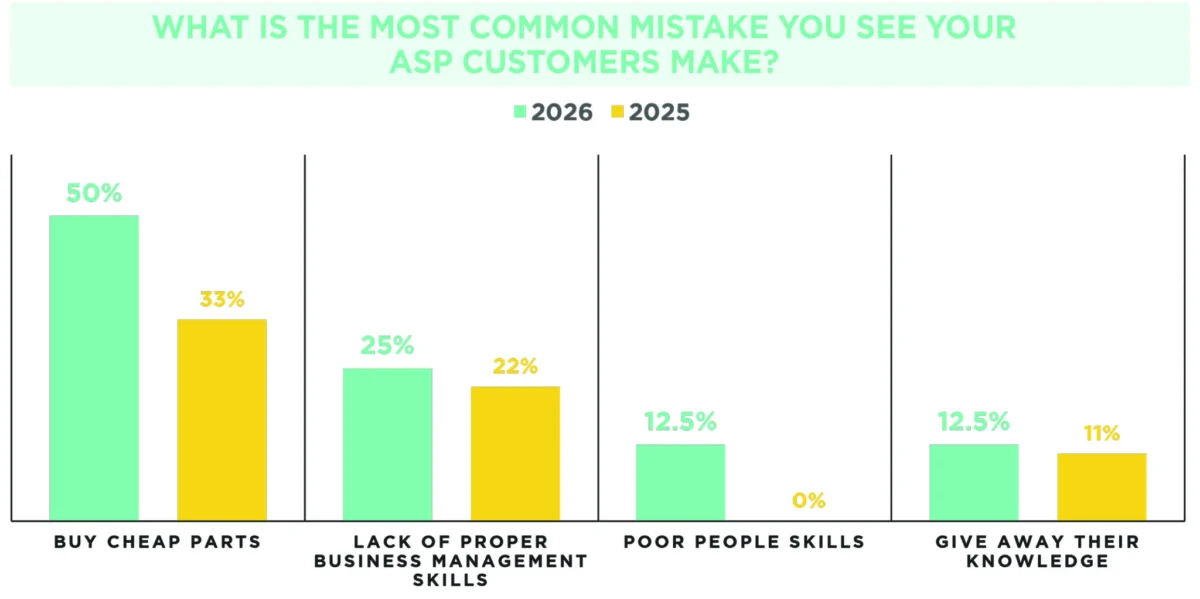
Half of all parts distributors surveyed identified the tendency of repair shops to prioritize cheap parts as the single most common mistake made by their customers. This is a significant escalation from 2025, when only 33% of jobbers flagged this behavior.
"Most shops seem to be in a race to the bottom, pricing-wise," one respondent noted. This phenomenon is often exacerbated by local economic pressures. In smaller communities, where the line between service provider and neighbor is blurred, shop owners frequently feel the burden of pricing sensitivity. "Because we are in a small town, everybody knows somebody, and they are afraid to charge too much to their ‘friend,’" one distributor explained.

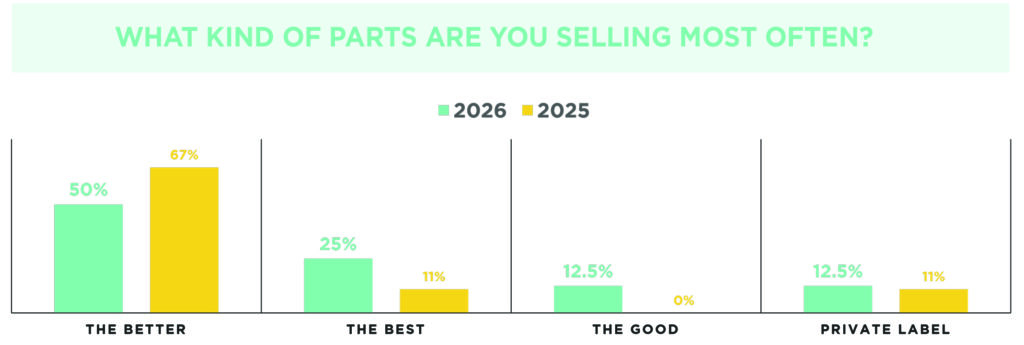
However, the sales volume data reveals a complex reality. While the market for "The Better" (mid-range components) remains the industry backbone, it has dipped from 67% of market share in 2025 to 50% in 2026. Conversely, the "Best" (premium components) has seen a resurgence, climbing to 25% of sales, up from just 11% a year ago. Simultaneously, the "Good" (basic tier) and private-label segments have gained traction, capturing 25% of the market combined.
This tiered fluctuation is further complicated by a decline in manufacturing consistency. Distributors report that even when shops opt for premium lines, quality is no longer a guaranteed metric. This has forced counter staff to pivot away from proactive selling to reactive damage control, spending an increasing amount of time managing warranty returns and defect claims.
Chronology of Challenges: From Availability to Personnel
The challenges facing the industry have shifted in priority over the last 18 months, mirroring the broader economic instability in Canada.
In 2025, the industry was primarily concerned with immediate supply chain bottlenecks and parts availability. By 2026, those concerns have been eclipsed by a critical shortage of human capital. Fifty percent of surveyed jobbers identified staffing shortages as their single biggest challenge—a massive leap from the 22% who cited it as a primary concern last year.
This staffing crisis is no longer confined to the technician level in service bays; it has migrated to the distribution counter. Finding personnel who possess both the technical aptitude to navigate complex vehicle systems and the retail finesse to manage customer relationships has become an existential challenge for many distributors.

The Financial Squeeze
Alongside labor shortages, cash flow has emerged as a significant threat to business health, with 25% of respondents highlighting it as an immediate concern. This is driven by a "trickle-down" effect of economic tightening; larger organizations are increasingly delaying payments, which forces jobbers to carry the financial burden of extended accounts receivable.
Looking toward the future, the industry’s outlook is increasingly guarded. Fifty percent of respondents anticipate that global geopolitical instability, tariffs, and shifting trade policies will define their business environment in the coming years. This is more than double the 22% of respondents who held this view in 2025, signaling that jobbers are bracing for a prolonged period of import-related volatility.
Supporting Data: The Partnership Pivot
The relationship between the jobber and the repair shop remains the industry’s foundational asset, yet the criteria for a successful partnership have shifted. The 2026 survey shows an even 50/50 split between "relationship strength" and "physical inventory availability" as the most critical aspects of the partnership.
This is a marked departure from 2025, where the relationship was viewed as the primary pillar (44%) and availability was a distant tertiary concern (11%). Today, it is clear that while a strong personal rapport is valued, it is a secondary support system—it cannot salvage a sale if the distributor lacks the part on the shelf.
When asked to identify all important factors in the partnership, 88% of all respondents placed availability and inventory at the very top of their list. As one respondent succinctly put it, "We also pride ourselves in having very good inventory—you can’t sell it if you don’t have it."
Official Responses and Perspectives
The feedback from the front lines of the industry suggests a move toward greater transparency to bridge the gap between shop expectations and warehouse realities.
Managing Delivery Friction
Delivery logistics remain a primary source of friction. While 50% of jobbers rate their delivery performance as "very good," there is a clear sentiment that many shops lack an understanding of the complexities involved in modern, urban-congested supply routes.
To combat this, some distributors are adopting data-sharing initiatives. By establishing electronically tracked, agreed-upon service agreements, these distributors are humanizing the counter staff and providing shops with realistic expectations. "We are not perfect, and neither are our customers," one respondent noted, highlighting that transparent communication is the best tool for mitigating frustration when errors inevitably occur.
The Rise of Digital Ordering
One of the most promising developments has been the widespread adoption of digital ordering channels. Jobbers report that these tools are not just a convenience, but a necessary operational optimization. By shifting routine orders to digital platforms, staff are freed from the telephone, reducing the potential for transcription errors and allowing for a more efficient allocation of labor. "Utilizing online ordering frees up staff to answer the phone [for complex queries]," one jobber noted.
Implications for the Future
The 2026 landscape suggests that the Canadian parts distribution industry is in the midst of a "survival of the fittest" evolution. The winners will be those who can successfully navigate three core pillars:
- Investment in Training: As identified by respondents, the key to better sales and upselling is a better-trained workforce. If staff are capable of explaining the value proposition of premium parts, they can help shift the "race to the bottom" toward a more sustainable model.
- Operational Transparency: Moving away from "over-promising and under-delivering" is essential. The success of those implementing tracked delivery windows shows that shops are willing to work with distributors who are honest about their limitations.
- Technological Integration: The shift toward online ordering is not just a trend but a requirement for efficiency. Stores that fail to modernize their procurement interfaces risk being left behind by more agile competitors.
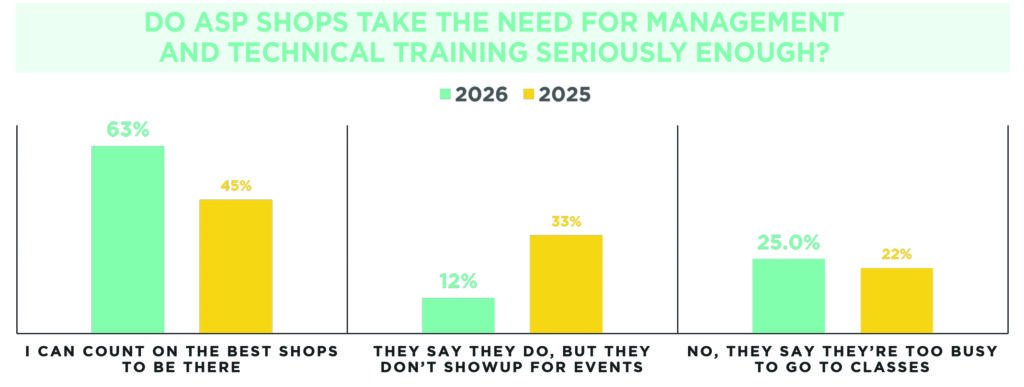
Finally, the survey highlights a silver lining: a renewed commitment to professional development. More than 60% of distributors now report that their top-tier shop customers are consistently attending educational events and management seminars. This increase in professional engagement suggests that while the industry is under pressure, the core participants are increasingly committed to the long-term health and modernization of the automotive aftermarket.
As the industry faces down the challenges of 2026, the message is clear: the era of "just-in-time" parts delivery is being replaced by an era of "just-in-case" planning, where communication, inventory depth, and technical expertise are the only currencies that matter.
