




As of July 2026, the United States presents a complex, state-by-state mosaic of fiscal policies regarding electric vehicles (EVs). As the automotive industry pivots away from internal combustion engines, state legislatures are scrambling to address two competing pressures: the need to incentivize the adoption of clean energy vehicles to meet climate goals and the urgent requirement to replace declining gasoline tax revenues that have historically funded road infrastructure. The result is a fragmented regulatory environment where a driver’s tax burden or incentive eligibility can change drastically simply by crossing a state line.
The Fiscal Crossroads: Main Facts of EV Taxation
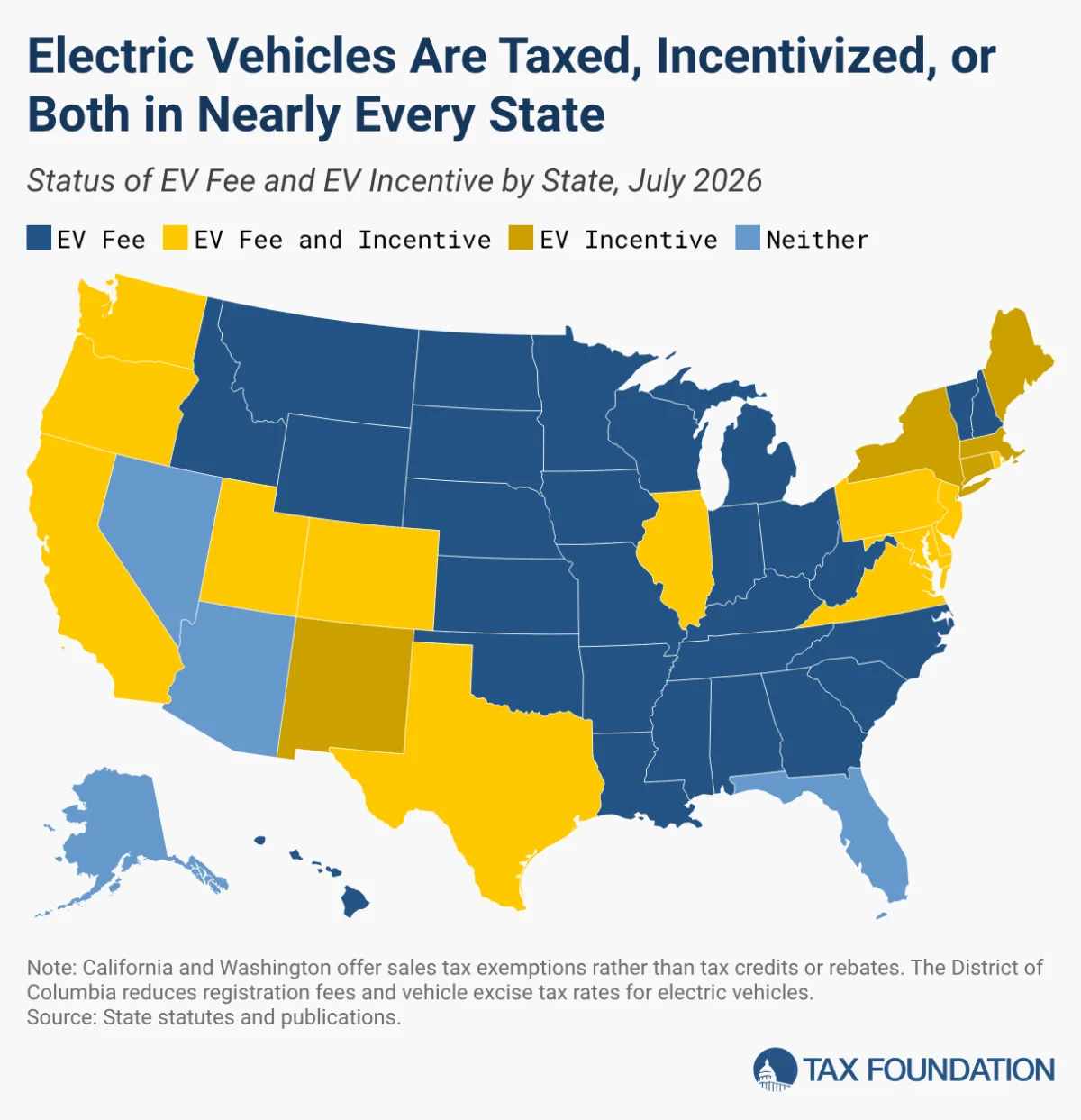
The primary conflict currently facing state departments of transportation is the “gas tax gap.” Traditionally, highway maintenance has been funded through excise taxes on every gallon of gasoline or diesel purchased. EVs, which never stop at the pump, effectively bypass this funding mechanism. To compensate, 46 states and the District of Columbia have implemented various legislative strategies, ranging from hefty annual registration surcharges to innovative Vehicle Miles Traveled (VMT) tax programs.
As of July 2026, the landscape is defined by high-fee states like Georgia—which imposes a $273.59 annual fee—and Michigan, with a $267 surcharge, contrasted sharply against states like Alaska and Arizona, which currently impose no specific annual fees on EV owners.
Furthermore, these fees are often tiered. Many states now distinguish between fully battery-electric vehicles (BEVs) and plug-in hybrid electric vehicles (PHEVs). The logic, often debated in state houses, is that PHEVs still contribute some gas tax revenue through their internal combustion engines, and therefore should be subject to a lower “bridge” fee than their all-electric counterparts.
Chronology: A Decade of Regulatory Evolution
The evolution of these policies has been rapid. In the early 2010s, most states offered generous tax credits or rebates to jumpstart the nascent EV market. During this period, the goal was simple: get as many EVs on the road as possible to lower carbon emissions.
By 2018, however, the conversation shifted toward sustainability. As EV adoption rates began to climb, states realized that the long-term solvency of their transportation trust funds was at risk. Washington and Oregon were among the first to explore pilot programs for VMT taxes, which track actual road usage rather than fuel consumption.
Between 2021 and 2024, the "fee era" hit its stride. As the federal government poured billions into the National Electric Vehicle Infrastructure (NEVI) program, states moved to institutionalize EV registration fees to ensure that the users of the newly expanded charging network were also paying for the roads they traveled. By 2025, the focus had bifurcated: while high-fee states solidified their revenue streams, a handful of states—including Maine, Massachusetts, and Colorado—doubled down on aggressive rebates to ensure that the transition to electric remained affordable for low-to-moderate-income households.
Supporting Data: The Cost of Ownership Across the Union
The following data highlights the vast disparity in how states treat the EV transition.
The High-Fee States (Over $200 Annual Surcharge)
States like Georgia, Michigan, Alabama, and North Carolina are leading the trend of "user-pays" taxation. In these jurisdictions, the annual fee is intended to mirror what an average driver would have paid in gasoline taxes over 12,000 to 15,000 miles of driving.
- Georgia: $273.59 (inclusive of license plate fees)
- Michigan: $267.00
- Pennsylvania: $250.00
- Indiana: $242.00
- North Carolina: $214.50
The Incentive-Heavy States
Conversely, states with ambitious climate goals continue to offer significant purchase rebates, though these are increasingly means-tested to favor lower-income residents.
- Maine: Offers rebates up to $8,000 for low-income residents purchasing a new EV.
- Massachusetts: Provides up to $6,000 for standard buyers, with additional incentives for rideshare drivers.
- Utah: Operates an "Electric Vehicle Replacement Assistance Program," which grants up to $10,000 to low-income drivers who replace older, polluting combustion vehicles with EVs.
The VMT Alternative
Some states have introduced a compromise. In Hawaii, Oregon, Utah, and Virginia, drivers can opt out of a flat annual fee by enrolling in a VMT program. This allows the state to charge a per-mile rate, ensuring that those who drive less pay less, while high-mileage commercial or commuter drivers contribute a more equitable share to the road fund.
Official Responses and Policy Rationales
State transportation secretaries and budget directors have offered varied justifications for these policies. In states with high fees, the rhetoric focuses on "fairness." For instance, representatives in Alabama and Mississippi have argued that it is inequitable for electric vehicle owners to use public roads without contributing to the state’s asphalt and bridge maintenance funds.
"We are not anti-EV," said one state legislative analyst from a high-fee Midwestern state. "We are pro-infrastructure. If the revenue from the gas tax disappears, we have to find it somewhere. If we don’t charge the EV driver, we have to raise property taxes or sales taxes, which affects everyone, not just the car owner."
In contrast, officials in states like Colorado and Maine emphasize the "social cost of carbon." They argue that the external costs of fossil fuel consumption—such as public health expenditures related to air quality—far outweigh the loss of gasoline tax revenue. By keeping fees low or non-existent and providing rebates, these states argue they are lowering the total cost of ownership for their citizens while accelerating the transition to a cleaner economy.
Implications: A Future of Uncertainty
The current "patchwork" of regulations has significant implications for the future of the automotive market and the average consumer.
1. Market Distortion
For the automotive industry, these disparate regulations make it difficult to market EVs nationally. A vehicle that is highly affordable in Massachusetts might be significantly more expensive to own in Pennsylvania when annual registration fees are factored in. This creates a "geographic preference" where EVs are clustered in states with favorable tax policies, potentially slowing the transition in rural or high-fee states.
2. The Rise of "Zombie" Incentives
A notable issue identified in the 2026 data is the existence of "operational" but "unfunded" programs. In states like Maryland, Texas, and Virginia, rebate programs exist on the books, but they have run out of funds and are no longer accepting new applicants. This creates a "bait-and-switch" scenario where potential buyers, seeing a listed incentive online, may make a purchasing decision based on outdated or exhausted government funding.
3. The Shift to VMT Taxes
The long-term implication is likely a national shift toward VMT taxation. As the fleet transitions to electric, flat registration fees will eventually be seen as regressive—taxing the owner of a small, efficient commuter EV the same as the owner of a massive, heavy electric truck. Tracking mileage, while raising privacy concerns, is increasingly viewed by policymakers as the only mathematically sound way to maintain the U.S. highway system in the post-gasoline era.
4. Equity Concerns
The trend of means-testing rebates, seen in states like Connecticut, New Jersey, and Illinois, represents a maturing of climate policy. Rather than providing broad-based incentives that benefit wealthy buyers who would have purchased an EV regardless, states are focusing their limited budgets on low-income households. This suggests that future EV policy will be as much about social equity and transportation access as it is about carbon reduction.
Conclusion
The transition to electric mobility is not just a technological challenge; it is a fiscal one. As of July 2026, the United States is in the midst of a massive, decentralized experiment. Some states are prioritizing the protection of their infrastructure budgets through high flat fees, while others are prioritizing the acceleration of the EV market through generous subsidies. For the consumer, the takeaway is clear: the cost of going electric is no longer just the price of the car, but a calculation that must include the specific regulatory environment of their home state. As the national fleet continues to transition, pressure will only grow for a more standardized, equitable, and sustainable approach to funding the roads of tomorrow.
