





In the landscape of modern fiscal policy, few concepts ignite as much debate as the "net wealth tax." Defined as a recurrent levy on an individual’s total assets minus their liabilities, the wealth tax represents an attempt to capture revenue beyond traditional income or consumption streams. While the logic—taxing the stock of wealth rather than just the flow of income—appeals to some policymakers seeking to address wealth inequality, the practical application has proven historically fraught with complexity, legal challenges, and economic stagnation.
Today, only a handful of European nations continue to levy a true net wealth tax, with many others having abandoned the practice in favor of targeted asset levies or outright repeal. This article examines the current state of wealth taxation in Europe, the historical context of these policies, and the broader economic implications of attempting to tax accumulated capital.
Main Facts: The Current European Landscape
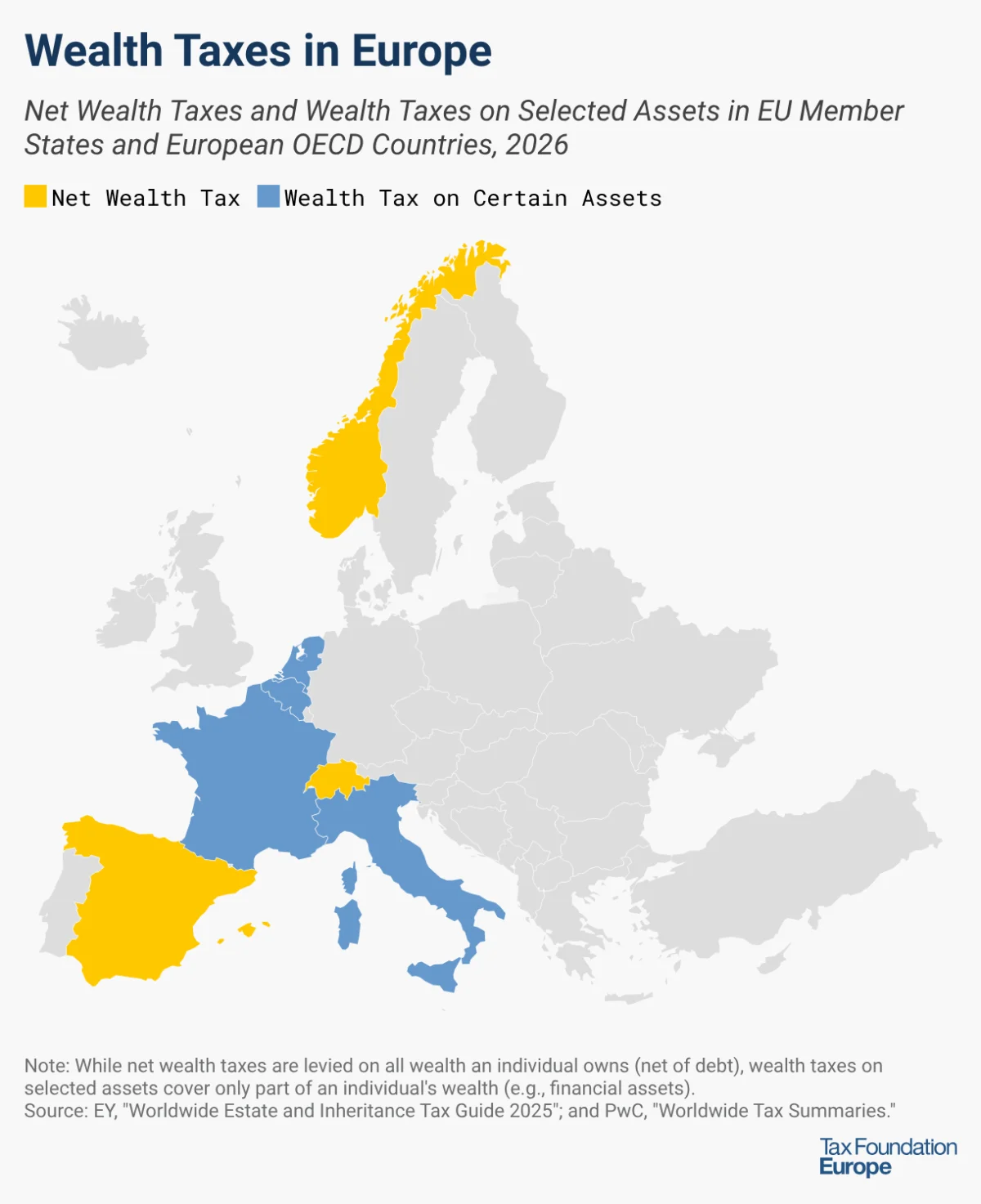
To understand wealth taxation, one must distinguish between a "net wealth tax"—which covers the entirety of an individual’s balance sheet—and taxes on selected assets. As of 2024, only three European countries maintain a comprehensive net wealth tax: Norway, Spain, and Switzerland.
The "Big Three" Wealth Tax Jurisdictions
- Norway: Often cited as the standard-bearer for this tax, Norway’s system dates back to 1892. It levies a 1 percent tax on net wealth stocks exceeding NOK 1.9 million. This is bifurcated into a 0.35 percent municipal tax and a 0.65 percent central government tax. For the ultra-wealthy, those with assets exceeding NOK 21.5 million, the rate climbs to 1.1 percent.
- Spain: Spain operates a highly fragmented, progressive system. Rates range from 0.16 percent to 3.5 percent depending on the autonomous region. While some regions, such as Andalusia and Madrid, have previously offered significant relief, the central government’s introduction of a "solidarity wealth tax" in 2022—targeting net assets exceeding EUR 3 million—has forced a recalibration of regional tax policies to ensure revenue stays local rather than being siphoned to the central state.
- Switzerland: Unique in its decentralized approach, Switzerland levies wealth taxes at the cantonal level. Because these taxes are set by local jurisdictions, rates and allowances vary significantly across the country, creating a competitive environment for residency.
Selected Asset Taxation
Several other nations have moved away from broad wealth taxes, replacing them with narrower, asset-specific levies. France serves as the most prominent example, having replaced its broad wealth tax with a real estate-only wealth tax in 2018. Italy focuses on financial assets held abroad and crypto assets, while Belgium imposes a "tax on securities accounts" (TSA) for those with significant investment holdings. The Netherlands currently finds itself in a state of legal flux, transitioning its "Box 3" wealth-based income tax system following a landmark Supreme Court ruling that deemed the previous assessment method a violation of property rights.
A Chronology of Wealth Taxation
The evolution of these taxes is a story of trial and error. The concept is not new; it is a nineteenth-century relic that has struggled to adapt to the liquidity and mobility of the twenty-first-century global economy.
- 1840 – The Swiss Implementation: Switzerland introduced its wealth tax, which remains one of the oldest in existence. Its longevity is largely attributed to the cantonal autonomy that prevents a "one-size-fits-all" stagnation.
- 1892 – The Norwegian Model: Established in the late 19th century, Norway’s tax has survived several political shifts, though it remains a constant point of contention in Norwegian domestic politics.
- Late 20th Century – The Wave of Repeals: Throughout the 1990s and early 2000s, European nations began to realize that wealth taxes were "leaky buckets." Administrative costs were high, and capital flight was rampant. Countries like Austria, Denmark, Germany, Sweden, and Finland abolished their wealth taxes during this period.
- 2018 – The French Pivot: The abolition of the Impôt de solidarité sur la fortune (ISF) in France marked a major turning point in European fiscal policy. President Emmanuel Macron’s administration argued that the tax was driving the wealthy, and their potential investments, out of France. It was replaced by a tax specifically targeting real estate, leaving financial assets untaxed to encourage capital reinvestment in the economy.
- 2022-2023 – The Solidarity Resurgence: Facing post-pandemic budget pressures, the Spanish government introduced the "solidarity wealth tax," signaling a temporary or perhaps lasting return to aggressive wealth-based revenue collection.
Supporting Data: Why Revenue Stagnates
The primary argument for wealth taxes is often revenue generation. However, data from the OECD and various fiscal policy institutes suggest a different reality. Wealth taxes typically account for a negligible percentage of total tax revenue in the countries where they are applied.
The administrative burden of these taxes is immense. Because wealth is often tied up in illiquid assets—such as family-owned businesses, art, or private equity—valuing these assets annually is a nightmare for tax authorities. This valuation difficulty creates significant "legal uncertainty," leading to protracted litigation between taxpayers and the state.
Furthermore, the "liquidity trap" is a recurring theme in the data. An individual may have a high net worth on paper (the value of a business, for instance) but lack the liquid cash flow to pay a 1 percent annual tax without selling off portions of their assets. This forces divestment, which can be detrimental to long-term business stability and employment.
Official Responses and Political Implications
The discourse surrounding these taxes is polarized. Proponents argue that wealth taxes are essential tools for reducing the concentration of wealth and funding social services. They view the tax as a matter of fairness, suggesting that those with the most "capacity to pay" should contribute proportionately to the public good.
Conversely, economists at organizations like the Tax Foundation and the OECD have consistently warned against the practice. Their reports suggest that wealth taxes are among the most harmful taxes a country can implement. The reasons provided are twofold:
- Disincentivizing Entrepreneurship: When the state takes a percentage of an entrepreneur’s total wealth annually, it reduces the "reward" for long-term innovation. This discourages the creation of high-growth companies.
- Capital Flight: In a globalized economy, capital is mobile. Wealthy individuals can and do move their assets—or their residency—to jurisdictions where wealth is not taxed. This results in a "race to the bottom" where the country implementing the tax often loses more in investment revenue than it gains in tax revenue.
The Dutch experience serves as a cautionary tale. When the judiciary intervenes to declare a tax system discriminatory or a violation of property rights, it creates a vacuum of policy uncertainty that can stifle economic growth for years.
Implications for the Future
As Europe looks toward the future, the trend appears to be moving away from the "broad-base" wealth tax. The complexity of valuing global assets, combined with the ease of capital mobility, makes the net wealth tax an increasingly inefficient tool for the modern state.
Instead, countries are shifting toward:
- Enhanced Capital Gains Taxation: Taxing the profit made when an asset is sold, rather than the asset itself while it is held.
- Inheritance and Estate Taxes: Addressing wealth inequality at the point of intergenerational transfer rather than on an annual basis.
- Real Estate-Specific Levies: Focusing on immobile assets that are easier to value and impossible to move offshore.
For policymakers, the lesson from the last century is clear: wealth is not a stagnant pool of money that can be tapped at will without consequence. It is the lifeblood of investment, research, and development. When that blood is drained annually through a net wealth tax, the body of the economy inevitably slows.
The move by Spain to extend its solidarity tax indefinitely and the ongoing struggles in the Netherlands illustrate that the debate is far from over. However, as the OECD report notes, the most effective path forward for nations seeking prosperity is not to hike wealth taxes, but to refine them—or, more decisively, to repeal them entirely in favor of broader, more stable revenue-generating mechanisms.
The European experiment with wealth taxation remains a stark reminder that fiscal policy is not merely an exercise in accounting, but a delicate balance of incentives, economic mobility, and the fundamental protection of private property. As long as countries continue to leverage these taxes, they will continue to grapple with the economic trade-offs that have defined this fiscal era for over a century.
