





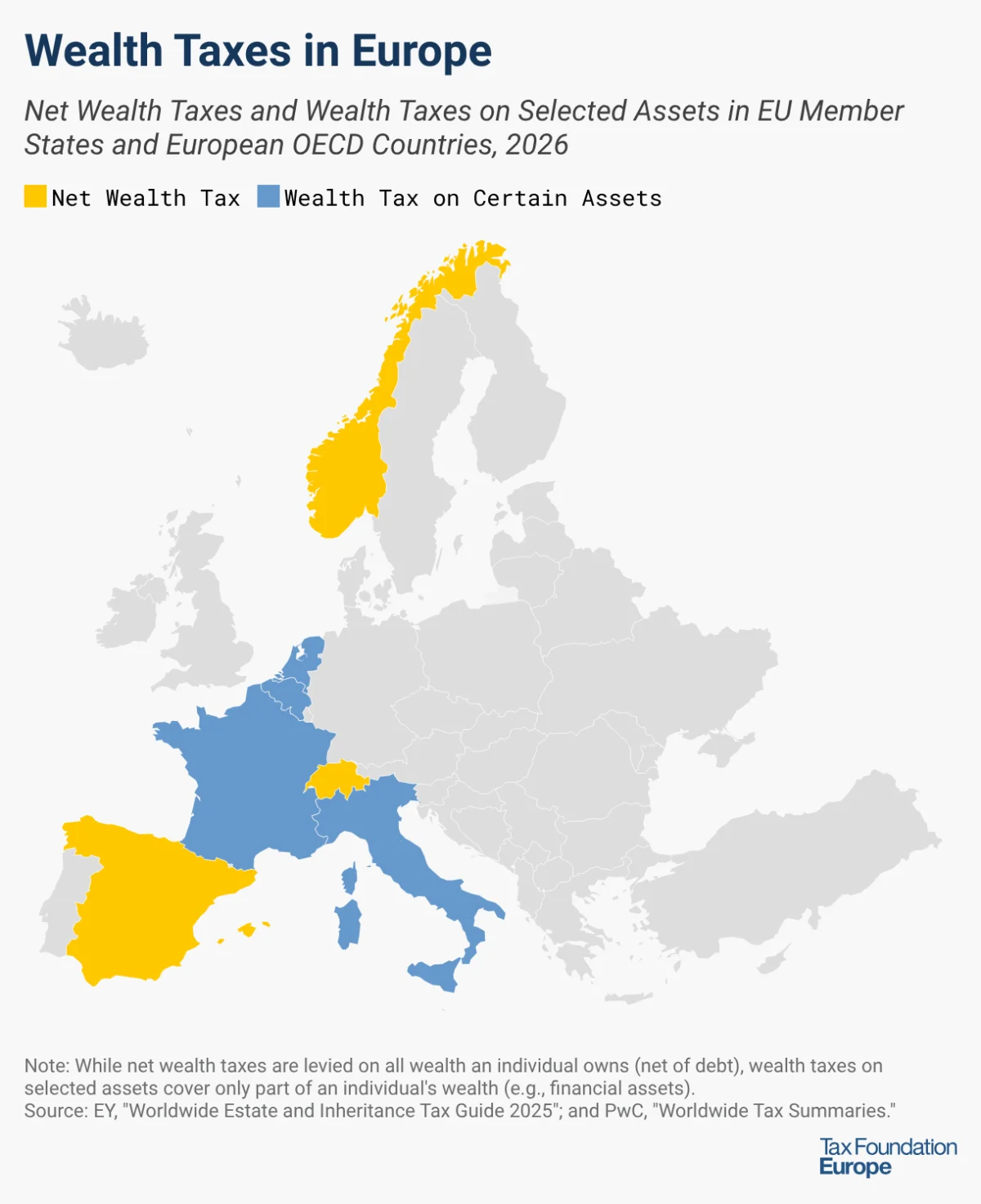
While the global conversation surrounding wealth inequality continues to intensify, a select group of European nations remains at the forefront of experimenting with direct taxation on accumulated net wealth. Unlike traditional income taxes, which target the flow of money into an individual’s pocket, net wealth taxes target the stock—the total market value of all assets owned minus any liabilities. As policymakers worldwide debate the efficacy of such levies, Europe serves as the primary laboratory for these controversial fiscal policies.
Main Facts: Defining the Landscape of Wealth Taxation
A net wealth tax is a recurrent levy imposed on an individual’s total net assets. Conceptually, it functions similarly to a real estate property tax; however, while property taxes are generally confined to immovable assets like land and buildings, a net wealth tax casts a much wider net, capturing financial portfolios, business holdings, and tangible personal property.
Currently, only three European nations—Norway, Spain, and Switzerland—impose a comprehensive net wealth tax on individuals. This represents a significant decline from the 1990s, when wealth taxes were far more prevalent across the continent. Beyond these three, several countries, including France, Italy, Belgium, and the Netherlands, have opted for targeted levies that apply to specific asset classes rather than a comprehensive net wealth tax. These "quasi-wealth" taxes often focus on real estate, financial securities, or foreign-held assets, creating a fragmented regulatory environment for high-net-worth individuals moving within the European Union.
A Brief Chronology: The Evolution of European Wealth Taxes
The history of wealth taxation in Europe is one of implementation, refinement, and frequent repeal.
- 1840 – The Swiss Model: Switzerland holds the distinction of having the longest-standing wealth tax system in Europe, having implemented its cantonal-level net wealth tax in the mid-19th century.
- 1892 – The Norwegian Foundation: Norway introduced its net wealth tax at the end of the 19th century. It remains a cornerstone of the Nordic social democratic model today.
- Late 20th Century – The Wave of Repeal: Throughout the 1990s and 2000s, many European nations, including Sweden, Germany, and Austria, abolished their wealth taxes, citing high administrative costs, capital flight, and economic distortions.
- 2018 – The French Pivot: France, once a leader in wealth taxation, abolished its general Impôt de solidarité sur la fortune (ISF) in 2018, replacing it with a narrower tax focused solely on real estate assets.
- 2022 – The Spanish Solidarity Shift: In response to regional tax competition, the Spanish central government introduced a "solidarity wealth tax" to prevent autonomous regions from effectively eliminating the tax through 100% relief schemes, a move that sparked significant legal and political friction.
Supporting Data: Regional Case Studies
The implementation of wealth taxes varies drastically in structure, rate, and administrative burden.
Norway: The Nordic Standard
Norway’s net wealth tax is split between municipal (0.35%) and central (0.65%) government coffers. It applies to net wealth exceeding NOK 1.9 million (approx. EUR 172,710). For the ultra-wealthy—those with net assets exceeding NOK 21.5 million—the rate climbs to 1.1%. This structure is designed to be highly progressive, ensuring that the wealthiest citizens contribute a larger share of their total net worth to the national budget.
Spain: The Tug-of-War Between Regions
Spain’s system is perhaps the most complex, characterized by a progressive tax rate ranging from 0.16% to 3.5%. The system is highly decentralized, allowing autonomous regions to adjust the tax burden. Recently, the central government intervened to ensure uniformity, introducing a solidarity tax for those with assets exceeding EUR 3 million. This effectively forced regions like Madrid and Andalusia, which had previously sought to grant full relief to their residents, to reinstate the tax to prevent revenue from flowing exclusively to the central government.
Switzerland: The Cantonal Approach
In Switzerland, wealth tax rates and allowances are determined at the cantonal level. Because Switzerland allows for significant autonomy, the tax burden varies widely depending on where a taxpayer resides. The system covers worldwide assets, excluding real estate and permanent establishments located abroad, creating a unique tax footprint for international residents.
The Alternative: Taxes on Selected Assets
Rather than a broad net wealth tax, other nations have adopted "niche" taxes that target specific types of wealth:
- France: The real estate wealth tax applies to net worldwide real estate assets valued at or above EUR 1.3 million. Rates can reach as high as 1.5%.
- Italy: The Italian government imposes a 0.2% to 0.4% tax on financial assets held abroad. Notably, this has recently expanded to include crypto assets held with non-resident intermediaries, reflecting the modern evolution of "wealth."
- Belgium: Since 2021, Belgium has utilized a "tax on securities accounts" (TSA) of 0.15% on accounts exceeding EUR 1 million.
- The Netherlands: The Dutch system is currently in a state of legal flux. Following a 2021 Supreme Court ruling that the previous wealth tax system violated property rights, the government is transitioning toward a system based on actual returns, expected to be fully realized by 2028.
Implications: Economic and Legal Consequences
The persistence of wealth taxes continues to draw sharp criticism from international organizations and economic analysts. The OECD has frequently noted that net wealth taxes can disincentivize entrepreneurship. Because these taxes are often levied on assets regardless of whether those assets generated a profit in a given year, they can force the liquidation of productive business assets to pay the tax bill.
1. Capital Flight and Legal Uncertainty
One of the most profound implications is the risk of capital flight. High-net-worth individuals are highly mobile; when faced with high wealth taxes, they often relocate to more tax-favorable jurisdictions. This not only erodes the tax base but also drains the domestic economy of potential investment capital. Furthermore, the complexity of valuing assets—ranging from private business shares to rare art and crypto assets—creates significant legal uncertainty, leading to frequent litigation between taxpayers and state authorities.
2. Revenue Efficiency
Contrary to the goals of proponents, wealth taxes often collect remarkably little revenue relative to the administrative complexity they create. The costs associated with auditing, valuation, and enforcement can consume a significant portion of the tax collected. As the OECD report indicates, the administrative burden often outweighs the fiscal benefit, leading to a "leaky" tax system that is difficult to enforce equitably.
3. Impact on Innovation
By taxing the capital base required for business expansion, wealth taxes can inadvertently punish innovation. Startups and small-to-medium enterprises, which often have high asset values but low liquidity, are particularly vulnerable. When a business owner must pay a percentage of their total wealth annually, they have less capital available to reinvest in research, development, or hiring.
Conclusion: The Path Forward
The European experience suggests that net wealth taxes are becoming an endangered species. As countries like the Netherlands move toward taxing actual returns and others continue to struggle with the administrative hurdles of asset valuation, the consensus among many fiscal experts is leaning toward repeal.
For governments seeking to address inequality, the challenge remains: how to tax wealth effectively without causing economic stagnation. While a wealth tax may appear to be a straightforward solution to fiscal imbalances, the historical record in Europe demonstrates that the secondary effects—including capital flight, legal friction, and diminished business investment—often complicate the fiscal landscape far more than the tax itself solves. As the global tax environment continues to shift, policymakers will likely look to broader, less intrusive forms of taxation that do not penalize the accumulation of capital, which remains the lifeblood of economic growth and long-term prosperity.
