





In the United States, few consumer goods are as heavily scrutinized and systematically taxed as cigarettes. For the average smoker, the price displayed at the convenience store counter is often just a fraction of the final cost, with a significant portion funneled into federal, state, and local coffers. As of July 2026, the tax burden on a single pack of 20 cigarettes has reached historic levels in several jurisdictions, reflecting a complex intersection of public health policy, revenue desperation, and economic theory.
The Landscape of Taxation: A Stark Geographic Divide
The disparity in cigarette taxation across state lines is profound. Policymakers cite various justifications for these levies: correcting the negative externalities associated with second-hand smoke, discouraging "sinful" or unhealthy behaviors, or simply tapping into a reliable stream of revenue to balance state budgets.
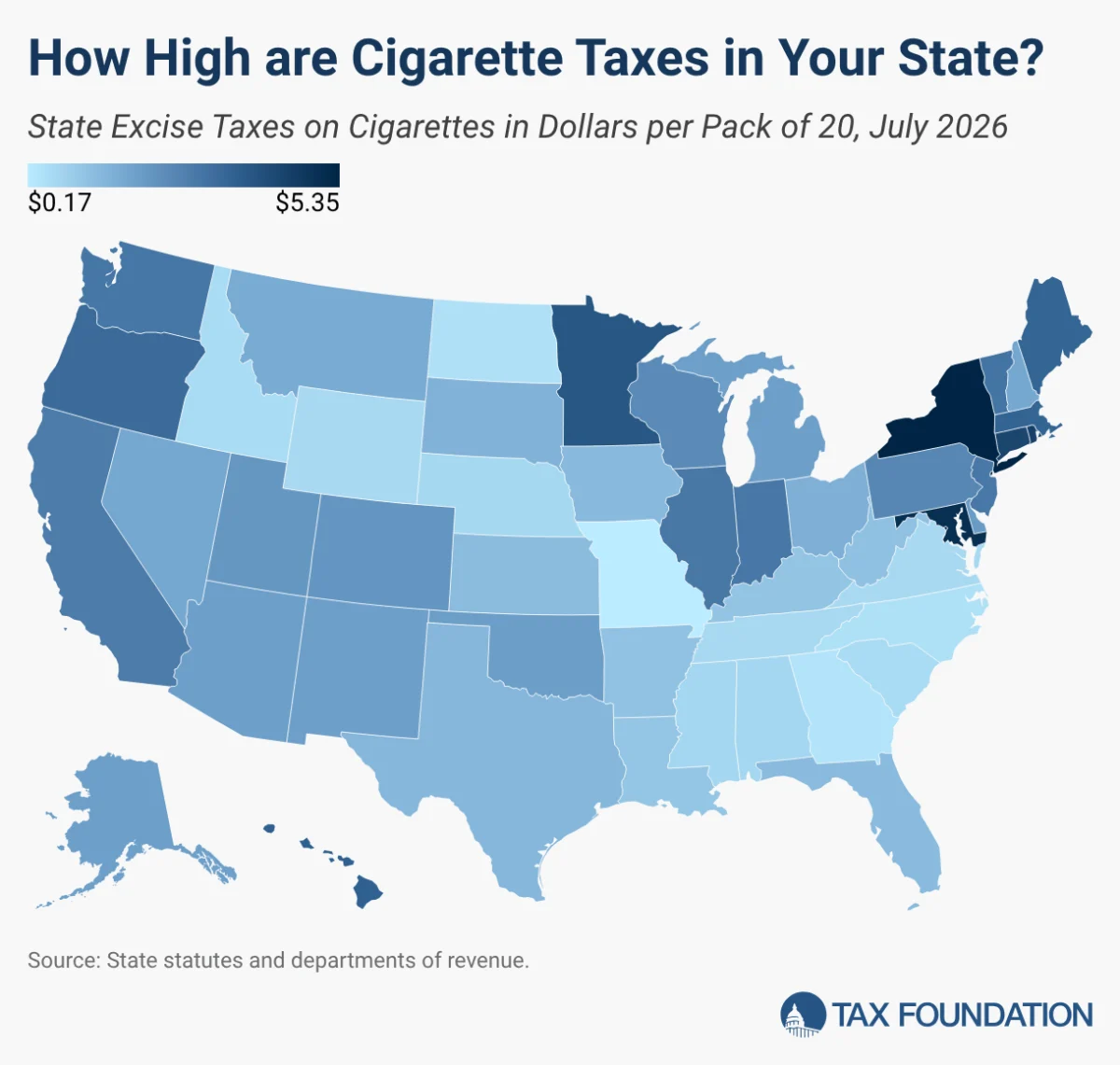
New York currently leads the nation in aggressive cigarette taxation, levying a staggering $5.35 per pack. The District of Columbia follows closely at $5.07, with Maryland ($5.00), Rhode Island ($4.50), and Connecticut ($4.35) rounding out the top five highest-tax jurisdictions. These figures represent the state excise tax alone and do not account for additional local levies or the standard $1.01 federal excise tax applied to every pack sold in the country.
Conversely, the tax burden is significantly lower in other parts of the country. Missouri maintains the lowest state cigarette tax at just $0.17 per pack. Georgia ($0.37), North Dakota ($0.44), and North Carolina ($0.45) also offer tax environments where the cost of the habit is far less impacted by state-level mandates.
State Excise Tax Rankings (July 2026)
| State | Tax per Pack | Rank |
|---|---|---|
| New York | $5.35 | 1 |
| Maryland | $5.00 | 2 |
| DC | $5.07 | 2* |
| Rhode Island | $4.50 | 3 |
| Connecticut | $4.35 | 4 |
| Minnesota | $3.88 | 5 |
| Hawaii | $3.60 | 6 |
| Massachusetts | $3.51 | 7 |
| Maine | $3.50 | 8 |
| Oregon | $3.33 | 9 |
(Note: While rankings fluctuate based on legislative sessions, the trend remains clear: coastal and Northeastern states dominate the high-tax tier.)
Chronology of a Declining Revenue Stream
The history of cigarette taxation in the U.S. is one of diminishing returns. For decades, smoking rates have trended downward—a victory for public health advocates but a fiscal headache for state treasurers.
Historically, excise taxes were viewed as a "golden goose" for government funding. However, the reliance on these taxes has created a structural irony: as public health initiatives successfully discourage smoking, the revenue generated to fund those very programs—or general government services—erodes.
- The Early Era: Cigarette taxes were initially introduced as modest revenue generators. Because the demand for nicotine was considered inelastic, policymakers felt comfortable raising these taxes without fear of an immediate collapse in consumption.
- The Mid-Century Shift: As the health consequences of tobacco use became undeniable, the narrative shifted from simple revenue generation to "sin taxes." Policymakers began using tax hikes as a punitive tool to curb consumption.
- The Modern Crisis: Over the last decade, the combination of widespread health awareness and inflation has forced states into a cycle of "chasing" revenue. As consumption drops, states raise rates to compensate, which further accelerates the decline in smoking and pushes consumers toward illicit markets.
Supporting Data: The Regressive Reality
One of the most persistent criticisms of cigarette taxes is their regressive nature. By definition, a regressive tax consumes a larger percentage of a low-income earner’s income than that of a high-income earner.
Data from 2023 demonstrates this disparity clearly. While the top 10 percent of income earners contribute significantly to federal income tax collections, their contribution to tobacco taxes is disproportionately small. In contrast, lower-income households spend a significantly higher share of their disposable income on tobacco products, making excise taxes a heavy financial burden on the nation’s most vulnerable populations.
The regressivity is even more pronounced at the state level. In New York, for example, the effective tax rate on the lowest income quintile is 22.2 times higher than that of the highest income quintile. Even in states like Utah, which have the least regressive structures, the ratio remains stark, with low-income smokers paying 11.2 times more in relative terms than their wealthier counterparts.
Implications: Smuggling, Illicit Markets, and Economic Distortion
The wide variance in state tax rates has created a "border-crossing" phenomenon that undermines the efficacy of these taxes. When a short drive across a state line can save a consumer over $4.00 per pack, the incentive to engage in cross-border trade—or outright smuggling—becomes irresistible.
The Rise of the Black Market
More than 1.5 billion packs of cigarettes are smuggled annually in the U.S. This black market thrives on the competitive advantage provided by lower-tax jurisdictions or, more dangerously, by illicit actors who bypass all taxes and safety regulations.
When states enact overly prohibitive policies, such as aggressive flavor bans or extreme tax hikes, they inadvertently hand a monopoly to illicit actors. These entities do not verify age, do not adhere to quality control standards, and contribute nothing to the tax base. Consequently, the legal market suffers, and public health is arguably undermined by the influx of unregulated, counterfeit products.
Revenue Volatility
Excise taxes are inherently narrow-based and volatile. Unlike broad-based taxes—such as personal income or general sales taxes—cigarette taxes are tied to a specific, shrinking product category. For states that have tethered their general funds to this revenue, the long-term outlook is precarious. As the currency loses value and consumption habits shift, these revenues become increasingly unreliable for funding core government services like infrastructure, education, or public safety.
Expert Perspectives and Policy Recommendations
Tax analysts and economists frequently argue that excise taxes are ill-suited for general fund financing. The consensus among many fiscal policy experts is that these taxes should be reserved for "earmarked" purposes—such as smoking cessation programs or health initiatives directly related to the product being taxed.
"Policymakers should be mindful of the economic reality," says one industry analyst. "When you push tax rates to a point where they incentivize criminal behavior, you have lost the plot on both health and revenue."
The International Comparison
Looking abroad provides context for the U.S. situation. The European Union maintains a minimum excise tax of $2.11 per pack. If this were a U.S. state, it would rank 19th in the nation. This demonstrates that while the U.S. has pockets of extremely high taxation, it also maintains a fragmented, patchwork system that is less cohesive than many international models.
Conclusion: A Call for Principles
The future of cigarette taxation in the U.S. must grapple with two conflicting realities: the desire to discourage a harmful habit and the necessity of maintaining a stable, fair, and efficient tax system.
As states continue to face budgetary pressures, the temptation to reach for the "easy" revenue of a cigarette tax hike will persist. However, the historical data suggests that this path is a dead end. By shifting toward broad-based, more equitable tax structures and avoiding the pitfalls of prohibitive excise rates, policymakers can foster a more stable economic environment. For now, however, the smoker remains caught in a cycle of rising costs, cross-border navigation, and an increasingly complex web of state-by-state fiscal policy.
