




By Financial News Desk
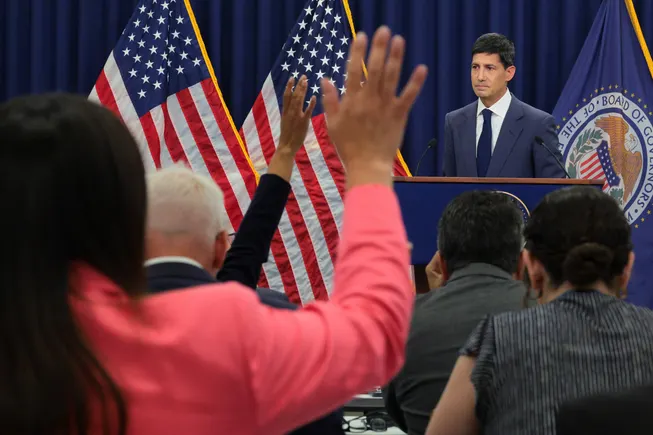
In the halls of the Eccles Building, a new philosophy is taking root. Kevin Warsh, barely nine weeks into his tenure as Chairman of the Federal Reserve, has begun to systematically dismantle the era of "forward guidance" that defined his predecessors. Following the conclusion of the July meeting of the Federal Open Market Committee (FOMC), the message from the central bank was clear: the Fed is stepping back from the microphone to let the markets speak for themselves.
Main Facts: A Pivot Toward Opacity
The most significant takeaway from the July FOMC meeting was not merely the decision to hold interest rates steady, but the deliberate absence of forward guidance in the committee’s post-meeting statement. Under Warsh’s leadership, the Fed has signaled a departure from the practice of providing explicit roadmaps for future monetary policy.
Warsh, who quipped on Wednesday that he has served as chair for exactly "eight weeks and four days," characterized the recent FOMC deliberations as "collegial and constructive." Yet, behind the collegiality lies a profound strategic shift. By withholding detailed forecasts and explicit guidance, the Fed is intentionally increasing its own opacity. The goal, according to Warsh, is to create an environment where investors, traders, and businesses must react directly to raw economic data rather than attempting to decode the nuance of Fed-speak.
"We’re trying not to interfere with that market signal," Warsh explained during the post-meeting press conference. "We want them reacting to events much more directly, which is a good thing."
Chronology of the Warsh Transition
The transition to this new regime has been rapid, marked by several distinct phases since Warsh took the helm:
- Early June: Warsh explicitly committed the Federal Reserve to a path of easing pricing pressures, following data that showed consumer prices cooling to a 3.5% annual rate, down from 4.2% in May.
- Late June: Pre-meeting volatility saw Fed officials like Logan and Hammack publicly discuss the possibility of a rate hike, creating heightened expectations that the Fed might intervene.
- Early July: The Fed announced the creation of five specialized task forces, aimed at scrutinizing everything from balance sheet policy to the systemic impacts of artificial intelligence.
- Mid-July: The FOMC meeting concludes with a hold on interest rates—a decision Warsh later described as "a rigorous review of the economic situation" rather than a final conclusion.
- Late August (Upcoming): The Chairman is scheduled to review progress reports from his five internal task forces ahead of the Jackson Hole Economic Symposium, which will serve as a critical checkpoint for the new leadership’s agenda.
Supporting Data: The Economic Backdrop
While the Fed retreats from its role as an economic forecaster, the hard data remains a source of significant concern. The U.S. economy is currently exhibiting a paradoxical strength: growth continues at a "solid pace," bolstered by robust productivity gains and steady levels of capital investment. Unemployment has remained remarkably stagnant, defying previous expectations of a cooling labor market.
However, the "price stability" mandate—which Warsh refers to as the path to "central bank heaven"—remains elusive. Inflation continues to hover stubbornly above the Fed’s 2% target. A major contributor to this persistence is the volatility in the energy sector. Global markets are currently reeling from supply shocks, exacerbated by the ongoing Iran conflict. On Wednesday alone, Brent crude oil prices surged over 6%, climbing above $89 per barrel and snapping a three-day downward trend. This volatility complicates the Fed’s mandate, as the central bank has little influence over geopolitical supply shocks that drive energy costs higher.
Official Responses and Internal Dynamics
Despite the move to hold rates steady, the FOMC meeting was not without internal friction. While Warsh noted that there was "broad agreement" regarding the overarching goals of the Fed, he acknowledged that there was a clear "lean" among members concerning the tactical execution of policy.
The decision to hold, rather than hike, was a point of contention given the previous warnings from committee members regarding the necessity of a more hawkish stance to combat pricing pressures. Warsh’s response to these critiques was to frame the decision as an iterative process. "It is the beginning, but not the end of the story," he stated, emphasizing that the Fed remains committed to its 2% target, even if the method of achieving that target is currently undergoing a "rigorous review."
Central to this review are the five task forces established under his leadership. These groups are tasked with modernizing the Fed’s internal mechanisms. The task force on monetary policy communications, in particular, is the engine behind the shift toward the current "unfiltered" approach. Meanwhile, the inclusion of an AI-focused task force suggests that Warsh is looking toward the long-term structural changes that technology may impose on the American economy, potentially changing how the Fed measures productivity and labor participation in the years to come.
Implications: A New Era for Markets
The shift in policy has profound implications for Wall Street and the broader business community. For years, markets had become addicted to the "Fed Put"—the expectation that the central bank would intervene to prevent market downturns or provide guidance to soften the blow of economic shifts.
By removing this crutch, Warsh is effectively forcing the market to price risk more accurately. If investors can no longer rely on the Fed to telegraph its next move, they will be forced to pay closer attention to corporate earnings, supply chain data, and geopolitical developments. While this may increase short-term volatility, proponents of the Warsh doctrine argue that it will lead to a more efficient allocation of capital in the long run.
However, the risk of this strategy is significant. In an environment characterized by "supply shocks" and global instability, a central bank that is too quiet may be perceived as a central bank that is out of control. If the economy begins to show signs of a sharper-than-expected downturn, the lack of forward guidance could exacerbate panic, as the market will have no "anchor" provided by the FOMC’s long-term projections.
As the financial world looks toward the August Jackson Hole Symposium, all eyes will be on the Chairman. Will the task forces produce a concrete plan for a new communications framework, or will they simply codify the current state of uncertainty?
For now, Warsh remains steadfast. He views his tenure not as a temporary bridge to the next crisis, but as a fundamental reorientation of the Federal Reserve’s relationship with the American economy. Whether this "direct" and "unfiltered" approach to monetary policy will lead to the promised stability or invite a period of heightened market turbulence remains the defining question of his young chairmanship.
As he prepares for the meetings in late August, Warsh’s message is one of patience. The central bank, he suggests, is moving away from the role of an economic oracle and back toward that of an objective observer—delivering on the remit of price stability, one data point at a time. Whether the markets are ready for such a hands-off approach remains to be seen, but one thing is certain: the era of predictable, guided monetary policy is officially over.
