





In a landscape defined by rapid economic adjustments, legislative maneuvering, and the long-tail recovery of disaster-stricken communities, the pulse of the American industry is beating with unpredictable intensity. This week’s developments span the corridors of insurance boardrooms, the halls of the Pennsylvania State House, and the charred remains of Californian neighborhoods, painting a complex portrait of a nation in flux.
I. Financial Fluctuations: The Q2 Insurance Market Review
The Council of Insurance Agents & Brokers (CIAB) has released its market survey for the second quarter of 2026, revealing a nuanced reality for policyholders and carriers alike. Across all accounts, premiums saw an average decrease of 2%, signaling a cooling period in certain sectors of the commercial insurance market.
The Anatomy of the Decrease
The market’s downward trend was most pronounced in the commercial property sector, which saw premiums drop by an impressive 6.3%. Analysts suggest this is a reactive correction. Carriers, having pushed for significant rate hikes in high-risk lines such as commercial auto and umbrella policies, found themselves with a surplus of property capacity.
In fact, 75% of surveyed brokers reported an increase in available capacity for property insurance. This glut of supply sparked aggressive competition among carriers, who lowered premiums to capture or retain client portfolios. Large accounts saw the most significant relief, with premiums falling by 3.7%, compounding a 2.7% decrease observed in the previous quarter. This shift indicates that while volatility remains, the sheer competitive pressure is beginning to supersede the inflationary trends of the early 2020s.

II. The AI Infrastructure Debate: Pennsylvania’s Regulatory Stance
The rapid expansion of artificial intelligence has created an insatiable demand for data centers, and Pennsylvania has become a focal point for this development. Due to its existing power infrastructure, vast natural gas reserves, and strategic proximity to the dense population centers of the East Coast, the state has become a magnet for tech giants.
Governor Shapiro’s Executive Mandate
Concerned that this growth could come at the cost of the public good, Governor Josh Shapiro has taken decisive action. By signing a new executive order, the Governor has introduced a framework of “strictest protections” to govern the industry.
“I’m using the full weight of my executive authority to block the objectionable, unwarranted projects and put the nation’s strictest set of protections in place,” Shapiro stated during the announcement.
The mandate requires companies to meet stringent environmental and transparency benchmarks. Developers must now secure local community approval, prove that their projects will not cause spikes in local utility rates, and implement safeguards to ensure that clean air and water standards are not compromised. The order effectively shifts the burden of proof onto the developers, ensuring that the march toward an AI-driven future does not trample the interests of Pennsylvanian citizens.

III. Integrity and Oversight: The Mississippi Insurance Crackdown
Regulatory bodies are increasingly vigilant regarding the credentials of those operating within the industry. In Mississippi, Insurance Commissioner Mike Chaney recently spearheaded an operation that stripped 59 insurance producers of their licenses following a discovery of widespread fraudulent reporting.
The Price of Deception
The investigation revealed that these individuals had provided false information regarding their primary residences to secure state licensure. The implications of this are significant, ranging from regulatory non-compliance to potential civil and criminal liability.
“The evidence is clear; these agents don’t live in Mississippi,” Commissioner Chaney stated. “They applied for a license here under false pretenses. To put it simply, they lied, and lying on the application, misrepresenting the facts, leads to losing your license.”
The severity of the response was underscored by the fact that all 59 agents were summoned to a hearing in late July. Their failure to attend the proceedings served as a tacit admission of their inability to substantiate their claims. The move sends a clear signal to the insurance community: state regulatory bodies are utilizing data-matching tools and cross-jurisdictional cooperation to ensure that the individuals selling products are operating in full compliance with the law.

IV. Social Displacement: The Changing Face of the Palisades
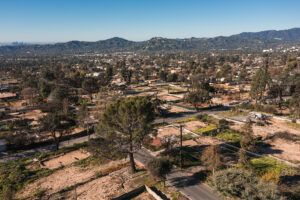
The recovery process following the January 2025 California wildfires has evolved into a study of social and economic displacement. In the Palisades, the path to reconstruction is littered with hurdles that go beyond physical debris.
A Community in Transition
For long-time residents, the tragedy of losing their homes has been compounded by the slow pace of recovery. Data indicates that fewer than one-third of the owners of destroyed homes have managed to secure rebuilding permits, and to date, only 1% of the homes have been completed.
Rich Wilken, a 79-year-old third-generation resident, describes a community that is fundamentally unrecognizable. “It’s gonna be more people with more money,” Wilken noted, recounting an encounter where a local resident complained about their Lamborghini being double-parked. As long-term residents struggle to navigate the permitting process and the rising costs of construction, wealthy investors are swooping in to purchase vacant lots. This “luxury replacement” dynamic is pricing out those who defined the community’s character for decades, leading to a profound sense of loss that insurance settlements alone cannot bridge.
V. The Legal Limbo of Cannabis-Derived Products
In Texas, the hemp industry is grappling with a sudden, sharp reversal of fortune. A legal battle is currently unfolding between hemp advocates and state authorities—including the Department of State Health Services and Attorney General Ken Paxton—over the status of hemp-derived THC products.

Prohibitions and Precedents
The state’s move to reclassify these substances as illegal has been met with immediate litigation from the industry, which argues that the state’s actions violate the 2018 federal farm bill. Sarah Todd, a representative for the Texas Cannabis Policy Center, described the move as a major regression.
“It’s a pretty big blow, and it’s recriminalizing a lot of cannabis products that have been completely legal and allowable in the state for many years,” Todd stated.
A federal judge’s recent decision to deny an emergency motion for a temporary restraining order means that the ban remains in full effect while the litigation proceeds. For businesses across the state, this creates a climate of uncertainty, as inventory is pulled from shelves and the legality of their operations remains in question.
VI. A Masterpiece Returned: The Case of the Milwaukee Picasso
In a rare moment of triumph for the art world, a stolen Picasso print, long thought to be lost to history, has been recovered in Milwaukee, Wisconsin. The piece, a signed print titled “Torero,” was stolen from the gallery of Bill DeLind in 2018.
The Value of a Story
The recovery occurred by chance when a local landlord, cleaning out a vacant apartment, discovered the artwork tucked away. When contacted by the police, DeLind expressed his shock. “When they called me, I was in disbelief,” he said.
The print, one of only 30 known to exist, was appraised at between $35,000 and $50,000 at the time of the theft. While the market value of the piece has remained relatively stable, DeLind suggests that the dramatic backstory of its theft and recovery could potentially elevate its value toward the higher end of that range. This recovery serves as a reminder that even in an era of digital tracking and high-tech security, the most enduring treasures are often found through the diligent work of local authorities and the serendipity of everyday life.
VII. Conclusion: Synthesizing the Trends
The events of the last quarter underscore a common theme: the necessity of robust oversight and the reality of rapid adaptation. From the insurance market’s reaction to property capacity to the legal tug-of-war over cannabis and the environmental regulation of AI infrastructure, the systems governing our society are being tested.
As we look toward the remainder of 2026, the focus will likely remain on how these sectors reconcile their competing interests. Whether it is the restoration of lost homes in California, the maintenance of professional integrity in Mississippi, or the balancing of innovation with regulation in Pennsylvania, the common thread is the need for transparency, accountability, and the resilience to weather periods of significant change. The landscape is not static; it is being written by these very decisions, and the implications will be felt for years to come.
