





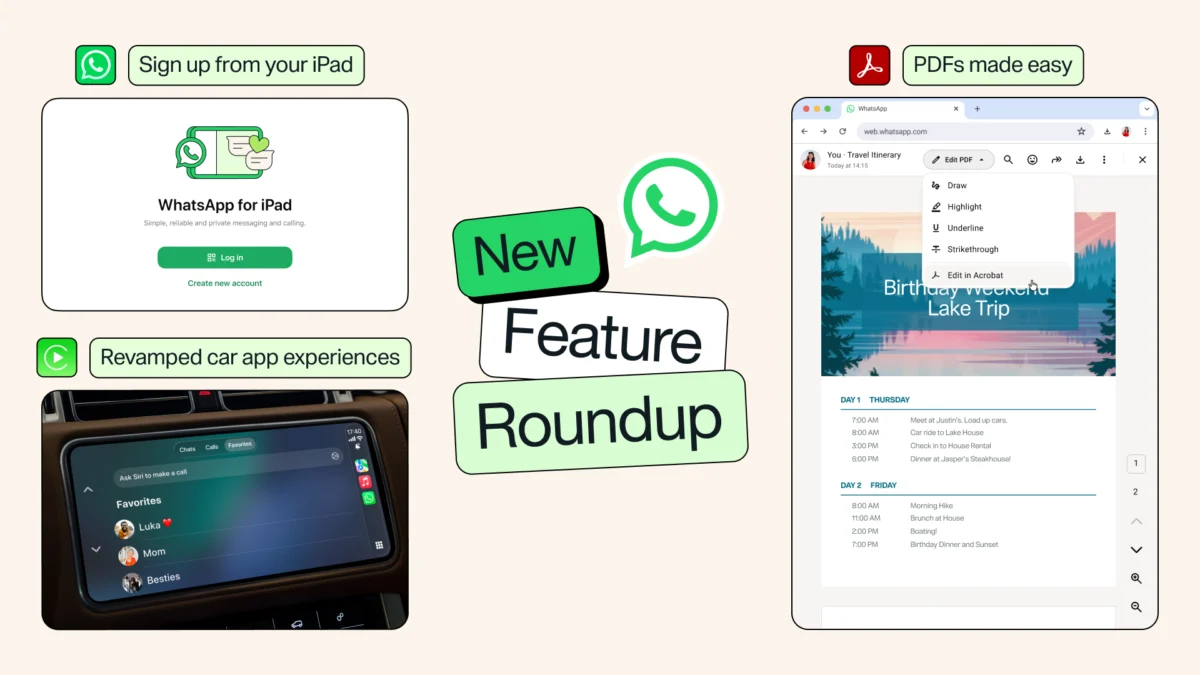
Meta-owned messaging giant WhatsApp has announced a sweeping suite of new features designed to transition the platform from a mobile-centric messaging application into a comprehensive, cross-device communications ecosystem. The updates, which began rolling out globally on Wednesday, introduce a highly anticipated standalone registration process for iPad users, a modernized experience for Apple CarPlay and Android Auto, in-app PDF annotation, and social music-sharing capabilities.
This aggressive feature expansion underscores Meta’s broader strategic objective: transforming WhatsApp from a utility tied to a single smartphone into an omnipresent, platform-agnostic communication hub capable of operating seamlessly across desktops, tablets, vehicles, and wearable devices.
Main Facts: The New Feature Suite
The latest update addresses several long-standing user requests while simultaneously expanding the application’s utility in productivity and automotive environments. The core updates are divided into four primary areas:
1. Standalone iPad Registration
Since WhatsApp launched its dedicated iPad client last year, users have been required to link the tablet app to an active account on a primary smartphone using a QR code. Under the new update, users can register for a brand-new WhatsApp account directly from their iPad.
While a phone number is still required to receive the initial SMS one-time passcode (OTP) for identity verification, the iPad application can now function as a standalone primary account. This means it operates independently of a smartphone, rather than as a secondary "companion" device.
2. Next-Generation CarPlay and Android Auto Integration
While WhatsApp previously offered basic integration with vehicle infotainment systems, its functionality was heavily restricted. Drivers could only dictate new messages or initiate voice calls through Siri or Google Assistant.
The revamped automotive experience drastically expands this interface. Users can now:
- Listen to incoming messages and reply hands-free through a more responsive voice UI.
- View and navigate their call history directly on the vehicle’s dashboard display.
- Access their curated "Favorite" contacts list to quickly initiate communication without taking their eyes off the road.
+-------------------------------------------------------------+
|               WHATSAPP AUTOMOTIVE EVOLUTION                 |
+------------------------------+------------------------------+
|      PREVIOUS LIMITATIONS    |         NEW FEATURES         |
+------------------------------+------------------------------+
| • Basic voice dictation      | • Hands-free message replies |
| • Simple outgoing calls      | • Direct dashboard UI access |
|                              | • Full call history logs     |
|                              | • "Favorite" contacts list   |
+------------------------------+------------------------------+
3. Native PDF Viewing and Annotation
Aimed at business professionals and remote workers, WhatsApp is rolling out native PDF support for its web and desktop applications. Previously, receiving a PDF required downloading the document to local storage and opening it via third-party software.
The new system allows users to open PDFs directly within the WhatsApp chat interface. Once open, users can perform lightweight edits, such as highlighting text, drawing, and adding annotations, before saving or sending the modified document back into the thread.
4. Status Music Integration
To boost user engagement and self-expression, WhatsApp has integrated with major audio streaming services, specifically Apple Music and Spotify. Users can now share songs directly from these external platforms to their WhatsApp Status, displaying the track details and allowing contacts to listen to a preview or jump directly to the song in their respective music apps.
Chronology: Tracing WhatsApp’s Rapid Development Cycle
The features announced this week represent the culmination of a rapid, multi-month development push by Meta to modernize WhatsApp’s underlying architecture and monetization strategies.
  May 2026                     June 2026                    July 2026 (Present)
+---------------------------+ +---------------------------+ +---------------------------+
| Launch of Meta Premium    | | Release of Usernames      | | Standalone iPad Sign-up   |
| Subscriptions             | | to protect phone numbers  | | CarPlay/Android Auto UI   |
| ("WhatsApp Plus")         | |                           | | Native PDF Editing        |
+---------------------------+ +---------------------------+ +---------------------------+- Late May 2026: Meta officially launched subscription plans for its core family of apps, including "WhatsApp Plus." This tier introduced premium features such as advanced profile customization, super reactions, and deep story insights.
- Late June 2026: WhatsApp introduced the "Usernames" feature. This privacy-centric update allowed users to reserve unique handles, enabling them to connect with others without disclosing their private phone numbers—a move critical for scaling the platform’s social and marketplace capabilities.
- July 2026 (Present): The platform rolls out standalone iPad onboarding, native PDF productivity tools, expanded automotive integrations, and music sharing on Status.
Supporting Data: The Shift to Ubiquitous Communication
Meta’s aggressive diversification of WhatsApp’s platform footprint is backed by shifting consumer habits and market data.
- Multi-Device Proliferation: According to consumer technology reports, the average household in Western markets now active-uses more than six connected devices daily. Relying on a single smartphone as the sole anchor for a communications profile has become an operational bottleneck for users who transition between laptops, tablets, and smart car interfaces throughout the day.
- The Automotive Tech Landscape: Data from the automotive sector shows that over 80% of new car buyers consider Apple CarPlay and Android Auto compatibility a non-negotiable feature. By deepening its integration within these operating systems, WhatsApp secures its position as the default communication standard for drivers, neutralizing competition from native carrier SMS and Apple’s iMessage.
- The Status Feature’s Scale: Despite being viewed by some as secondary to Instagram Stories, WhatsApp Status is used by over 450 million active users daily. Integrating music sharing with industry leaders Spotify and Apple Music leverages this massive scale, driving higher daily engagement and keeping users within the Meta ecosystem longer.
Official Responses and Corporate Philosophy
WhatsApp’s leadership has framed these updates as a natural evolution toward a highly flexible, user-centric communication model.
In a statement explaining the rationale behind the Status music-sharing feature, a WhatsApp spokesperson remarked:
"Our goal is to provide users with more dynamic, personal ways to express themselves. Allowing direct sharing from Spotify and Apple Music to WhatsApp Status makes the sharing experience more seamless, unique, and reflective of our users’ daily lives."
Addressing the technical shift regarding the iPad app, a WhatsApp spokesperson confirmed to TechCrunch that the change represents a fundamental shift in how the platform manages identity:
"While users still need an active phone number to receive the initial one-time passcode for registration, once verified, the iPad application operates as an entirely standalone account. It is no longer tethered to or dependent on a primary smartphone companion device."
Implications: Reshaping the Messaging Market
The strategic rollout of these features carries profound implications for the competitive landscape, security standards, and Meta’s long-term monetization strategies.
Competitive Pressure on iMessage and Telegram
By launching a standalone iPad app that does not require a linked phone, WhatsApp directly challenges Apple’s native iMessage ecosystem, which has long enjoyed a monopoly on tablet-based messaging among iOS users. Furthermore, the introduction of usernames and standalone tablet apps brings WhatsApp to functional parity with Telegram, which has traditionally been favored by users seeking multi-device flexibility and phone number privacy.
+-----------------------------------------------------------------------+
|                 CROSS-PLATFORM COMPETITIVE LANDSCAPE                  |
+-----------------------+-----------------------+-----------------------+
| FEATURE               | WHATSAPP              | APPLE iMESSAGE        |
+-----------------------+-----------------------+-----------------------+
| Standalone iPad App   | Yes (with SMS OTP)    | Yes (via Apple ID)    |
| CarPlay/Android Auto  | Dual Platform Support | iOS Only              |
| Cross-Platform Sync   | iOS, Android, Web, PC | Apple Devices Only    |
| Document Annotation   | Native (Web/Desktop)  | Basic Markup          |
+-----------------------+-----------------------+-----------------------+
Security, Privacy, and Multi-Device Challenges
Maintaining end-to-end encryption (E2EE) across multiple standalone devices has historically been a significant engineering hurdle. WhatsApp’s transition to standalone iPad accounts indicates that Meta has successfully scaled its proprietary multi-device encryption protocol. This architecture allows each device to maintain its own cryptographic keys, ensuring that communication remains private and secure without relying on a central smartphone to decrypt messages.
Enterprise and Monetization Horizons
The inclusion of native PDF editing on Web and Desktop is a clear nod to WhatsApp’s growing role in business communications. Especially in regions across Europe, Latin America, and Asia-Pacific, WhatsApp is the primary medium for business-to-consumer (B2C) and business-to-business (B2B) transactions. Enabling lightweight document annotation directly within the chat window streamlines operations for small businesses, making the platform an indispensable utility.
Furthermore, these high-utility updates build a compelling value proposition for Meta’s newly launched subscription tiers. As users begin to rely on WhatsApp for productivity, driving, and social sharing, the incentive to upgrade to premium tiers like "WhatsApp Plus" for advanced customization and analytics grows significantly. By continuously raising the baseline of its free app, Meta is solidifying the foundation of its next major monetization engine.
