



For generations, the path to automotive enthusiasm has been paved with plastic bricks, die-cast metal, and the occasional grease-stained afternoon in a family garage. While modern toys like LEGO Speed Champions or high-fidelity die-cast models capture the aesthetic allure of performance machines, they often leave the actual "how" of automotive engineering hidden behind static, non-functional shells.
Thames & Kosmos, a company long established as a titan in the educational toy sector, has bridged this divide with its latest offering: the V8 Race Car model kit. This isn’t merely a display piece for a shelf; it is a fully functional, transparent mechanical laboratory designed to demystify the internal combustion engine, the manual transmission, and the complex geometry of a racing suspension. At a retail price point of $39.95, it stands as a compelling, budget-conscious alternative to hobby-grade model kits, offering a tangible lesson in mechanical physics that few other consumer products can match.
The Core Specs: A Miniature Engineering Marvel
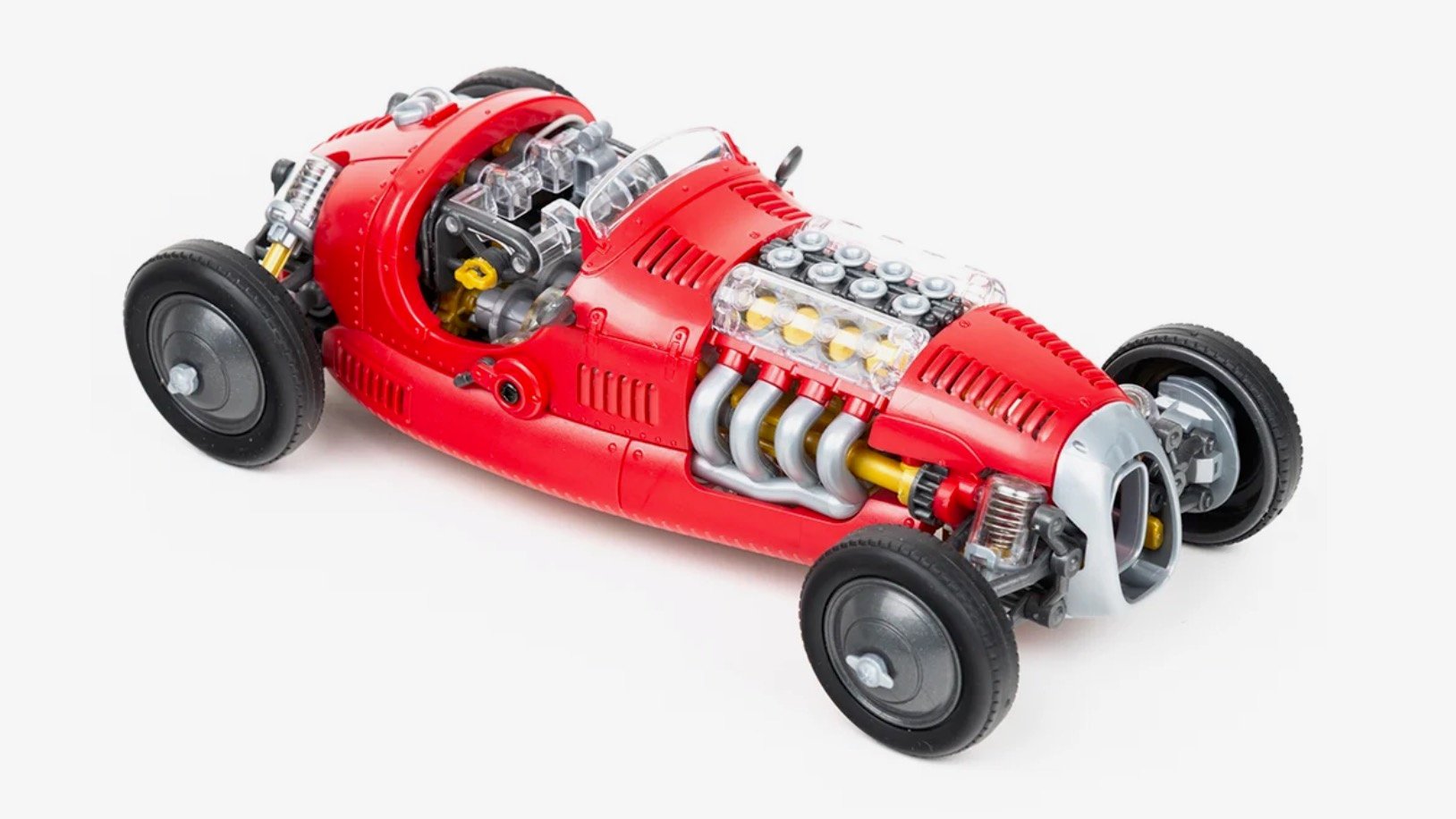
At the heart of the Thames & Kosmos V8 Race Car is a commitment to functional accuracy. Comprising 233 individual components, the kit allows builders to assemble a scale replica of a prewar Grand Prix-style racer. The "cigar-on-wheels" design is more than just a stylistic nod to automotive history; it serves as a minimalist canvas that allows the internal mechanics to remain the center of attention.
The Mechanical Breakdown:
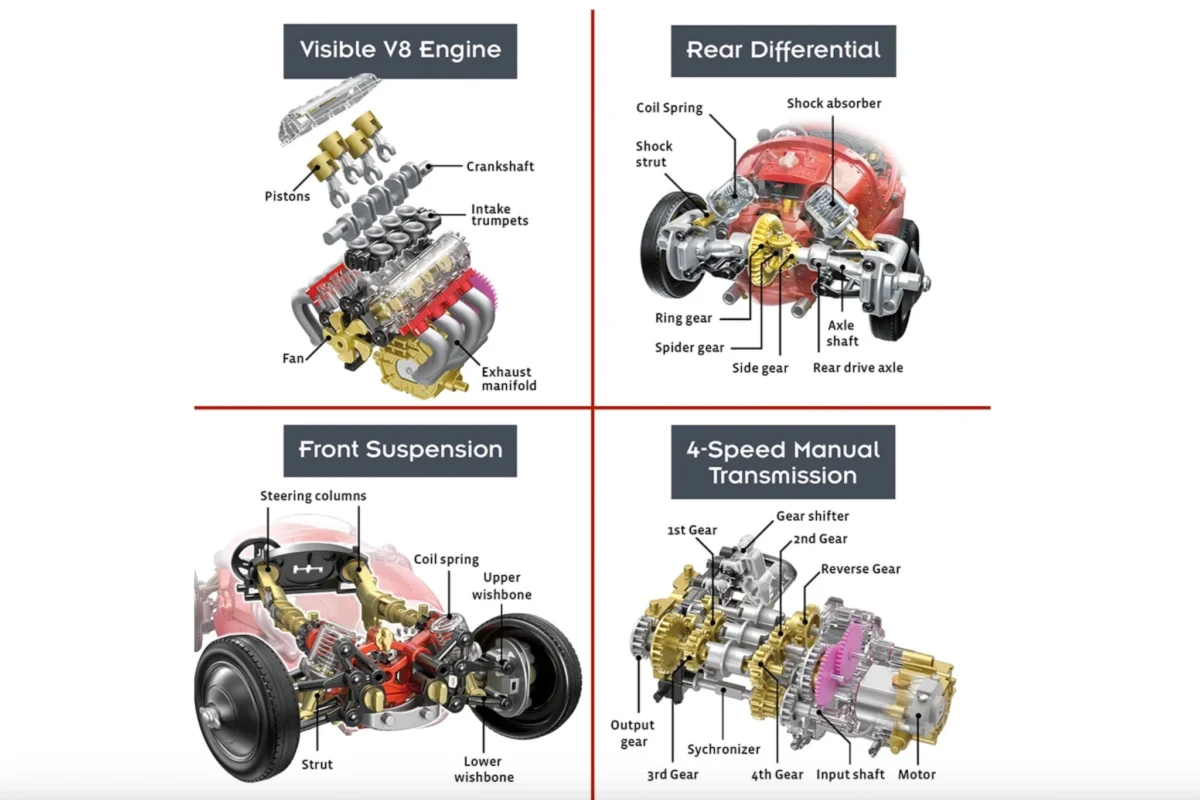
- The Powerplant: The model features a transparent V8 engine block, allowing users to observe the synchronized dance of the pistons and the rotation of the crankshaft.
- The Drivetrain: Perhaps the most impressive feature is the four-speed manual transmission. Builders install miniature gears, synchronizers, and shafts, culminating in a working shifter that allows the user to manually cycle through gears while the assembly is in motion.
- The Driveline: Power is transferred through a functioning differential—a rarity in kits at this price point—complete with ring and spider gears that split power to the axle shafts.
- The Suspension: The model utilizes a double-wishbone suspension system equipped with actual coil springs, providing a clear demonstration of how weight transfer and road irregularities are managed in a racing environment.
The entire assembly is brought to life by an integrated electric motor, powered by two AAA batteries. This motor mimics the output of an engine, driving the input shaft and allowing the builder to witness the entire drivetrain sequence from the engine, through the transmission, and out to the wheels.
A Chronology of Educational Play
The evolution of the "model car" as an educational tool has seen a fascinating trajectory. In the mid-20th century, plastic model kits (often referred to as "glue-together" models) were the gold standard. While they required significant dexterity and patience, they were almost entirely static.
With the advent of the 21st century, companies like LEGO revolutionized the market with Technic lines, which introduced basic mechanical movement. However, these sets often prioritize artistic form over engineering function. Thames & Kosmos has carved out a unique niche by focusing on "STEM-first" architecture.
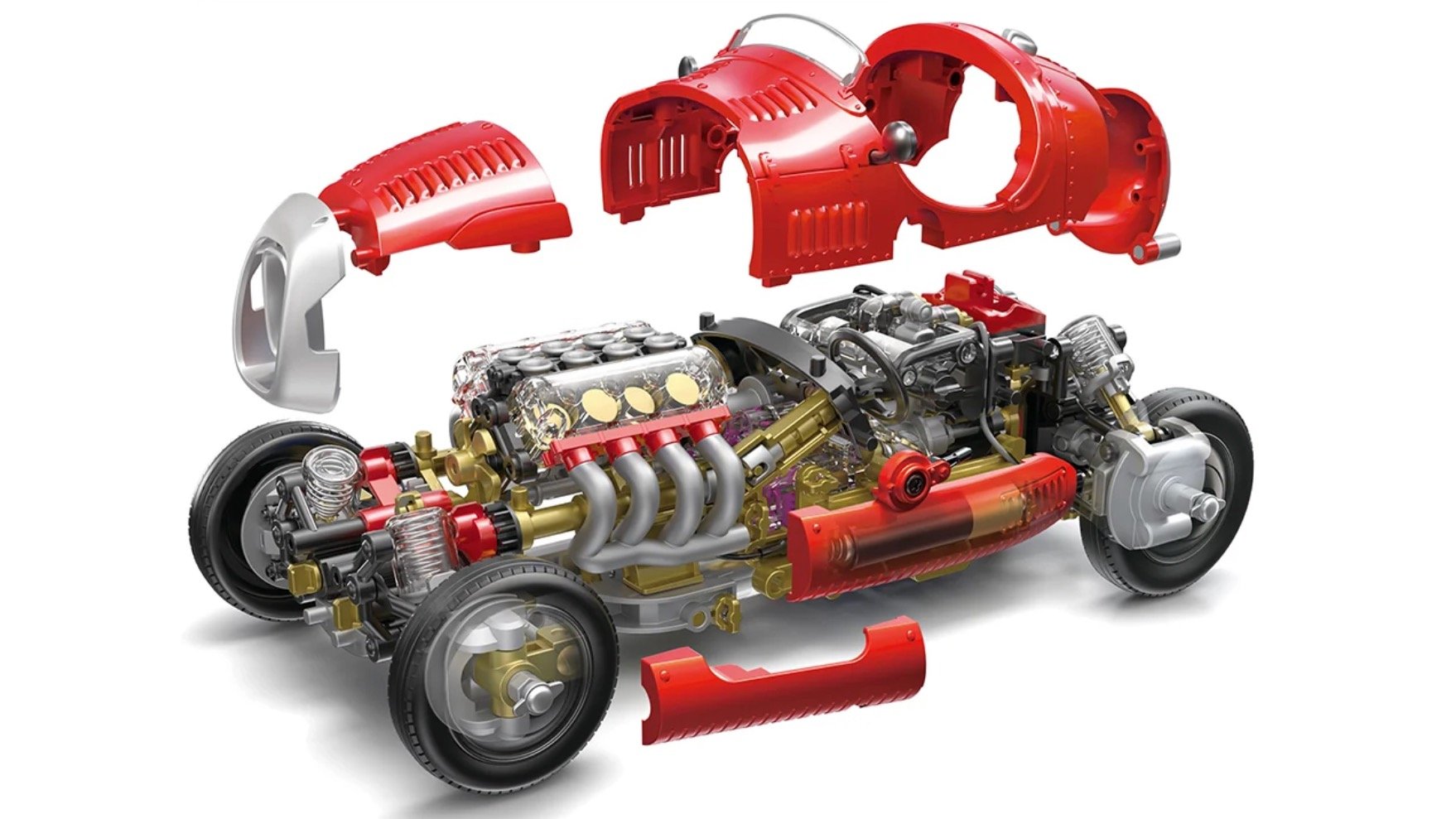
The development of this V8 kit represents a culmination of years of feedback from educators and parents seeking to pivot away from passive screen-time toward tactile learning. By choosing the classic "open-wheel" race car silhouette, the designers ensured that the components remain visible from every angle. This design choice is critical; it eliminates the "black box" nature of most toys, forcing the builder to understand the spatial relationship between the transmission shafts and the drive axles as they assemble them.
Supporting Data: The Case for Tactile Learning
Educational psychology consistently demonstrates that "learning by doing" creates stronger cognitive retention than visual or auditory instruction alone. According to studies on STEM integration in primary and secondary education, students who engage with physical models of complex systems develop a deeper "mental map" of mechanical principles.
Key Learning Outcomes:
- Kinetic Energy Transfer: By observing the transition of energy from the electric motor to the drivetrain, students grasp the concept of rotational force.
- Gear Ratios: The four-speed transmission serves as a perfect, low-stakes introduction to the concept of torque versus speed. As the user shifts gears, the change in output speed relative to the motor input becomes visually intuitive.
- Mechanical Advantage: The double-wishbone suspension provides a tactile demonstration of how geometry can stabilize a vehicle.
- Spatial Reasoning: With 233 parts, the assembly process acts as a rigorous exercise in following technical diagrams and understanding 3D spatial alignment.
The accompanying 40-page manual is not merely a list of assembly steps; it serves as a textbook for the kit. It defines the vocabulary of the automotive world—terms like "differential," "synchronizer," and "wishbone"—and places them within the context of the user’s build. This integration of theoretical explanation with hands-on practice is what elevates the product from a "toy" to a "learning system."
The Manufacturer’s Perspective: Bridging the Gap
Thames & Kosmos has built its reputation on the idea that play should be an active, inquisitive process. In an era where vehicle technology is moving toward electrification and autonomous systems, there is a growing concern among automotive enthusiasts and educators alike that the "mechanical soul" of the car is being lost.
By focusing on the V8 engine and the manual transmission, Thames & Kosmos is preserving the legacy of internal combustion. For many children, this kit will be their first exposure to the mechanics that have defined the last century of human mobility. The ability to swap the steering wheel from left to right further emphasizes the global nature of automotive design, teaching kids that engineering is a universal language.
Implications: The Future of Mechanical Literacy
The rise of high-quality educational kits like the V8 Race Car has significant implications for the future of the automotive workforce and enthusiast culture.
Cultivating the Next Generation of Engineers
We are currently facing a global skills gap in engineering and precision manufacturing. While a plastic model kit will not turn a 10-year-old into a master mechanic overnight, it does something equally important: it fosters a "can-do" attitude toward complex machinery. A child who has successfully assembled a working differential is significantly less intimidated by the prospect of working on a real car later in life.
The "Analog" Counter-Movement
In a world dominated by digital simulation—from racing video games to VR driving experiences—there is a growing desire for the "analog" experience. Video games are exceptional at simulating the sensation of driving, but they fail to convey the physicality of a car. By combining the digital-age interest in cars (often sparked by games) with the analog assembly of a physical kit, parents can help children build a bridge between their screen-based hobbies and the real world.
Accessibility and Inclusion
At $39.95, the kit is positioned in a "sweet spot" of the toy market. It is accessible enough to be a birthday gift or a weekend project, yet robust enough to offer a genuine educational return on investment. By removing the financial barrier to entry that often surrounds high-end robotics or complex engineering kits, Thames & Kosmos ensures that mechanical literacy is available to a wider demographic.
Conclusion: More Than Just a Model
The Thames & Kosmos V8 Race Car is more than just a distraction for a rainy afternoon. It is a sophisticated pedagogical tool wrapped in the exciting, high-octane aesthetic of motorsport. It challenges the builder to think critically, to work with precision, and to appreciate the invisible choreography of parts that happens every time a driver touches the accelerator.
In a household where floors are already littered with LEGO bricks and Hot Wheels, this kit serves as the "next step" in a young enthusiast’s journey. It rewards curiosity, demands patience, and delivers the satisfaction of seeing a machine come to life under one’s own hands. Whether intended for a budding engineer or a nostalgic gearhead, this kit succeeds in proving that the most engaging technology is often the kind you can hold, assemble, and watch run in the palm of your hand.
As we look toward an automotive future that is increasingly automated and digital, the importance of these tactile, mechanical lessons cannot be overstated. They ensure that even as the technology changes, the fundamental appreciation for how things work remains firmly in the driver’s seat.
