





As extreme weather events become a permanent, accelerating feature of the global landscape, municipalities across the United States are facing a daunting reality: the infrastructure of the 20th century is increasingly ill-equipped for the climate of the 21st. From record-shattering heatwaves to catastrophic flooding, the pressure on local governments to protect residents and critical assets has never been higher.
However, a recent expert panel hosted by Clark University highlighted a systemic challenge that threatens to leave vulnerable communities behind: the "resilience gap." While the necessity for action is universal, the capacity to fund and execute complex climate projects is not. As federal aid packages from the Biden era begin to sunset, cities are finding themselves in a precarious position, forced to innovate or risk being overwhelmed by the costs of inaction.
The Anatomy of the Resilience Gap
The fundamental problem facing modern cities is not necessarily a lack of knowledge, but a lack of administrative and fiscal "muscle." According to Mark Davidson, a geography professor at Clark University’s School of Climate, Environment, and Society, the resilience gap is as much a capacity issue as it is a planning one.
“Municipalities understand what needs to be done,” Davidson explained during the panel. “The harder question for them is: How do we act on what we know at this stage? How do we get the capacity?”
The data supports this assessment. A recent survey conducted by the National League of Cities revealed that 84% of municipalities report insufficient capital budgets to meet their climate goals. Furthermore, 81% are currently scrambling to rethink their infrastructure investment strategies as the window for federal stimulus funding closes. The core issue, Davidson argues, is the reliance on temporary, competitive grant funding to solve permanent, systemic problems.
The Paradox of Competition
The current model for distributing federal and state climate aid often relies on competitive grant programs. While intended to foster innovation, these programs inherently favor cities that already possess specialized staff, legal expertise, and matching funds.
“You need staff time, you need expertise,” Davidson noted. “Sometimes you need matching funding, and that’s a paradox. So, cities often need to compete with one another to win the money to create capacity. Consequently, those with capacity already have a built-in advantage, leaving under-resourced localities behind.”
To overcome this, experts suggest that cities must pivot toward collaborative models, sharing expertise not only with each other but with academic institutions, private firms, and regional networks like ICLEI—Local Governments for Sustainability.
Chronology: A New Paradigm for Municipal Action
The evolution of local climate response has shifted from reactive disaster management to proactive, long-term resilience planning.
- Early 2000s: Climate adaptation was largely siloed, focused on minor emergency preparedness rather than infrastructure overhauls.
- 2020–2023: A surge in federal funding provided a temporary lifeline, allowing cities to launch large-scale climate studies and initial mitigation projects.
- 2024: The "Resilience Pivot." As federal funding streams tighten, cities like Riverside, California, and states like Massachusetts have begun building permanent financing vehicles and "layered" policy programs to ensure sustainability beyond the initial influx of cash.
Supporting Data: The Fiscal Reality of Climate Change
The scale of the investment required is staggering. In Massachusetts, for example, the Office of Climate Innovation and Resilience conducted an exhaustive analysis to determine the cost of future-proofing the state. The results were sobering: between $90 billion and $130 billion will be required by 2050 to address high-hazard dams, coastal infrastructure, and the protection of natural buffers like wetlands and forests.
For smaller or lower-income municipalities, these numbers are often insurmountable without a fundamental shift in how resilience is financed. The reliance on simple subsidies is no longer viable. Instead, experts point to a three-pronged strategy that emphasizes layered programming, innovative financing, and deep community integration.
Official Responses and Strategic Solutions
1. The "Layered" Program Approach: The Case of Riverside
Riverside, California, serves as a blueprint for how cities can combat extreme heat and wildfire risk simultaneously. In 2024, the city endured 79 days where temperatures exceeded 95°F—a 65% increase since 2003—with peaks hitting 115°F.
Mayor Patricia Lock Dawson explained that Riverside manages this by "stacking" programs. Rather than treating heat as a singular issue, the city integrates it into everything from emergency management to neighborhood development.
- Ready Riverside: A comprehensive communication campaign launched by the Fire Department’s Office of Emergency Management to educate residents on extreme heat safety.
- Data-Driven Planning: By utilizing a community engagement map to track tree canopies, the city successfully secured California Transformative Communities grants. This enabled the planting of 1,000 new trees and the installation of solar panels on 100 homes in a single neighborhood, directly mitigating urban heat islands while providing clean energy.
“Despite the federal government stepping back, the work continues,” Mayor Dawson stated. “It has to.”
2. Building New Financing Infrastructure
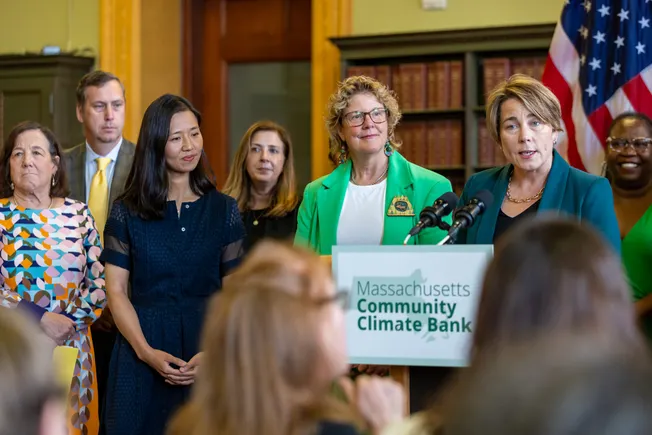
In Massachusetts, the state government is moving away from the "subsidy-only" mindset. Chief Climate Officer Melissa Hoffer has championed the creation of the Massachusetts Community Climate Bank, which provides low-interest financing for retrofitting affordable housing.
Furthermore, the proposed "Mass Ready Act" seeks to establish a permanent revolving fund for resilience. Unlike traditional grants, a revolving fund allows the state to recycle capital, financing low-interest loans for resilience projects that wouldn’t otherwise qualify for federal disaster relief. This shift is echoed at the national level, where organizations like ICLEI USA are training local governments to speak the language of private investors, framing climate risk reduction as a tangible asset that can attract private capital.
3. Structural Community Engagement
Perhaps the most significant shift in modern resilience strategy is the move away from "consultation" toward "co-governance."
Saharnaz Mirzazad, executive director of ICLEI USA, argues that community engagement should be a structural requirement, not an afterthought. For major infrastructure projects, Mirzazad recommends establishing local governance bodies that have a direct role in prioritizing spending and maintenance.
Riverside followed this model closely, gathering over 4,000 comments through 36 separate events to draft their climate adaptation plan. By involving the public from the inception of the project, cities ensure that the infrastructure reflects the actual needs of the people, fostering both higher community satisfaction and greater long-term political accountability.
Implications for the Future
The path forward for American cities is fraught with difficulty, but it is also a period of profound ingenuity. As federal budgets become more volatile, the cities that thrive will be those that view climate resilience not as a series of one-off projects, but as a permanent, integral component of their fiscal and operational identity.
The "resilience gap" remains a significant threat to social and economic equity. Without intentional policy interventions to provide technical and financial assistance to smaller, less-resourced municipalities, the divide between climate-ready cities and those left vulnerable will continue to widen.
However, the strategies highlighted by experts—leveraging regional networks, creating revolving financing funds, and embedding community voices into the design process—offer a robust roadmap. By shifting the focus from "competing for capacity" to "collaborating for sustainability," cities can build the infrastructure necessary to endure an era of extreme weather. The message from the experts is clear: the era of relying on outside intervention is ending; the era of localized, systemic, and community-driven resilience must begin in earnest.
