





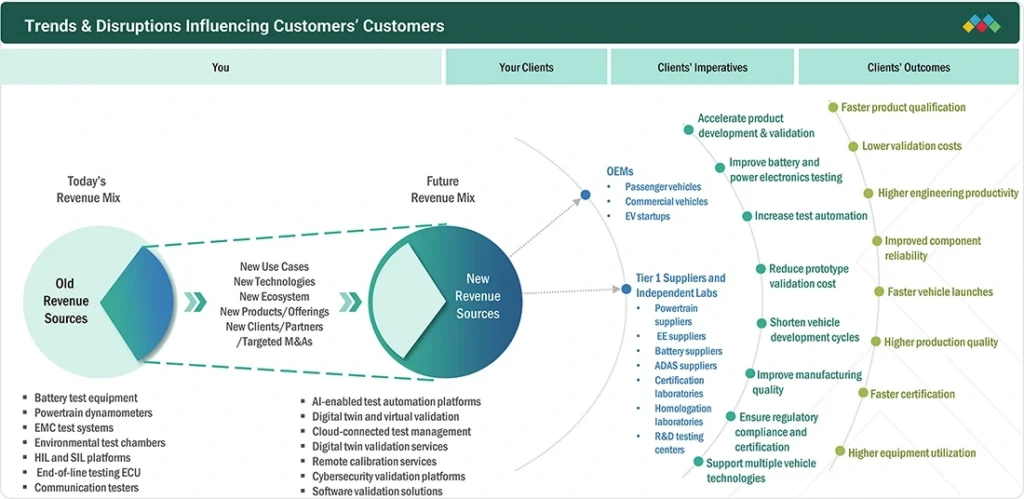
The global automotive landscape is currently undergoing its most significant transformation since the invention of the assembly line. As the industry pivots aggressively toward electrification, autonomous driving, and increasingly complex software-defined vehicles, the infrastructure required to validate these technologies is evolving in lockstep. According to the latest comprehensive analysis from MarketsandMarkets, the global automotive test equipment market is projected to surge from US$4.47 billion in 2026 to US$5.92 billion by 2033.
This expansion is not merely a reflection of increased vehicle production; it is a direct consequence of the escalating complexity of vehicle architectures. As cars evolve into "computers on wheels," the necessity for precision, reliability, and safety testing has moved to the forefront of manufacturing and research and development (R&D) strategies.
The Core Drivers of Market Evolution
The shift in the automotive test equipment sector is being propelled by a convergence of three primary forces: the rapid adoption of electric vehicles (EVs), the integration of advanced driver-assistance systems (ADAS), and the tightening of global regulatory frameworks regarding emissions and safety.
Electrification and Propulsion Shifts
As manufacturers transition from internal combustion engines (ICE) to battery electric vehicles (BEVs) and hybrids, the fundamental testing requirements have shifted. The traditional focus on mechanical durability has been supplanted by the need to test high-voltage battery management systems, power inverters, and electric motor performance. This transition has necessitated a massive capital investment in specialized test beds that can simulate real-world charging cycles, thermal management, and electrical load balancing.
Software Complexity and ADAS
Modern vehicles now contain millions of lines of code. The integration of sensors, cameras, and LiDAR for ADAS requires a new generation of hardware-in-the-loop (HIL) and software-in-the-loop (SIL) testing. Manufacturers must now validate not only the physical components of a vehicle but also the decision-making algorithms that govern autonomous features.
Regulatory Pressure
Governments worldwide, particularly in Europe and parts of Asia, are implementing stricter standards for vehicle safety and environmental performance. These mandates require exhaustive end-of-line testing, forcing OEMs to modernize their assembly lines to ensure every vehicle meets stringent compliance benchmarks before leaving the factory.
Chronology: A Trajectory of Technological Investment
The decade leading up to 2033 represents a critical period of transition for automotive testing facilities.
- 2026 (The Baseline): The market stands at US$4.47 billion. At this juncture, the focus remains on the co-existence of legacy ICE testing and the early-stage scaling of dedicated EV propulsion test systems.
- 2026–2029 (The Transition Phase): Increased adoption of EVs forces major OEMs to retool assembly plants. R&D centers begin a massive shift, prioritizing the development of battery-specific test equipment.
- 2030 (The R&D Milestone): R&D centers are projected to represent more than US$1.4 billion of the total market, as the industry races to refine autonomous driving technologies and next-generation solid-state battery testing.
- 2031–2033 (The Maturity Phase): With EV and ADAS technologies reaching higher levels of market saturation, testing demand shifts toward efficiency and high-speed validation, bringing the market to an estimated valuation of US$5.92 billion.
Supporting Data: Segmenting the Growth
The MarketsandMarkets report provides a granular view of where capital will be deployed within the automotive testing ecosystem.

Equipment Type Breakdown
The diversification of testing hardware reflects the technological heterogeneity of the modern vehicle fleet:
- Chassis Dynamometers: Projected to grow from US$0.57 billion in 2026 to US$0.71 billion by 2033. These remain essential for evaluating vehicle performance and emissions under controlled, simulated driving conditions.
- Engine Dynamometers: Expected to rise from US$0.42 billion to US$0.53 billion. While ICE usage may decline, the growth here is supported by the continued development of high-efficiency hybrid powertrains.
- Battery and E-Motor Test Systems: The clear leader in growth, these systems are forecast to reach a valuation of US$1.12 billion by 2033. This reflects the intense R&D focus on propulsion systems that define the competitiveness of new EV models.
Vehicle and Technology Segments
Passenger cars will remain the dominant force, accounting for over 60% of total demand in 2026. However, the internal growth rates of specific technology segments tell the story of the industry’s future:
- EV Propulsion Systems: Forecast at a 7.7% CAGR through 2033.
- ADAS Testing Systems: Projected at a 6.3% CAGR, driven by the proliferation of sensor-laden vehicles entering the mass market.
Regional Dynamics: The Global Powerhouse
Geography plays a significant role in the distribution of this growth. The Asia Pacific region is set to command the largest share of demand throughout the forecast period. This is largely attributed to the aggressive production targets in China, India, and Southeast Asia, where local OEMs and global manufacturers are scaling up capacity to meet both domestic demand and export goals.
Europe, meanwhile, maintains a steady growth rate. The continent’s stringent emissions standards and robust EV development subsidies serve as a constant catalyst for equipment upgrades. European manufacturers, often early adopters of high-end testing automation, are focusing heavily on integrating environmental and safety validation into their existing manufacturing lines.
Industry Perspectives: The Role of Key Players
The supply side of this market is dominated by global engineering heavyweights. Companies such as AVL, HORIBA, National Instruments, Dürr AG, and Bosch serve as the backbone of the industry. These organizations are not merely vendors; they are strategic partners that enable OEMs to meet tight launch windows.
Industry analysts suggest that the competitive advantage for these suppliers lies in their ability to offer "turnkey" testing solutions. Rather than providing isolated hardware, the market is demanding integrated ecosystems—software that connects seamlessly with hardware, providing real-time data analytics. This allows manufacturers to reduce the "time-to-market" for new models, a critical metric in an industry where speed is a currency.
Implications: The Future of the Automotive Factory
The findings from the report carry profound implications for the automotive sector.
1. The Rise of the "Smart Factory"
OEM assembly plants are increasingly becoming the primary drivers of testing demand. As automation becomes ubiquitous, end-of-line testing is no longer a final check but a continuous process. Every vehicle must be scanned, validated, and calibrated as it moves through the production line, ensuring that software updates and hardware configurations are perfectly synchronized.

2. Talent and Skill Acquisition
The shift toward sophisticated test equipment creates a vacuum for skilled labor. Testing modern vehicles requires a workforce that understands mechanical engineering, electrical systems, and software diagnostics. Manufacturers and testing firms will need to invest heavily in training programs to ensure they have the expertise to operate the high-tech equipment being deployed.
3. Sustainability and Resource Efficiency
While the testing equipment itself contributes to the development of greener vehicles, the manufacturing of this equipment must also align with global sustainability goals. Suppliers are now being tasked with developing energy-efficient testing chambers that minimize the carbon footprint of the testing process itself.
4. Strategic Outsourcing
With the cost of testing infrastructure rising, many smaller OEMs and Tier-1 suppliers may pivot toward outsourcing their testing requirements to independent, state-of-the-art facilities. This "testing-as-a-service" model could become a significant sub-segment of the market, allowing firms to validate new technology without the prohibitive capital expenditure of building proprietary test labs.
Conclusion: A High-Stakes Race for Validation
As we look toward 2033, the automotive test equipment market serves as a bellwether for the broader industry. The movement from US$4.47 billion to US$5.92 billion is a testament to the fact that the "future of mobility" is not just about the vehicle itself, but the rigors of the process used to bring it to life.
For the players involved—from the engineers at AVL and Bosch to the production line managers in the Asia Pacific—the challenge is clear: build systems that are fast enough to keep pace with rapid innovation, accurate enough to meet extreme safety standards, and flexible enough to accommodate a constantly shifting technological landscape. The race is on, and in the world of automotive testing, precision is the only path to the finish line.
For further insights and a detailed breakdown of the data, the full report can be accessed via MarketsandMarkets.
