





Introduction
For over a century, aviation has been bound by a fundamental physical constraint: the weight-to-energy ratio. Whether powered by aviation turbine fuel, heavy lithium-ion batteries, or hydrogen fuel cells, aircraft must carry their source of propulsion with them, limiting their time aloft to hours or, in extreme cases, days.
Now, a Bengaluru-based aerospace startup is attempting to shatter this paradigm by looking to nature.
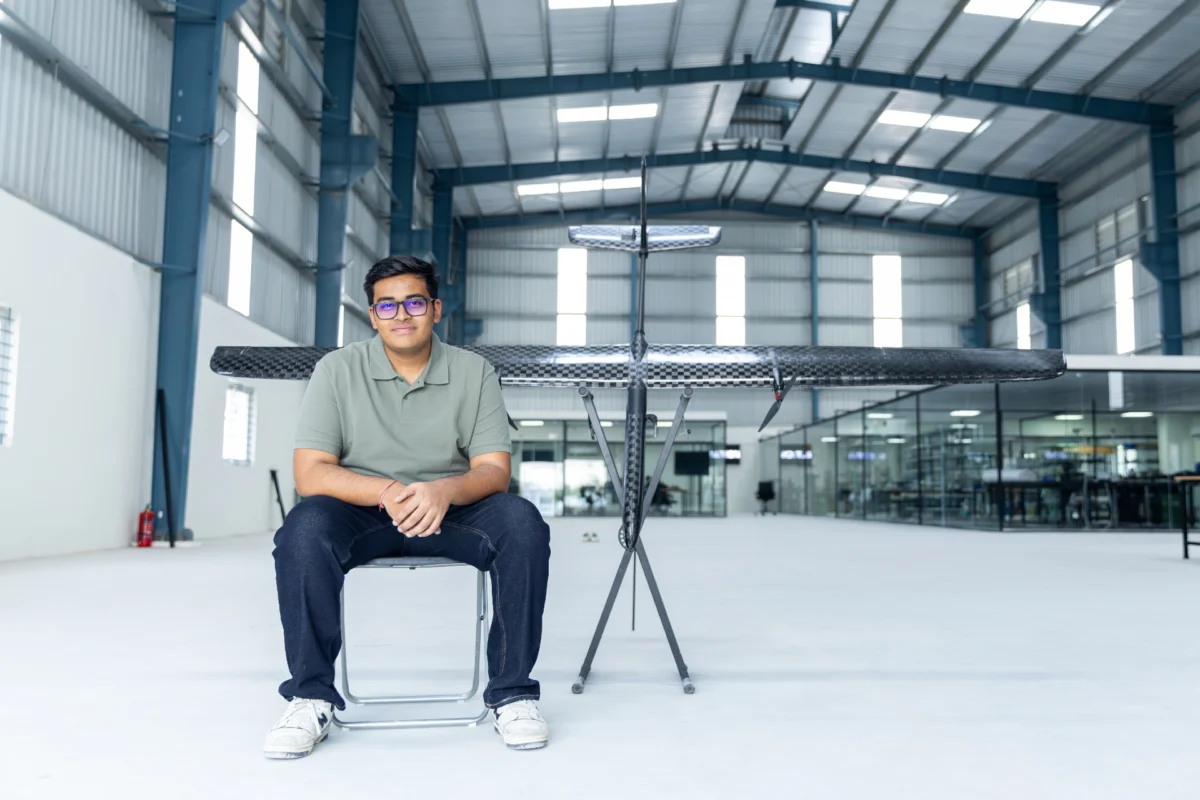
Alteon, founded by 20-year-old college dropout Samay Sanghvi, has emerged from stealth with an ambitious goal: to design and deploy autonomous, fixed-wing aircraft capable of remaining in the sky for more than a year at a time. Rather than relying on massive battery packs or solar arrays, Alteon’s aircraft are designed to harvest energy directly from the ocean’s wind patterns using a flight technique called "dynamic soaring"—the same method utilized by the wandering albatross to traverse thousands of miles across open seas without flapping its wings.
To realize this vision, the young startup has secured $2.5 million in a pre-seed funding round led by prominent solo investor Lachy Groom, with participation from India-focused Together Fund, alongside early backing from Emergent Ventures and the 1517 Fund. The rapid fundraising highlights the intense interest in high-endurance autonomous systems, with Groom reportedly committing to the investment within the first 30 minutes of his initial meeting with Sanghvi.
The Main Facts: Breaking the Fuel Barrier via Nature’s Blueprint
Conventional uncrewed aerial vehicles (UAVs) and high-altitude pseudo-satellites (HAPS) have long struggled with the trade-offs of energy storage. Solar-powered aircraft, while capable of multi-week flights, are constrained by seasonal sunlight variations, geographic latitude limits, and the structural fragility of carrying massive wing areas to support solar panels.
Alteon is bypassing solar reliance entirely, focusing instead on the kinetic energy stored within the planetary boundary layer over the world’s oceans.
Dynamic Soaring Cycle:
[High Wind Speed Layer] ---> 1. Climb & Turn (Gain Kinetic Energy)
                                  |
                                  v
                             2. Dive & Glide
                                  |
                                  v
[Low Wind Speed Layer]  ---> 3. Low-Altitude Maneuver (Near Ocean Surface)
The startup’s core technology relies on dynamic soaring, a flight maneuver that exploits differences in wind speed across different altitudes—a phenomenon known as wind shear. Close to the ocean’s surface, friction from the water slows the wind down. Just a few meters higher, the wind moves significantly faster.
By continuously crossing the boundary between these two layers of air, an aircraft can extract kinetic energy from the wind gradient, maintaining speed and altitude indefinitely without burning fuel or draining onboard power.
Initially, Alteon is developing a small, autonomous fixed-wing aircraft with a wingspan of approximately three meters. The aircraft is engineered to fly mere centimeters or meters above the ocean swells, execute a rapid climb into the faster-moving air above, turn, dive back down toward the surface, and repeat the cycle.
To convert this kinetic motion into usable electricity for onboard payloads (such as cameras, radar, and sensors), Alteon plans to utilize its propellers in reverse. When the aircraft harvests excess energy from the wind, the propellers will act as miniature wind turbines, generating electricity to recharge small, onboard emergency batteries.
Chronology: From RC Crashes to Autonomous Flights Over the Bay of Bengal
The genesis of Alteon trace back to 2023, when its founder, Samay Sanghvi, graduated from high school. Fascinated by aerodynamics and long-endurance flight, Sanghvi bypassed the traditional university track to study the physics of dynamic soaring independently.
Alteon's Development Timeline:
2023: Sanghvi graduates high school; begins building/crashing RC prototypes.
2024: Early conceptual design and aerodynamic modeling of dynamic soaring systems.
2025: Alteon formally incorporated; secures backing from Emergent Ventures & 1517.
2026: Raises $2.5M pre-seed led by Lachy Groom; completes autonomous tests over Bay of Bengal.
The early stages of the venture were marked by rapid, trial-and-error prototyping:
- Late 2023 – 2024: Sanghvi began building, testing, and inevitably crashing hand-built radio-controlled models to understand the flight mechanics of low-altitude wind harvesting.
- Early 2025: Having demonstrated early-stage proof of concepts, Sanghvi formally incorporated Alteon in Bengaluru. The venture quickly drew the attention of early-stage deep-tech syndicates, securing initial micro-grants and backing from Emergent Ventures and the 1517 Fund—a venture firm famous for backing founders who opt out of university to build deep-tech startups.
- Mid-2026: Alteon scaled its engineering operations, establishing a dedicated research and development facility in Bengaluru.
- August 2026: The startup announced its $2.5 million pre-seed round led by Lachy Groom and Together Fund. Concurrently, Alteon achieved its first major flight testing milestone: successfully deploying its custom autonomous flight control system over the Bay of Bengal.
During the Bay of Bengal trials, Alteon’s prototype demonstrated highly precise autonomous navigation. The aircraft successfully executed seven continuous "O-shaped" flight loops at speeds exceeding 62 miles per hour (100 km/h), maintaining a flight path within just one meter of the ocean’s surface.
While this test relied on onboard power rather than passive wind harvesting, it proved that the startup’s custom flight computer and sensing suite could handle the complex, low-altitude maneuvers required for dynamic soaring.
Supporting Data: Operational Footprint and Engineering Cadence
Despite its young leadership, Alteon has built a remarkably robust manufacturing and testing pipeline in India’s primary aerospace hub.
| Operational Metric | Value / Specification |
|---|---|
| Headcount | 20 specialized engineers and roboticists |
| Facility Size | 10,000-square-foot facility in Bengaluru |
| Production Rate | 4 to 5 prototype aircraft manufactured per week |
| Testing Cadence | Over 200 test flights conducted in a 30-day period |
| Initial Aircraft Wingspan | Approximately 3 meters |
| Test Speed (Bay of Bengal) | >62 mph (approx. 100 km/h) |
| Test Altitude (Bay of Bengal) | Within 1 meter of the water’s surface |
This high-frequency testing loop allows the startup to rapidly iterate on structural designs, carbon-fiber composites, and flight control software. By building and testing multiple airframes each week, the team can push prototypes to their physical limits, analyze structural failures, and implement software updates in near-real-time.
Official Responses and Technical Skepticism: Expert Evaluations
While the investment community has expressed immense enthusiasm for Alteon’s approach, academic and aerospace experts emphasize that the path to year-long flight is fraught with unprecedented engineering hurdles.

Dr. Gabriel Bousquet, a Silicon Valley-based aerospace and robotics engineer who conducted extensive research on dynamic soaring during his doctoral studies at the Massachusetts Institute of Technology (MIT), analyzed Alteon’s recent flight over the Bay of Bengal. He described the low-altitude test as a "promising first result," but noted that the true test of the technology lies ahead.
"The harder challenge will be proving that the aircraft can reliably extract enough energy from real-world winds to sustain flight for extended periods," Dr. Bousquet told TechCrunch.
Bousquet pointed out that flying at ultra-low altitudes—where wind shear is strongest—forces the aircraft into an incredibly hostile environment. To harvest wind energy safely, the aircraft must continuously sense and adapt to a constantly shifting ocean surface. The flight control algorithms must process and react to:
- High-frequency turbulence and sudden wind gusts.
- Rising and falling ocean swells and unpredictable wave heights.
- Marine salt spray, heavy rain, and mist, which can degrade aerodynamic efficiency and corrode sensors.
- Rapidly changing light and visibility conditions that challenge optical sensors.
Dr. Bharath Swaminathan, an expert who earned his PhD from the Indian Institute of Technology (IIT) Madras specializing in the stability of dynamic soaring systems, agreed that the underlying physics of the concept are sound but cautioned against underestimating the chaotic nature of the atmosphere.
"Keeping an aircraft airborne for several days using dynamic soaring would itself be a very big step, and a big achievement," Swaminathan said.
Swaminathan explained that while macro-scale wind patterns over oceans are relatively predictable, localized wind shear and turbulence are highly variable. An autonomous aircraft must be able to detect micro-scale changes in wind speed in real-time to adjust its angle of attack and flight path. If the wind shear drops unexpectedly, the aircraft must instantly transition to battery-powered propulsion to avoid crashing into the water—a challenge that may only be fully understood through extensive, long-range maritime testing.
Addressing these technical risks, lead investor Lachy Groom remains highly confident in the team’s ability to solve these fundamental engineering problems.
"Ambitious problems are always going to come with risks," Groom stated. "For me, it came down to believing Samay and the Alteon team are the ones to figure them out."
Implications: The Future of Maritime Surveillance and Beyond
If Alteon succeeds in achieving what Sanghvi calls "energy-neutral dynamic soaring"—the milestone where the aircraft remains aloft indefinitely with its motor turned off—the implications for global maritime operations, environmental science, and defense will be profound.
Traditional Satellites             Alteon Autonomous UAVs
----------------------             ----------------------
- High orbit / High latency        - Ultra-low altitude flight
- Re-visit rate limitations        - Continuous, real-time presence
- Multimillion-dollar launches     - Fraction of the cost
- Passive observation              - Active, dynamic sensing
1. Persistent Maritime Surveillance
Governments and coast guards currently monitor territorial waters using a combination of expensive manned patrol aircraft, short-endurance drones, and satellite imagery. Satellites, while offering broad coverage, are limited by orbital pass times and cloud cover.
A fleet of low-cost, dynamic-soaring UAVs could provide continuous, real-time visibility over vast swaths of the ocean. This could revolutionize the detection of illegal, unreported, and unregulated (IUU) fishing, maritime piracy, human trafficking, and illicit smuggling corridors.
2. Environmental and Climate Monitoring
The oceans play a critical role in regulating global climate, yet gathering continuous, localized atmospheric and oceanographic data remains challenging.
Alteon’s aircraft could be equipped with meteorological and environmental sensors to measure sea-surface temperatures, carbon dioxide absorption, salinity, and wave heights over months-long missions. This would provide climatologists with an unprecedented density of real-time data from remote marine regions, such as the Southern Ocean or the deep Pacific, which are currently only sampled by passing cargo ships or occasional research vessels.
3. Border Security and Search and Rescue (SAR)
With the ability to loiter over search zones indefinitely, these aircraft could act as persistent communication relays and observation platforms during maritime search and rescue operations. In the event of a shipwreck or lost vessel, Alteon’s UAVs could maintain a continuous eye over the search grid, coordinating rescue efforts without the need to return to land to refuel.
4. Communications and Remote Connectivity
Much like high-altitude balloon networks or low-Earth orbit satellites, a network of persistent, low-altitude UAVs could serve as telecommunications relays, providing internet and cellular connectivity to remote islands, shipping lanes, and offshore industrial installations (such as wind farms and oil rigs) at a fraction of the cost of space-based infrastructure.
As Alteon prepares for its next phase of testing, the global aerospace community will be watching closely. If this 20-year-old founder can successfully mimic the flight of the albatross, the future of aviation may no longer be defined by how much fuel an aircraft can carry, but by how well it can harness the natural energy of the planet.
