





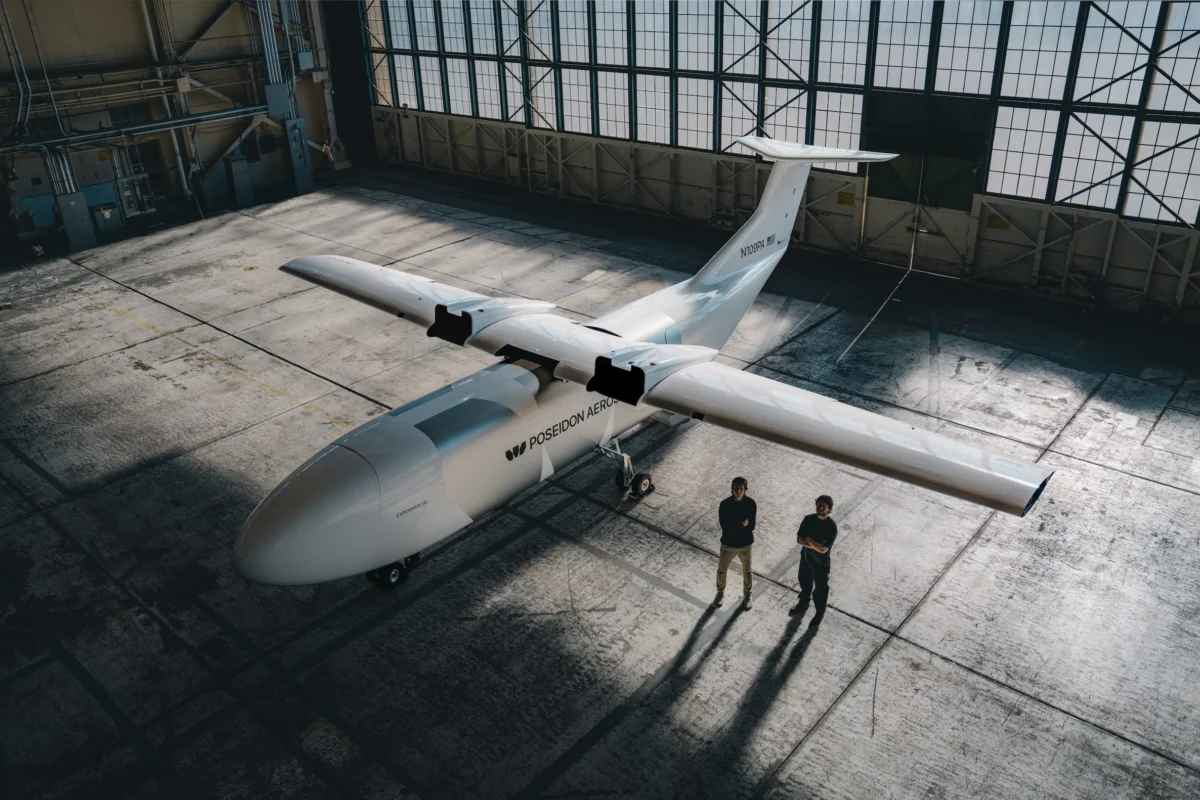
Silicon Valley has long been captivated by the allure of the "move fast and break things" ethos. In the aerospace sector, this philosophy has manifested as a gold rush into advanced air mobility (AAM)—a landscape crowded with electric vertical takeoff and landing (eVTOL) passenger concepts, hydrogen-powered regional airliners, and flashy urban air mobility networks.
Yet, David Zagaynov, co-founder and CEO of Poseidon Aerospace, represents a stark departure from this high-tech idealism. He does not want to break things; he simply wants to move things fast, reliably, and at the lowest possible cost.
By eschewing the complex, unproven propulsion technologies that dominate the venture-backed aviation market, Poseidon Aerospace has emerged as a formidable contrarian. Armed with a newly secured $60 million Series A funding round, the Alameda, California-based startup is preparing for the maiden flight of its full-scale, uncrewed cargo plane, the Egret, powered not by next-generation batteries or liquid hydrogen, but by conventional combustion engines.
Main Facts: A Capital-Intensive Push for Pragmatic Autonomy
Poseidon Aerospace’s recent financial and operational milestones underscore a growing investor appetite for pragmatic, dual-use technology that addresses immediate bottlenecks in global supply chains and national defense.
The Series A War Chest
Poseidon recently finalized a $60 million Series A funding round, bringing its total capital raised to date to $71 million. The round was led by TQ Ventures, an early-stage venture capital firm known for backing highly efficient, operationally intensive businesses. New institutional investors joining the cap table include:
- Hanwha Asset Management: The investment arm of the South Korean industrial conglomerate Hanwha Group, which has deep ties to defense and aerospace manufacturing.
- G Squared: A growth-stage venture firm focused on disruptive technology platforms.
- JAWS: An investment vehicle backing high-growth, industry-defining startups.
Existing investors also demonstrated continued confidence by participating in the round, including Starship Ventures, Draper Associates (led by veteran venture capitalist Tim Draper), and Drover Ventures.
The Aircraft Portfolio: Egret and Heron
Rather than designing a multi-role passenger-and-cargo platform, Poseidon has focused exclusively on aerologistics. Its engineering pipeline centers on two uncrewed, fixed-wing aircraft:
- The Egret: A 50-foot-wingspan, uncrewed cargo aircraft designed for traditional runway operations. It relies on standard internal combustion engines to transport regional cargo over mid-range distances.
- The Heron: A seaplane variant of the Egret, engineered to operate from open water, harbors, and coastal regions, bypassing traditional runway infrastructure entirely.
Core Strategic Focus
The company is initially targeting two primary end markets:
- Defense Logistics: Providing resilient, point-to-point cargo delivery in contested or degraded environments where traditional logistics infrastructure has been compromised or does not exist.
- Regional Commercial Cargo: Operating an autonomous, regional point-to-point air cargo network to compete directly with existing third-party logistics feeders, servicing major integrators such as FedEx, UPS, and DHL.
Chronology: From Amazon Logistics to the Alameda Hangar
The foundation of Poseidon Aerospace traces back to 2024, when co-founders David Zagaynov and Parker Tenney identified a fundamental disconnect between the aerospace startup ecosystem and the operational realities of global logistics.
[Early 2024] -------------------> [Mid-2024] -------------------> [Late 2024]
Zagaynov & Tenney                 $11M Seed Round;                $60M Series A;
conceptualize Poseidon            Seagull prototype flight        Alameda hangar expansion
The Founders’ Epiphany
While working in logistics at Amazon, Zagaynov observed firsthand the inefficiencies of regional middle-mile delivery systems. Concurrently, Parker Tenney, then working at defense giant Lockheed Martin, was analyzing the rapid rise of uncrewed aerial systems (UAS) and advanced air mobility.
During their frequent discussions, the duo realized that the vast majority of aerospace startups were falling victim to what they termed "nerd-sniping"—becoming so enamored with solving complex engineering challenges (such as transitioning tilt-rotor eVTOL flight systems or cryogenic hydrogen storage) that they lost sight of commercial viability. They resolved to build an aerospace company focused solely on improving the economics of moving freight.
Initial Prototyping and Seed Funding
To prove their thesis, the founders rapidly designed and built a quarter-scale technology demonstrator named the Seagull. In mid-2023, the startup secured an $11 million seed funding round to finance initial flight testing of the Seagull and to begin engineering work on its full-scale successor. The successful flight-test campaign of the Seagull validated the company’s aerodynamic profiles and autonomous flight-control software.
Scale-Up and the Series A
By late 2024, the limitations of their initial testing facilities prompted a major expansion. Poseidon secured a historic, expansive former Navy hangar in Alameda, California, providing the physical footprint required to assemble a 50-foot-wingspan aircraft.
With the closing of the $60 million Series A, the company is rapidly expanding its engineering and manufacturing teams. The immediate objective is to complete the assembly of the first full-scale Egret aircraft in preparation for its inaugural test flight, scheduled to take place before the end of this year.
Supporting Data: The Physics and Economics of "A Box with Wings"
Poseidon’s contrarian design choices are rooted in fundamental physics and the brutal cost structures of the logistics industry. By stripping away the complexities of modern "green" aviation, the company aims to operate on a significantly lower cost curve.
The Energy Density Problem
A primary driver behind Poseidon’s decision to use internal combustion engines is the unmatched energy density of liquid hydrocarbon fuels compared to modern batteries.
| Propulsion Type | Practical Energy Density (Wh/kg) | Operational Implications for Cargo |
|---|---|---|
| Lithium-Ion Battery | ~250–300 Wh/kg | Severe payload penalties; extremely limited range; long recharge downtime. |
| Liquid Hydrogen | ~33,300 Wh/kg (system-level is far lower) | Requires heavy cryogenic tanks, complex fuel cells, and nonexistent airport infrastructure. |
| Aviation Gasoline / Jet-A | ~12,000 Wh/kg | High payload capacity; long range; utilizes existing, global refueling infrastructure. |
By opting for traditional fuels, Poseidon ensures its aircraft can maximize payload capacity over hundreds of miles without requiring airports to install expensive megawatt-level charging grids or cryogenic hydrogen fueling stations.
Structural Efficiency through Demanning
Designing an aircraft from scratch to be uncrewed yields massive structural and aerodynamic advantages. Eliminating human pilots from the airframe removes the necessity of:
- Pressurized cockpits and heavy windshields
- Oxygen generation and life support systems
- Ejection seats or crash-survivable cabin structures
- Manual flight controls, instrumentation, and displays
Traditional Regional Aircraft Weight Distribution:
[ Cockpit & Life Support ] [ Empty Airframe Weight ] [ Fuel ] [ Payload ]
                                    vs.
Poseidon Egret Autonomous Weight Distribution:
                           [ Empty Airframe Weight ] [ Fuel ] [ Payload (Expanded) ]
By removing this "structured weight," Poseidon significantly alters the ratio of payload to empty weight. A lighter airframe requires smaller, more fuel-efficient engines, initiating a virtuous engineering cycle that drives down both capital expenditures (CapEx) and operational expenditures (OpEx).
Overcoming Pilot Constraints
In the commercial regional air cargo sector, pilot scheduling represents one of the largest operational bottlenecks and cost drivers. Under FAA Part 117 regulations, commercial pilots are subject to strict daily and cumulative flight duty period limits.
If a regional cargo pilot flies a five-hour leg to a remote destination, they frequently exhaust their legal duty hours, requiring the operator to pay for overnight lodging, meals, and ground transportation, while the multi-million-dollar aircraft sits idle on the tarmac.
By utilizing autonomous and remote-piloting systems, Poseidon’s aircraft can operate with near-continuous utilization, limited only by routine maintenance intervals and refueling turnaround times.
Official Responses and Investor Perspectives
The leadership at Poseidon Aerospace and their backing investors are aligned in their disdain for overly complex technology that fails to solve real-world problems.
David Zagaynov, Co-Founder and CEO of Poseidon Aerospace, detailed this philosophy:
"Philosophically, we want to build the future of aerologistics. Not to be a hater, but I think a lot of people who start aerospace companies get nerd-sniped by very cool technology and then want to implement it into the market. For us, we want to improve cargo. Can I make a really good box with wings to move things for super cheap? If you do that, then abstracting the tech away, we’re left with unmanned cargo planes that are able to operate on a much lower cost curve, and have much higher utilization."
Zagaynov also highlighted how the commoditized nature of the logistics industry plays directly into Poseidon’s hands:
"What’s very nice is, logistics is a commodity, and so if you sell a commodity and do it better, faster, cheaper, the demand is all yours."
The Regulatory Landscape
While Poseidon’s technology is intentionally low-tech on the propulsion side, it relies heavily on cutting-edge software for autonomous operations. Zagaynov noted that the regulatory environment in the United States has become surprisingly accommodating, largely due to the Federal Aviation Administration’s (FAA) efforts to integrate eVTOL and urban air mobility concepts.
The FAA’s recent pilot programs, designed to establish certification pathways for highly automated and electric aircraft, have laid critical groundwork that Poseidon can exploit. "There’s a path to commercialization that I don’t think existed like five to 10 years ago," Zagaynov observed, indicating that the regulatory friction for autonomous flight has decreased significantly.
Implications: Reshaping Defense and Commercial Supply Chains
The successful deployment of the Egret and Heron platforms could trigger profound shifts in both military logistics and the commercial express shipping sector.
Traditional Hub-and-Spoke:
[Origin] ──> [Central Hub (Sortation)] ──> [Destination] (Slower, higher handling costs)

Poseidon Point-to-Point:
[Origin] ────────────────────────────────> [Destination] (Direct, continuous utilization)
Commercial: Dismantling the Hub-and-Spoke Model
Traditional regional air cargo operations rely heavily on the hub-and-spoke model. Small feeder aircraft fly cargo from regional airports to a central sortation hub (such as FedEx’s hub in Memphis or UPS’s hub in Louisville), where packages are sorted and flown back out to their final destinations. This model is highly centralized because it optimizes the scheduling of manned crews and large aircraft.
Poseidon intends to disrupt this paradigm by operating its own regional air cargo business rather than selling its planes to third parties. By leveraging autonomous, low-cost aircraft, Poseidon can economically run point-to-point routes, mimicking the highly efficient networks of low-cost passenger carriers like Breeze Airways or Avelo Airlines.
Because autonomous planes do not need to return pilots to their home bases, Poseidon can dynamically reroute its fleet in real-time based on regional demand spikes, bypassing congested hub airports entirely and delivering freight directly to regional distribution centers.
Defense: Countering Adversary Denial in the Indo-Pacific
In modern military planning, particularly within the U.S. Department of Defense’s focus on the Indo-Pacific theater, logistics is widely considered the soft underbelly of joint operations. The U.S. military’s reliance on massive, centralized airfields and large cargo transport aircraft (such as the C-17 Globemaster) makes its supply chains highly vulnerable to long-range missile strikes and anti-access/area-denial (A2/AD) strategies.
Poseidon’s uncrewed platforms, particularly the water-landing Heron, offer a solution for "distributed maritime operations."
- Infrastructure Independence: The Heron can deliver critical payloads—such as spare parts, medical supplies, or munitions—to remote island outposts, vessels at sea, or coastal regions with degraded or nonexistent runway infrastructure.
- Resilience through Attrition: Because these aircraft are designed to be cheap and uncrewed, commanders can deploy them in high-threat environments where risking a manned C-130 or V-22 Osprey would be tactically unacceptable.
- Geopolitical Competition: The strategic urgency is compounded by geopolitical competitors. China is actively testing heavy cargo drones—such as the Tengden TB-001 and large-scale autonomous conversions of utility aircraft—to secure its own regional logistics dominance. Poseidon’s rapid development cycle directly addresses this capability gap for the U.S. and its allies.
By combining the physical reliability of time-tested internal combustion engines with the operational flexibility of modern autonomous flight software, Poseidon Aerospace is positioning itself to dominate the unglamorous, highly lucrative world of mid-mile logistics. If the upcoming test flight of the Egret succeeds, the startup will have proved that in the race to define the future of aviation, the winning strategy might not be reinventing the engine, but simply building a better box with wings.
