





Main Facts: The $2.5 Million Bet on Perpetual Flight
In the high-stakes world of aerospace engineering, the limitation of flight has always been defined by fuel. Whether burning aviation gasoline or draining lithium-ion batteries, every aircraft eventually faces the pull of gravity once its onboard energy reserves are depleted.
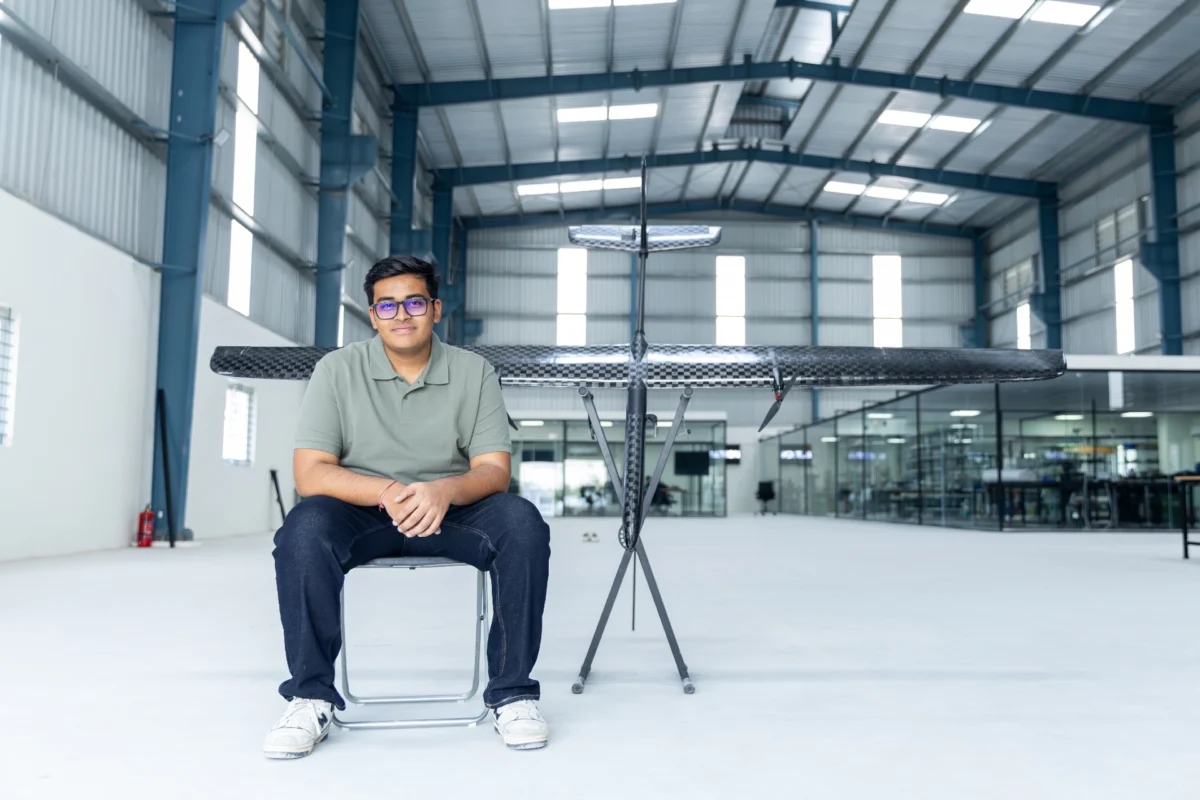
However, a Bengaluru-based startup named Alteon is attempting to shatter this fundamental constraint. Founded by 20-year-old Samay Sanghvi, Alteon has set its sights on an extraordinarily ambitious goal: engineering an autonomous aircraft capable of remaining in the sky for more than a year at a time. Instead of relying on heavy battery packs or traditional combustible fuels, the aircraft aims to harvest its energy directly from the environment, specifically utilizing the powerful, shifting wind patterns immediately above the ocean’s surface.
To realize this vision, Alteon announced the successful close of a $2.5 million pre-seed funding round. The round was led by Lachy Groom, a prominent Silicon Valley solo investor and former Stripe executive known for backing high-conviction, deep-tech founders early in their journeys. The funding round also saw participation from Together Fund, alongside early backing from Emergent Ventures and 1517.
According to Sanghvi, Groom’s commitment was remarkably swift. The investor decided to lead the round within the first 30 minutes of their initial meeting, captivated by the sheer scale of the technical challenge and the potential geopolitical and commercial implications of perpetual atmospheric flight.
The Science of Dynamic Soaring
At the core of Alteon’s technology is a flight maneuver known as "dynamic soaring." This technique is directly inspired by nature—specifically the wandering albatross, a seabird capable of traveling thousands of miles across open oceans without flapping its wings.
   High-Speed Air
  ------------------>  (Aircraft climbs into fast wind, gaining airspeed)
              ^
             /
            /
          v /
  ------------------>  (Aircraft descends into slow wind near surface)
    Low-Speed Air / Ocean Surface
Dynamic soaring exploits "wind shear," which refers to the variations in wind speed at different altitudes. Close to the ocean’s surface, friction with the water slows the wind down. Just tens of feet higher, the wind moves significantly faster.
By repeatedly crossing the boundary between these layers of air traveling at different speeds, an aircraft can continuously extract kinetic energy from the wind gradient. The vehicle climbs into the fast-moving air to gain airspeed, turns, glides back down into the slower-moving boundary layer near the water, and repeats the cycle. If executed correctly, the energy harvested from the wind shear exceeds the drag experienced by the airframe, allowing the aircraft to maintain speed and altitude indefinitely without burning any onboard fuel.
Chronology: From High School Tinkering to a Bengaluru Aerospace Hub
The genesis of Alteon is a story of rapid iteration, self-taught engineering, and a relentless focus on physical testing.
- 2023: The High School Graduate’s Garage. Straight out of high school, a then-17-year-old Samay Sanghvi began investigating the mathematics of dynamic soaring. Lacking formal aerospace training, Sanghvi adopted a highly empirical approach to learning: building, flying, and inevitably crashing radio-controlled (RC) scale models. These early failures provided critical data on flight dynamics, control surface response, and the structural limits of lightweight composites.
- Early 2024: Attracting Early Believers. As Sanghvi’s prototypes grew more sophisticated, his work caught the attention of specialized, early-stage venture funds. He secured initial backing from Emergent Ventures—a fellowship and grant program known for supporting highly non-conformist talent—and 1517, a fund that explicitly invests in founders who opt out of traditional university paths to build deep-tech companies.
- 2025: Formal Incorporation and Scaling. With proof-of-concept models successfully demonstrating basic aerodynamic stability, Sanghvi formally incorporated Alteon in 2025. He established the company’s headquarters in Bengaluru, India—a city widely regarded as the country’s aerospace capital due to its dense concentration of defense laboratories, space agencies, and engineering talent.
- Mid-2026: The Testing Blitz. By mid-2026, Alteon had expanded its footprint to a state-of-the-art 10,000-square-foot facility in Bengaluru, employing a specialized team of 20 engineers. To accelerate development, the startup instituted a rapid-prototyping cycle, manufacturing four to five experimental aircraft every week. In the 30 days leading up to their funding announcement, the team conducted more than 200 physical test flights, culminating in an autonomous flight over the Bay of Bengal.
Supporting Data: Engineering Specifications and Flight Testing Achievements
Alteon’s development strategy relies on translating complex aerodynamic theory into physical, repeatable flight data. The startup’s current testing phase and future design roadmap are built around specific engineering milestones:
| Parameter / Milestone | Current Specification / Status | Future Target / Goal |
|---|---|---|
| Wingspan | ~3 meters (Prototype scale) | Scaled operational airframe |
| Test Flight Velocity | >62 mph (100 km/h) | Optimized soaring velocity |
| Flight Altitude | ~1 meter above water surface | Adaptive boundary layer altitude |
| Energy Generation | Battery-powered propulsion | Regenerative propeller turbines |
| Current Milestone | Autonomous O-shaped cycles | "Energy-neutral" dynamic soaring |
| Operational Endurance | Hours (limited by battery capacity) | >1 year (continuous) |
The Bay of Bengal Test Flight
While the ultimate goal of year-long flight remains on the horizon, Alteon recently achieved a critical validation of its guidance, navigation, and control (GNC) systems. During a test flight over the open waters of the Bay of Bengal, an Alteon prototype successfully demonstrated autonomous low-altitude control.
The aircraft completed seven consecutive, O-shaped flight cycles at speeds exceeding 62 miles per hour (100 km/h). Crucially, the autonomous system maintained a flight path within just one meter of the ocean’s surface. Flying at this extreme low altitude is necessary to exploit the steepest wind shear gradients, but it leaves virtually zero margin for error.
The Next Milestone: Energy-Neutral Flight
Alteon is currently working toward its next major engineering hurdle: "energy-neutral dynamic soaring."
Currently, the aircraft uses its onboard batteries and electric motors to launch, climb, and recover from unstable maneuvers. Energy-neutral soaring will require the aircraft to completely shut down its active propulsion system and rely solely on the wind to maintain altitude and speed.
Once energy-neutrality is achieved, the startup plans to implement a regenerative power system. When the wind provides excess kinetic energy, the aircraft will adjust its flight path to spin its propellers backward. This action transforms the electric motors into generators (acting as turbines), converting the kinetic energy of the wind into electricity to recharge the onboard batteries. These batteries will power the aircraft’s critical payloads, including sensors, transponders, and satellite communication links.
Official Responses: Investor Conviction and Expert Skepticism
The intersection of venture capital optimism and academic rigor highlights both the immense potential and the formidable technical hurdles facing Alteon.

The Investor’s Perspective
For Lachy Groom, the decision to back Alteon was a bet on the team’s ability to solve a generation-defining engineering problem. Acknowledging the high technical risk of the project, Groom emphasized that breakthrough innovations require backing ambitious founders who are unafraid of physical constraints:
"Ambitious problems are always going to come with risks. For me, it came down to believing Samay and the Alteon team are the ones to figure them out."
The Academic and Engineering View
While the aerospace community watches Alteon’s progress with interest, experts point out that the transition from short test flights to multi-month endurance is an extraordinarily steep climb.
Dr. Gabriel Bousquet, a Silicon Valley-based aerospace and robotics engineer who conducted extensive research on dynamic soaring during his PhD at the Massachusetts Institute of Technology (MIT), described Alteon’s low-altitude test over the Bay of Bengal as a "promising first result." However, Bousquet cautioned that the real-world environment is far more hostile than a controlled flight model:
"The harder challenge will be proving that the aircraft can reliably extract enough energy from real-world winds to sustain flight for extended periods. Flying low enough to harvest that energy safely is particularly difficult. The aircraft would have to contend with turbulence, waves, spray, rain, and changing light conditions while continuously sensing and reacting to a moving ocean surface."
Dr. Bharath Swaminathan, who earned his PhD from the Indian Institute of Technology (IIT) Madras specializing in the stability of dynamic soaring, agreed that the underlying physics of the venture are mathematically sound. He praised the startup’s empirical drive, noting that keeping an unpowered aircraft aloft for even a few days would represent a historic milestone in aviation:
"Keeping an aircraft airborne for several days using dynamic soaring would itself be a very big step, and a big achievement. While large-scale wind conditions may be predictable, local wind shear and turbulence can vary substantially, complicating an aircraft’s ability to continuously extract energy from the wind. Some of those challenges may only emerge through real-world flight testing."
Implications: A Paradigm Shift in Maritime Surveillance and Earth Observation
If Alteon successfully overcomes the physical and aerodynamic challenges of dynamic soaring, the implications for global maritime operations, environmental science, and national security could be profound.
+-------------------------------------------------------------------------+
|                        ALTEON OPERATIONAL PARADIGM                      |
+-------------------------------------------------------------------------+
|                                                                         |
|  [Satellite Observation]     -->   High cost, periodic revisit times    |
|  [Crewed Patrol Aircraft]    -->   Extremely high hourly cost, fuel-bound |
|                                                                         |
|  =============================== VS =================================== |
|                                                                         |
|  [Alteon Autonomous UAV]     -->   Continuous, year-long endurance      |
|                              -->   Zero fuel consumption                |
|                              -->   Real-time, low-altitude monitoring   |
+-------------------------------------------------------------------------+
Redefining Maritime Surveillance
Currently, governments and coastal authorities monitor their Exclusive Economic Zones (EEZs) using a mix of three expensive assets:
- Satellites: While capable of broad coverage, satellites are limited by orbit schedules (revisit times) and can be obstructed by cloud cover.
- Crewed Patrol Aircraft: Aircraft like the Boeing P-8 Poseidon offer excellent sensor capabilities but cost tens of thousands of dollars per flight hour to operate and burn massive quantities of fossil fuel.
- Traditional Long-Endurance UAVs: Large drones like the MQ-9 Reaper can stay aloft for over 24 hours, but they remain bound by fuel capacity and require extensive logistics footprints.
An autonomous, wind-powered aircraft capable of flying indefinitely at low altitudes would provide a continuous, real-time "eye in the sky" over the ocean. Governments could monitor thousands of miles of coastline for illegal, unreported, and unregulated (IUU) fishing, detect maritime piracy, track smuggling vessels, and secure remote border regions at a fraction of the cost of current methods.
Environmental and Climate Monitoring
Beyond defense and security, a perpetual atmospheric platform could revolutionize earth science. Operating just meters above the water, Alteon’s aircraft could collect unprecedented data on ocean-atmosphere interactions, which are critical drivers of global climate systems.
The drones could continuously measure sea surface temperatures, monitor ocean acidification, track oil spills in real-time, and provide early warning systems for hurricanes and typhoons by flying directly into the boundary layers where these storms gather strength.
By replacing fuel-burning patrol planes with wind-harvesting gliders, Alteon’s technology also offers a zero-carbon alternative for atmospheric research, aligning with global efforts to decarbonize aviation and maritime logistics.
As Alteon continues to ramp up its testing frequency in Bengaluru, the startup finds itself at the intersection of classical aerodynamics and modern autonomous robotics. If Samay Sanghvi’s team can prove that their 3-meter wingspan aircraft can reliably ride the ocean wind shear without power, they will not just have built a successful startup—they will have unlocked a entirely new class of atmospheric vehicle.
