





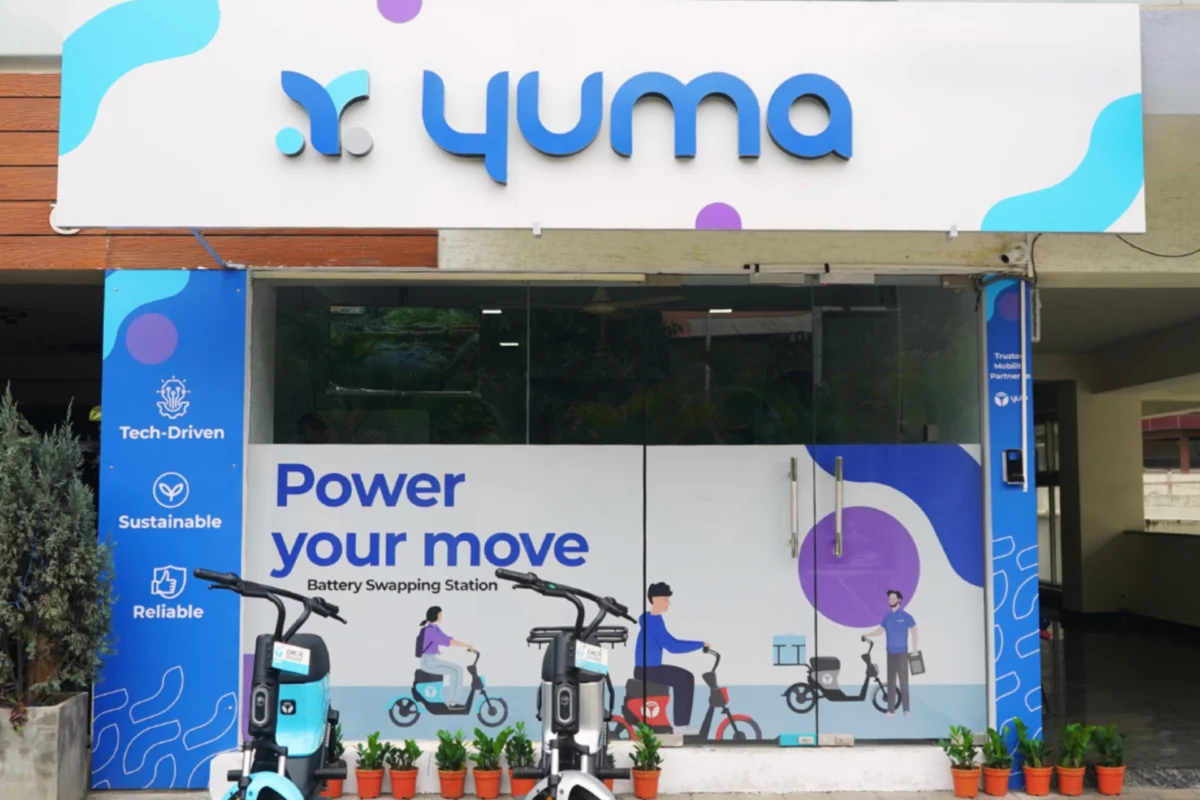
While electric vehicle battery-swapping models have faced significant commercial hurdles and struggled to achieve viability in Western markets, the unique economics of India’s urban transport landscape are telling a different story. In a bold endorsement of this localized thesis, Canadian automotive supply giant Magna International has committed an additional $35 million in funding to Yuma Energy, a Bengaluru-based battery-swapping network.
This capital injection underscores a growing conviction that the high-density, rapid-turnaround demands of India’s millions of two- and three-wheeled commercial vehicles present the ideal environment for battery-swapping technology to scale profitably.
1. Main Facts: The Transaction and Equity Realignment
Magna International’s $35 million investment marks a significant deepening of its commitment to Yuma Energy, a company originally established as a joint venture between Magna and the prominent Indian shared electric mobility startup, Yulu.
Key Transaction Details
- Investor: Magna International (Ontario, Canada)
- Recipient: Yuma Energy (Bengaluru, India)
- Funding Amount: $35 million (USD)
- Equity Shift: Magna is increasing its majority stake beyond the 51% equity share it acquired at the joint venture’s inception in early 2023. Consequently, Yulu’s original 49% stake will be diluted. The exact revised ownership split has not been publicly disclosed by either party.
- Primary Use of Funds: The capital will be deployed to aggressively expand Yuma’s physical swapping infrastructure, double its active battery fleet over the next 12 to 18 months, and extend its geographical footprint into new Tier-1 and Tier-2 Indian cities.
Yuma Energy operates as an independent, vertically integrated battery-swapping network. Unlike pure-play service providers, Yuma designs and manufactures its proprietary battery packs at a dedicated facility in Chennai, while fabricating its charging units in Bengaluru. This end-to-end control over hardware, firmware, and software allows Yuma to optimize charging cycles, improve battery longevity, and maintain high network reliability.
2. Chronology of the Magna-Yulu-Yuma Partnership
The partnership between the Canadian automotive supplier and India’s micro-mobility pioneer has evolved rapidly over the past four years, reflecting the accelerating pace of electrification in India’s logistics and gig economies.
[2022] Magna commits $77M total ($25M to Yulu, $52M to JV)
   │
[Early 2023] Yuma Energy officially spins out of Yulu as a Joint Venture
   │
[March 2026] Yuma ends FY with ~₹1 billion ($10.5M) in revenue
   │
[August 2026] Yulu raises $93M to expand its e-bike fleet
   │
[Late 2026] Magna invests additional $35M in Yuma to double battery fleet- September 2022: The Initial Entry
Magna International made its entry into the micromobility and battery-swapping sector by committing a combined $77 million to the Indian market. This initial capital was split into two channels: $25 million went directly into Yulu to support its electric two-wheeler fleet expansion, while $52 million was allocated to establish a dedicated battery-swapping joint venture. - Early 2023: The Birth of Yuma
Yuma Energy was officially launched and spun out of Yulu. The newly formed entity took over Yulu’s existing charging infrastructure and began operating as an open-network battery-swapping provider, intending to serve both Yulu and third-party commercial fleets. - Fiscal Year Ending March 2026: Achieving Scale
Yuma built out its network to encompass over 400 stations and achieved an annualized revenue of approximately ₹1 billion (around $10.5 million USD), demonstrating the initial commercial viability of its stations. - August 2026: Yulu’s Capital Infusion
Yulu raised $93 million in a funding round to expand its electric two-wheeler fleet. This expansion directly catalyzed the need for a corresponding scale-up of Yuma’s network, as thousands of new Yulu bikes required immediate battery support. - Late 2026: Magna’s $35 Million Follow-on
To prevent infrastructure bottlenecks and capitalize on Yulu’s expansion, Magna stepped in with the current $35 million investment, diluting Yulu’s stake and positioning Yuma for its next phase of independent growth.
3. Supporting Data and Operational Metrics
The economics of battery swapping rely entirely on utilization rates, density, and asset rotation. Yuma’s current operational data indicates a business model that is rapidly approaching critical mass.
| Operational Metric | Current Status (Late 2026) | Target (Next 12–18 Months) |
|---|---|---|
| Total Lifetime Swaps | Over 60 million | N/A |
| Active Battery Fleet | ~100,000 units | ~200,000 units |
| Swapping Stations | Over 400 stations | Significant expansion targeted |
| Charging Units | Over 2,500 units | To be doubled |
| Annual Revenue (FY26) | ₹1 billion (~$10.5 million USD) | Projected steep growth |
| EBITDA Status | Select older stations positive | Company-wide break-even (2 quarters) |
| Non-Yulu Revenue Share | 15% – 20% | 25% |
Geographical Footprint and Expansion
Yuma currently operates across 18 major urban corridors in India, including:
- Tier-1 Metros: Bengaluru, Mumbai, Hyderabad, Kolkata, Chennai, and the National Capital Region (NCR/Delhi).
- High-Growth Hubs: Pune, Jaipur, Lucknow, Indore, Coimbatore, and Kochi.
With the fresh $35 million injection, Yuma is preparing for a dedicated launch in Pune and Chennai, alongside densifying its existing network in cities where delivery demand is saturated.
Fleet Diversification
While Yulu historically accounted for nearly the entirety of Yuma’s transaction volume, the network has successfully initiated diversification:
- Current Third-Party Share: 15% to 20% of swaps in the most recent quarter came from non-Yulu customers.
- Platform Integration: Yuma’s battery packs have been integrated into more than 10 distinct vehicle platforms from third-party manufacturers, including Kinetic Green, Motovolt, BGauss, and Quantum Energy.
- B2B Fleets: Yuma now services more than five independent commercial delivery fleets, reducing its single-customer dependency risk.
4. Official Responses and Executive Perspectives
The strategic rationale behind the investment centers on the operational realities of India’s gig economy, where driver uptime translates directly to daily earnings.
In an interview, Muthu Subramanian, Managing Director of Yuma Energy, highlighted the contrast between consumer charging preferences and commercial delivery necessities:
"With Indian gig workers’ high runtime on a daily basis, an EV makes absolute sense in terms of cost of ownership. Uptime is important. A battery can be exchanged in under two minutes, while even a 20- or 30-minute fast charge takes a rider off the road and requires more space and power to serve multiple vehicles at once."
Subramanian acknowledged the capital-intensive nature of building out an infrastructure network ahead of consumer adoption curves:
"It’s a capital-intensive business, and the unit economics will play out at scale. We are targeting company-wide EBITDA break-even within the next two quarters, supported by the fact that our established, high-utilization legacy stations are already operating profitably."
Commenting on the shifting ownership dynamics and the dilution of Yulu’s stake, Subramanian declined to provide specific equity percentages but emphasized that both Magna and Yulu remain aligned on the long-term vision of decoupling vehicle ownership from energy infrastructure.
5. Strategic Implications: The Indian Gig Economy and Global Horizons
Magna’s decision to increase its exposure to Yuma Energy carries profound implications for the broader electric vehicle ecosystem, both within India and across emerging markets globally.
Why Battery Swapping Works in India (and Fails in the West)
In North America and Europe, electric vehicles are predominantly passenger cars with large, heavy battery packs (ranging from 50 kWh to over 100 kWh). Swapping these packs requires massive, automated, multi-million-dollar robotic bays. Furthermore, passenger cars sit parked for over 90% of the day, making slower, overnight home-charging or workplace-charging highly practical.
In India, the electrification frontier is led by lightweight two- and three-wheelers utilized for e-commerce, food delivery, and quick-commerce services (such as Blinkit, Zepto, and Instamart).
- Physical Feasibility: Two-wheeler batteries weigh between 10 to 12 kg, allowing for manual, rapid swapping by the driver without the need for complex robotics.
- Real Estate Efficiency: Swapping kiosks occupy a fraction of the space required for traditional charging stations, a critical advantage in hyper-dense Indian metros where real estate prices are prohibitive.
- Grid Constraints: Distributing power across hundreds of individual slow-charging vehicles strains municipal grids; localized, centralized charging at swapping kiosks allows for optimized, balanced power draw.
The Quick-Commerce Catalyst
India’s quick-commerce sector has experienced explosive growth, with companies promising delivery times of under 10 minutes. This hyper-competitive operational environment penalizes any vehicle downtime. For a delivery rider, waiting 45 minutes at a fast-charging station represents lost wages.
Currently, only 10% to 15% of the estimated millions of gig delivery vehicles in India are electric. This low penetration rate represents a massive addressable market. By offering a sub-two-minute swap, Yuma removes the "range anxiety" and "charging downtime" barriers, accelerating the transition of fleet operators from internal combustion engines to electric models.
Global Expansion Pathways
While India remains Yuma’s primary focus for the next 12 to 18 months, the company’s long-term roadmap includes exporting its vertically integrated model to other regions characterized by high two-wheeler density.
- Southeast Asia: Countries like Vietnam, Thailand, and Indonesia feature massive commuter and delivery two-wheeler populations that face identical urbanization and grid challenges to those of India.
- Africa: Rapidly growing urban centers in East and West Africa, dominated by "boda-boda" (motorcycle taxi) networks, present prime opportunities for low-cost, rugged battery-swapping networks.
By mastering the unit economics, local manufacturing, and software management of battery swapping in the demanding Indian market, Magna and Yuma are positioning themselves to export a proven, highly scalable blueprint to the rest of the developing world.
