




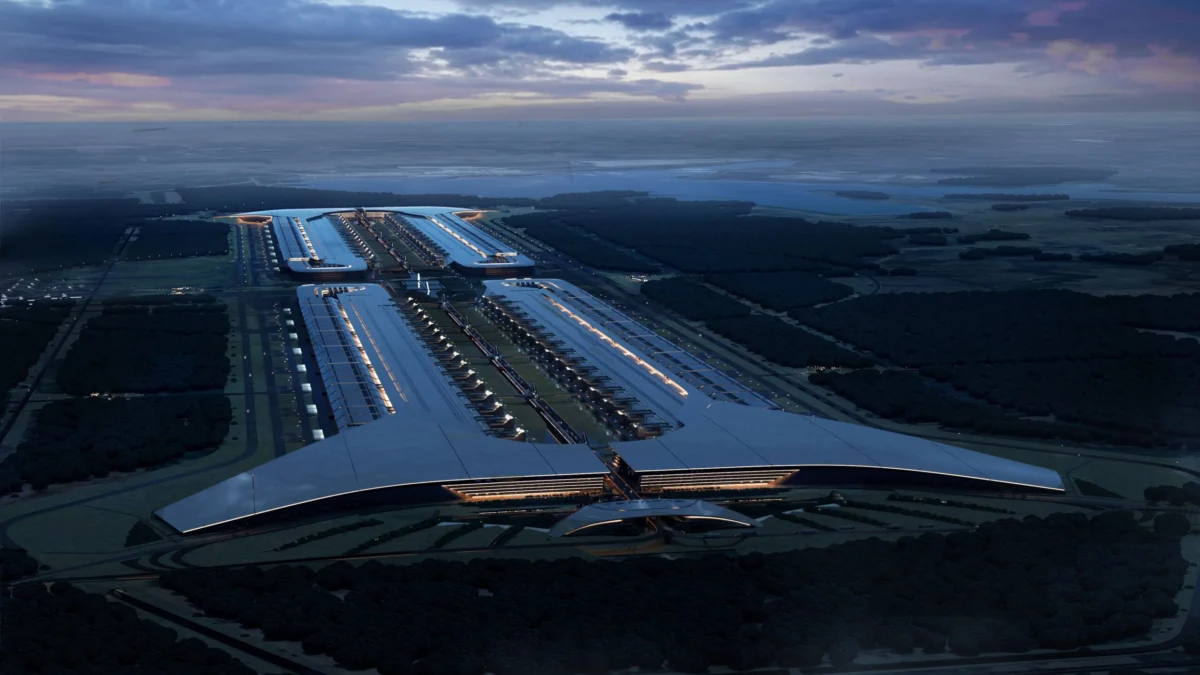
GRIMES COUNTY, Texas — In a move that seeks to redraw the map of global semiconductor manufacturing and consolidate the hardware ecosystems of his industrial empire, Elon Musk has announced that Tesla and SpaceX will jointly build a colossal semiconductor fabrication facility in Grimes County, Texas.
Dubbed "Terafab," the facility represents an initial joint investment of $16.8 billion, with long-term projections suggesting total expenditures could scale to an unprecedented $119 billion over a multi-phase development timeline. Designed to bridge the chasm between current global chip fabrication capacity and the exponential computational demands of artificial intelligence, autonomous transport, and orbital networks, the project is being described by Musk as "the largest and most valuable building on Earth by far."
Main Facts: The Genesis of Terafab
The joint venture between Tesla and SpaceX marks a rare, highly formalized manufacturing collaboration between the electric vehicle pioneer and the aerospace giant. Located in Grimes County—a predominantly rural area situated northwest of Houston and adjacent to Brazos County—the facility is designed to address a critical bottleneck in Musk’s long-term technology roadmap.
Key Dimensions of the Project:
- Initial Capital Expenditure: $16.8 billion committed jointly by Tesla and SpaceX.
- Potential Total Investment: Up to $119 billion over multiple phases, according to SpaceX regulatory filings.
- Physical Footprint: Planned for more than 100 million square feet of vertically integrated manufacturing space.
- Employment Impact: A commitment to hire at least 3,000 workers from Grimes and Brazos counties.
- Core Output: Advanced logic and memory devices, specifically optimized for edge computing, low-latency AI inference, and high-power aerospace operations.
The underlying motivation for Terafab is vertical integration carried to its logical extreme. Rather than relying on external foundries like Taiwan Semiconductor Manufacturing Company (TSMC) or Samsung to fabricate proprietary silicon designs—such as Tesla’s Full Self-Driving (FSD) chips or Dojo AI training tiles—Tesla and SpaceX intend to bring design, manufacturing, packaging, and testing under a single, gargantuan roof.
Chronology: From Whispers to a $16.8 Billion Reality
The path to Thursday’s official announcement has been marked by strategic silence, localized political maneuvering, and sudden public disclosures.
[April 2026]           [May 2026]              [Wednesday Night]        [Thursday Morning]
Intel signs on to      SpaceX filings hint     Heated Grimes County     Official joint reveal
the project as a       at $119B multi-phase    town hall meeting        by Musk & SpaceX;
partner.               capital expenditure.    over tax abatements.     site confirmed.
1. Early Partner Alliances (Spring 2026)
In April 2026, legacy semiconductor giant Intel signed on to contribute to the Terafab project. While Intel’s executive leadership remained guarded about the precise nature of their contributions—whether acting as an IP partner, providing packaging expertise, or supplying lithography equipment—the alliance signaled that Musk’s companies were actively courting established semiconductor veterans to de-risk the highly complex task of building a fab from scratch.
2. Regulatory Clues and Corporate Silence (May 2026)
By early May 2026, SpaceX regulatory filings began hinting at the staggering scale of the project, indicating that the aerospace firm’s multi-phase spending on the site could top $119 billion. However, during SpaceX’s first-quarter earnings call of that week, executives conspicuously avoided the topic of Terafab, choosing instead to focus on Starlink subscriber metrics and Starship launch cadences. This silence heightened anticipation and fueled speculation among industry analysts.
3. Local Friction (Mid-Week)
On Wednesday, the localized reality of the project collided with public scrutiny. Hundreds of residents packed a heavily attended Grimes County commissioners’ meeting. Community members expressed deep frustrations over what they characterized as a lack of transparency regarding the environmental footprint of the fab, alongside the substantial tax abatements proposed to lure the tech giants to the region.
4. The Thursday Announcement
Less than 24 hours after the contentious town hall, Elon Musk and SpaceX bypassed traditional media channels to formally unveil the project. Musk confirmed the Grimes County site on the social media platform X, while SpaceX updated its website with detailed specifications of the fab’s mission, scale, and environmental mitigation strategies.
Supporting Data: Engineering a 100 Million Square Foot Monolith
To comprehend the scale of Terafab, one must look at the physical and financial metrics that set it apart from any existing industrial facility in the world.
| Metric | Terafab (Planned) | TSMC Fab 18 (Taiwan) | Giga Texas (Tesla) |
|---|---|---|---|
| Footprint (Sq. Ft.) | 100+ Million | ~20 Million | ~10 Million |
| Initial Investment | $16.8 Billion | $17 Billion | $1.1 Billion |
| Projected Ultimate Cost | $119 Billion | ~$40 Billion (Site total) | N/A |
| Primary Focus | Logic, Memory, Packaging | Advanced Logic (3nm/5nm) | Vehicle & Battery Assembly |
Vertical Integration and Recursive Design
Traditional semiconductor supply chains are highly fragmented. A chip designed in California might be fabricated in Taiwan, sent to Malaysia for packaging and testing, and then shipped to Mexico for integration into an automotive electronic control unit (ECU).
SpaceX’s technical brief outlines a radically different approach:
"A vertically integrated factory with more than 100 million square feet of manufacturing space is planned. This facility will house the manufacturing, packaging, and testing of advanced logic and memory devices… Bringing these aspects together in one location will enable fast, recursive improvements and accelerate new compute deployed."
By consolidating fabrication and packaging, engineers can execute rapid hardware-software co-design feedback loops. If an edge-computing chip intended for a Tesla humanoid robot exhibits thermal anomalies during testing, the design can be modified and re-fabricated in days rather than months.
Target Hardware Portfolios
The factory’s output is earmarked for three distinct, high-volume computational paradigms:
- Edge Inference (Tesla Optimus): Humanoid robots operating in unstructured human environments require real-time, low-latency sensory processing. Terafab will produce highly specialized, low-power neural processing units (NPUs) tailored for the Optimus platform.
- Autonomous Vehicles (Tesla Cybercab): Level 4/5 autonomous driving demands massive redundant computing pipelines capable of processing high-resolution camera feeds instantly.
- Space-Based Data Centers (SpaceX Starlink): Perhaps the most ambitious aspect of the announcement is the production of high-power chips designed for SpaceX’s orbital data centers. By processing AI training and inference tasks directly in space, SpaceX aims to bypass ground-based latency bottlenecks and provide orbital cloud computing services.
Official Responses: Economic Promises vs. Local Skepticism
The announcement of Terafab has drawn a sharp line between state-level economic development officials, who view the project as a historic win, and local residents, who worry about the immediate impact on their rural way of life.
State and Educational Endorsements
Texas Governor Greg Abbott’s office aggressively promoted the expansion, framing it as a validation of the state’s business-friendly regulatory climate and its growing status as a domestic semiconductor hub.
As part of the state’s rollout, Dr. Sarah Borowicz, Superintendent of the Anderson-Shiro Consolidated Independent School District (CISD), championed the long-term educational benefits of the partnership:
"We believe this agreement will strengthen our district, expand opportunities, and better prepare our students for their future. There are defining moments in the life of a school district, and this is one of those moments. Our commitment now is to ensure that every opportunity created through this agreement is managed wisely, transparently, and always with students at the center of every decision."
Local school districts stand to benefit from a significantly expanded industrial tax base once the initial tax abatement periods expire, alongside potential STEM pipeline programs funded directly by Tesla and SpaceX.
Community Backlash and Environmental Mitigation
At the local level, the reception has been far more cautious. During Wednesday’s county meeting, residents voiced anxiety over the strain a 100-million-square-foot facility would place on local infrastructure, utility grids, and water tables. Semiconductor fabrication is notoriously water-intensive, requiring millions of gallons of ultra-pure water daily to wash silicon wafers during the photolithography process.
In an apparent bid to defuse these environmental concerns, SpaceX explicitly addressed its water sourcing strategy on Thursday, stating that the joint venture is "committing to the use of" surface water from the local Gibbons Creek Reservoir rather than tapping into the region’s fragile underground aquifers. This concession is aimed at preserving local groundwater levels, which agricultural operations in Grimes and Brazos counties rely on heavily.
Implications: The Geopolitical and Industrial Ripple Effects
The construction of Terafab carries profound implications that stretch far beyond the borders of East Texas, impacting global supply chain geopolitics, the AI hardware race, and the structure of Musk’s corporate empire.
                        ┌────────────────────────┐
                        │   Terafab Production   │
                        └───────────┬────────────┘
                                    │
         ┌──────────────────────────┼──────────────────────────┐
         ▼                          ▼                          ▼
┌─────────────────┐        ┌─────────────────┐        ┌─────────────────┐
│  Tesla Optimus  │        │ Tesla Cybercab  │        │ SpaceX Starlink │
│ Humanoid Robots │        │  Robotaxi Fleet │        │ Orbital Servers │
└─────────────────┘        └─────────────────┘        └─────────────────┘
1. Reducing Reliance on East Asian Foundries
Currently, the advanced semiconductor supply chain is heavily centralized in the Asia-Pacific region, specifically in Taiwan. Amid growing geopolitical tensions between the United States and China, both Tesla and SpaceX face existential risks if access to TSMC’s advanced nodes is compromised. Terafab provides Musk with a domestic insurance policy, aligning with the broader goals of the U.S. CHIPS and Science Act to onshore critical silicon manufacturing.
2. The Dawn of Space-Based Cloud Computing
By designing and fabricating chips optimized for "space-based data centers," SpaceX is preparing to pioneer a new tier of infrastructure. Satellites equipped with radiation-hardened, high-performance computing (HPC) chips could perform complex AI processing in orbit, transmitting only the processed results back to Earth. This could revolutionize military intelligence, climate monitoring, and global telecommunications.
3. A New Paradigm for Corporate Collaboration
Tesla (a publicly traded automotive and energy company) and SpaceX (a privately held aerospace firm) have historically shared engineering talent and material science breakthroughs on an informal basis. However, co-developing a $16.8 billion physical asset like Terafab represents a massive integration of their capital and operational structures. This joint venture could serve as a blueprint for how Musk intends to unify his various entities—including xAI and Neuralink—under a single, self-sustaining silicon foundation.
As construction begins in Grimes County, the tech and automotive sectors will be watching closely. If successful, Terafab will not only be the largest building on Earth, but the heart of an independent, vertically integrated technological empire.
