


In the digital age, the collector car market has undergone a radical transformation, moving from the hushed, tuxedoed atmosphere of traditional auction houses to the high-speed, 24/7 accessibility of online platforms. At the center of this revolution sits Bring a Trailer (BaT). Once a humble blog aggregating Craigslist finds, it has evolved into a global auction Goliath, turning the act of buying and selling vintage and enthusiast vehicles into a high-stakes spectator sport.
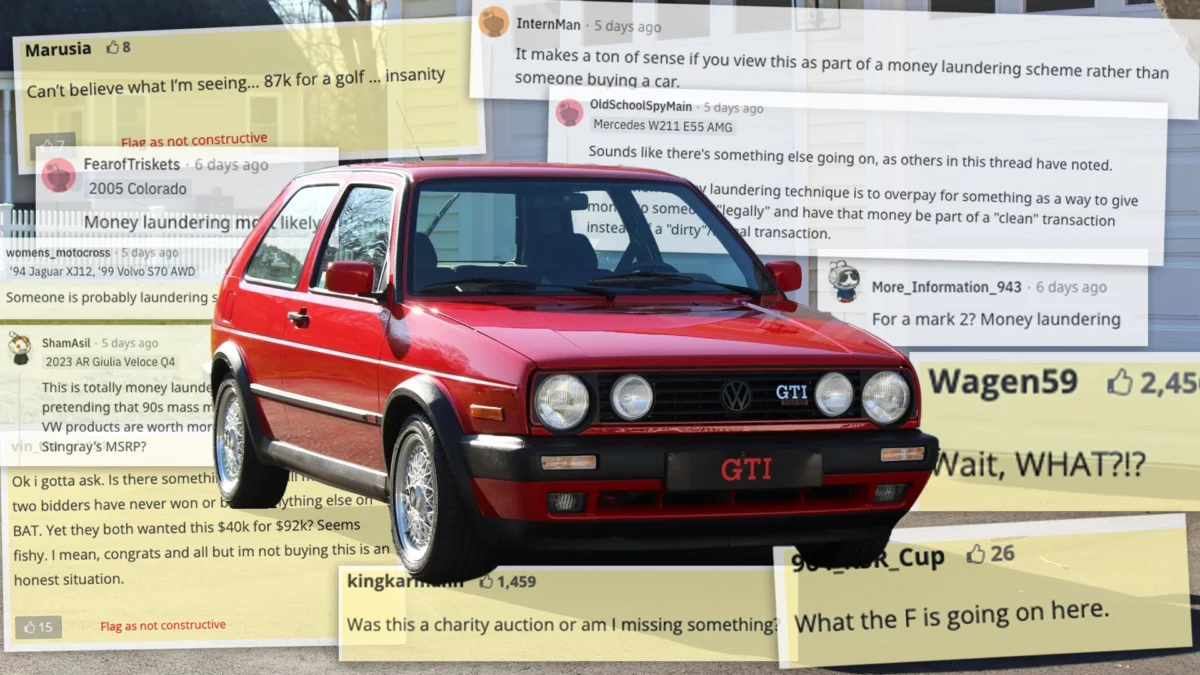
However, with its meteoric rise to prominence comes intense public scrutiny. When a seemingly mundane vehicle—such as a 1992 Volkswagen Golf GTI—fetches a staggering $87,000, the internet community often reacts with a blend of disbelief and suspicion. Amidst the "BaT tax" jokes and debates over valuation, a darker theory has frequently emerged in comment sections: Is this platform being used for money laundering?
On a recent episode of The Drivecast, Howard Swig, President of Bring a Trailer, addressed these allegations head-on, offering a rare glimpse into the mechanics of the world’s most influential online auction house.
The Anatomy of an Outlier: The $87,000 GTI Phenomenon
To understand why the public is so quick to suspect illicit activity, one must first look at the psychology of the enthusiast market. In recent years, cars like the BMW E30 M3 have seen their values skyrocket, a trend that is widely accepted as a result of scarcity and nostalgia. Yet, when the valuation curve is broken by an unexpected outlier, the shock is palpable.
The 1992 Volkswagen Golf GTI sale serves as the quintessential example. When the hammer fell at $87,000, the automotive world went into a collective frenzy. For the uninitiated, paying near-supercar money for a three-decade-old economy car seems irrational. To the seasoned collector, however, it represents the intersection of "museum-grade" preservation and the emotional premium of a "holy grail" find.
When observers cannot rationalize a price point through traditional market logic, they often reach for the most convenient explanation: financial criminality. But according to platform leadership, what the public perceives as "laundering" is often simply the byproduct of a digital stage that magnifies the quirks of extreme wealth.
Chronology of a Controversy: From Blog to Bull Market
The trajectory of Bring a Trailer is a masterclass in market disruption.
- The Origins (2007): Randy Nonnenberg and Gentry Underwood founded the site as a curated list of interesting cars for sale on various platforms. It was a community hub, not an auction house.
- The Pivot (2014): BaT officially launched its auction platform, stripping away the friction of traditional car buying. By keeping the community-driven comment section—a feature that allows for expert vetting and peer review—they created a layer of trust that didn’t exist elsewhere.
- The Pandemic Boom (2020-2022): COVID-19 accelerated the digitization of the collector car space. With physical shows shuttered, BaT became the primary theater for high-end vehicle transactions.
- The Scrutiny Phase (2023-Present): As prices hit record highs, the "money laundering" narrative moved from fringe conspiracy theory in comment threads to mainstream discourse, prompting the platform to address the elephant in the room.
Throughout this timeline, the platform has maintained that its growth is organic, driven by an expanding demographic of enthusiasts who have the disposable income to treat cars not just as vehicles, but as alternative asset classes.
Supporting Data: Why "The BaT Tax" Isn’t Just Noise
The term "BaT tax" refers to the premium often paid for cars sold on the site compared to the broader market. Critics argue this premium is artificial, inflated by shill bidding or, worse, illicit money entering the system. However, analysts point to several factors that justify these higher prices:
- Verified Pedigree: BaT’s vetting process is rigorous. Sellers must provide extensive documentation, service records, and high-resolution imagery. This reduces the "risk premium" for buyers.
- Global Liquidity: Traditional auctions are geographically limited. BaT allows a collector in Dubai to bid against a enthusiast in Ohio, creating a global price floor that is often higher than local markets.
- The "Voyeurism" Effect: As Howard Swig noted, the platform provides a public stage for the wealthy to spend their capital. The transparency of the process—where everyone can see the bid history and the participants—is ironically what fuels the suspicion, as it turns private transactions into public data points.
When questioned about why bidders sometimes jump by thousands of dollars—a move that looks like price manipulation to an outsider—Swig noted that such behavior is simply a reflection of personal wealth and intent. If a buyer wants to signal dominance in an auction, they will bid aggressively. It is a social performance, not a criminal one.
Official Responses: Howard Swig Sets the Record Straight
In his interview with The Drive, Howard Swig was characteristically candid. Addressing the allegations of money laundering, he dismissed the idea as "extreme" and fundamentally inaccurate.
"I think Bring a Trailer is one of these places where there’s this amazing voyeurism for people spending money," Swig explained. "And when people see that, and elsewhere too, people have all sorts of opinions."
Swig drew a compelling analogy to the world of fine wine. A collector may spend millions on a cellar of vintage Bordeaux, only to leave the bottles corked for decades. To a casual observer, that is a "waste" or an irrational use of capital. To the collector, it is a personal pursuit of joy and value preservation. The same logic applies to the $87,000 GTI: the buyer is not necessarily looking for a daily driver; they are acquiring a piece of history that they value at that price point.
Perhaps the most definitive response regarding the suspicion of laundering was Swig’s humorous reality check: "If you’re a money launderer and you are spending $90,000 on a… Golf GTI, I would love to meet you. I don’t know. That doesn’t seem like a wise way to do that."
Indeed, from a financial crime perspective, purchasing depreciable, difficult-to-transport, and highly visible physical assets is a poor strategy for washing illicit funds.
The Broader Implications: The Future of Collectibles
The controversy surrounding the $87,000 VW GTI is a microcosm of a broader shift in how society views value. As traditional assets like stocks and real estate become increasingly volatile, collectors are turning toward "passion assets."
The Trust Equation
The long-term viability of platforms like Bring a Trailer relies entirely on the perception of legitimacy. If the community ever believed that the platform was truly facilitating money laundering, the "social trust" that keeps bidders active would collapse. This is why leadership is so defensive of their reputation.
The Democratization of Appraisal
The most significant implication of the BaT model is that it has essentially crowdsourced vehicle appraisal. By allowing the public to comment on every aspect of a car—its rust, its service history, its provenance—the site has created a transparent, albeit sometimes brutal, market. While this occasionally leads to public shaming of sellers, it also ensures that the price paid is the result of a collective consensus rather than a secret backroom deal.
Final Thoughts
While the internet will likely continue to cry "money laundering" whenever a humble hatchback breaks a price record, the reality is far more mundane. It is a mix of nostalgia-driven inflation, the democratization of high-end auction access, and the simple fact that in a global market, there is always someone willing to pay more for a pristine piece of their childhood.
Bring a Trailer has successfully turned the niche hobby of car collecting into a mainstream financial phenomenon. The "crazy" prices are not evidence of a crime; they are evidence of a market that has finally, for better or worse, found its true global ceiling. For those still skeptical, the advice remains the same: if you don’t like the price, you don’t have to bid. But don’t mistake a high bid for a dark conspiracy.
