





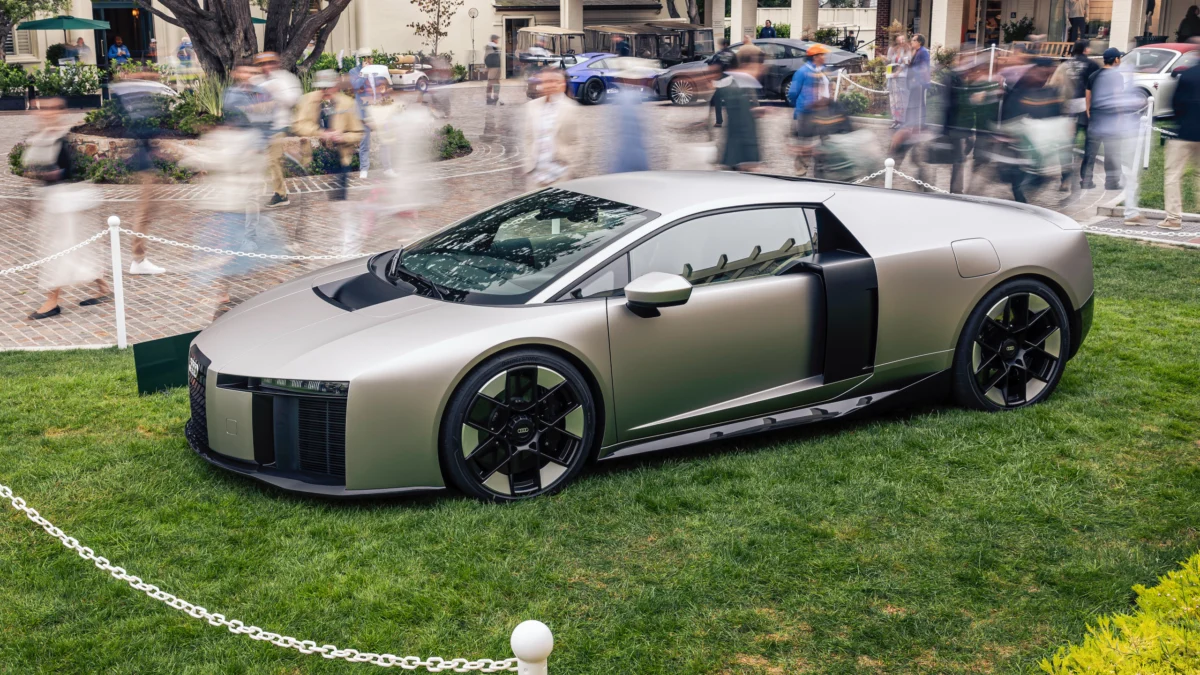
For nearly two decades, the Audi R8 stood as the gold standard of the “everyday supercar.” It was the bridge between the sterile precision of German engineering and the raw, visceral drama of Italian performance. When the R8 was retired, enthusiasts held their breath, waiting for the inevitable successor. Instead, they received the Audi Nuvolari—a 1,000-horsepower titan that shares the Lamborghini lineage of its predecessor but operates in an entirely different orbit.
While the Nuvolari’s silhouette might evoke nostalgia for the R8, Audi has been adamant: this is not a sequel. It is a departure. To understand why Audi walked away from the high-volume supercar segment to embrace a hyper-exclusive, limited-run strategy, we must look at the convergence of Formula One ambitions, stringent emissions regulations, and the shifting economics of high-performance manufacturing.
The Strategic Shift: From Mass Production to Halo Vision
The Audi R8 was a triumph of industrial scale. It proved that a supercar could be driven to the grocery store on a Tuesday and taken to the Nürburgring on a Sunday. However, the landscape for such vehicles has shifted dramatically.
In an exclusive sit-down with The Drive, Audi’s Chief Technology Officer and Head of R&D, Rouven Mohr, clarified that the Nuvolari was never intended to be a mass-market successor to the R8. Where the R8 was a volume-driven flagship designed to elevate the brand’s image across a broad spectrum, the Nuvolari is a “halo brand vision.” Its primary purpose is to serve as a physical manifestation of Audi’s entry into Formula One.
This shift in philosophy is not merely about aesthetics or branding; it is a calculated response to the realities of 21st-century automotive production. By pivoting to a limited-run model, Audi has traded the R8’s accessibility for the technical freedom required to push the boundaries of performance.
Chronology: The Race Against Time
The development of the Nuvolari was dictated by a timeline that left no room for the traditional, multi-year industrialization cycles seen in previous Audi sports cars. The project was conceived under intense pressure, with three primary drivers shaping its accelerated timeline.
1. The Formula One Deadline
Audi’s entry into the pinnacle of motorsport, Formula One, created an immediate, non-negotiable deadline. The brand needed a halo vehicle that could debut in tandem with its F1 efforts to cement its performance credentials. To meet this window, Audi abandoned the massive, cross-departmental bureaucracy typically associated with its flagship vehicle launches. Instead, they empowered a small, nimble “skunkworks” team, capable of making rapid decisions without the inertia of a massive corporate machine.
2. Navigating the Euro 6 to Euro 7 Transition
Regulatory compliance is the silent architect of modern automotive design. The Nuvolari team was racing to beat the regulatory pivot from Euro 6 to the significantly more stringent Euro 7 emissions standards. Had the project missed its target window, the cost of re-engineering the powertrain to meet the new regulations would have rendered the project financially non-viable. By launching within the Euro 6 timeframe, Audi was able to retain the raw, high-performance character of the engine without the compromises that would have been forced by the upcoming standards.
3. The Industrialization Pivot
Traditional supercar manufacturing relies heavily on metal tooling, which is a slow and expensive process. To achieve the Nuvolari’s lightning-fast development, Audi opted for carbon fiber technology. While material costs for carbon fiber are substantially higher than those for stamped metal, the tooling time is a fraction of the duration. By accepting higher material costs, Audi gained the speed necessary to align the vehicle’s launch with their F1 debut.
Supporting Data: The Economics of Exclusivity
To understand why the Nuvolari is destined to be a rare sighting rather than a showroom staple, one must examine the intersection of manufacturing costs and market saturation.
According to Rouven Mohr, the decision to use advanced carbon fiber construction creates a high "cost floor" for the vehicle. This means that even before the first unit is sold, the investment required to build the car is so high that selling it at a price point comparable to the R8 would result in catastrophic losses.
Furthermore, scaling production to the levels of the R8—which saw thousands of units produced over its lifespan—would be counterproductive. As Mohr notes, “If you have a 10,000 volume, you lose the exclusivity.” For a halo car intended to represent the absolute pinnacle of a brand’s technical capability, ubiquity is the enemy of desire. By capping production, Audi preserves the vehicle’s status as a collector’s item, ensuring that the “halo” remains bright and untarnished by the dilution that comes with mass production.
Official Perspectives: The CTO’s Rationale
Audi’s leadership is transparent about the trade-offs made during the Nuvolari’s creation. The engineering team faced a binary choice: build a car that is mass-producible but compromised, or build a car that is a technical masterpiece at the expense of volume.
Mohr emphasized the importance of this distinction:
“There are aspects that are enabling the short timeline that you cannot transfer to mass production. We decided also for the small volume to be fast and to accept higher material costs because we are choosing the carbon technology. If you go with metal, starting to make the tool until you have the tool is defining a big chunk of your industrialization timeline. So this is for sure not representative because you cannot do it in mass production.”
This admission highlights a critical evolution in how legacy automakers are adapting to a world where speed-to-market is increasingly the most valuable currency. By sacrificing the "scale" of the R8, Audi has secured a vehicle that serves as a high-octane advertisement for its future in motorsport.
Implications: A New Era for Audi Performance
The decision to position the Nuvolari as a niche halo model rather than a successor to the R8 sends a clear signal to the market. Audi is moving away from the concept of the "everyday" supercar and toward a model of specialized, event-driven performance.
The Death of the "Everyday Supercar"?
The R8 was a unique moment in history—a car that offered supercar performance without the punishing maintenance and reliability issues of its contemporaries. The Nuvolari, by contrast, is an uncompromising machine. Its reliance on expensive materials and a niche manufacturing process suggests that Audi is no longer interested in competing for the hearts of the daily-driver supercar market, at least not with a V8-powered, carbon-fiber-clad halo car.
Future-Proofing the Brand
By linking the Nuvolari so closely to its F1 program, Audi is effectively using the car to prime the market for its racing future. The implications are clear: future performance models from Audi will likely be more integrated with their motorsport efforts, utilizing technology transfers from the track to the road. This transition suggests that while we may lose the R8’s accessibility, we may gain a new breed of hyper-focused performance vehicles that are more technologically advanced than anything Audi has produced before.
A Collector’s Legacy
The Nuvolari’s status as a “limited-run footnote” is, in reality, a deliberate design choice. In the world of high-end automotive collecting, rarity is the ultimate driver of value. By avoiding the mass market, Audi is ensuring that the Nuvolari remains a sought-after relic, a testament to a specific moment in time when the company prioritized speed and F1 glory over the bottom-line benefits of high-volume sales.
Conclusion
The Audi Nuvolari is not the R8’s successor, and that is precisely the point. It is a bold, high-stakes project born from a unique set of circumstances: a looming regulatory wall, a global racing debut, and a shift toward exclusive, high-cost manufacturing. While fans of the R8 may mourn the loss of an accessible, everyday supercar, they must recognize that the Nuvolari represents a necessary evolution for Audi.
In a world where speed is the defining metric of success, Audi has chosen to build a car that captures the spirit of the moment, regardless of the cost. The Nuvolari is a signal that Audi’s future isn’t about repeating the successes of the past—it is about redefining the boundaries of what a performance halo car can be. Whether this strategy will pay off in the long run remains to be seen, but one thing is certain: for those lucky enough to own one, the Nuvolari will be far more than just a car—it will be a piece of history.
