





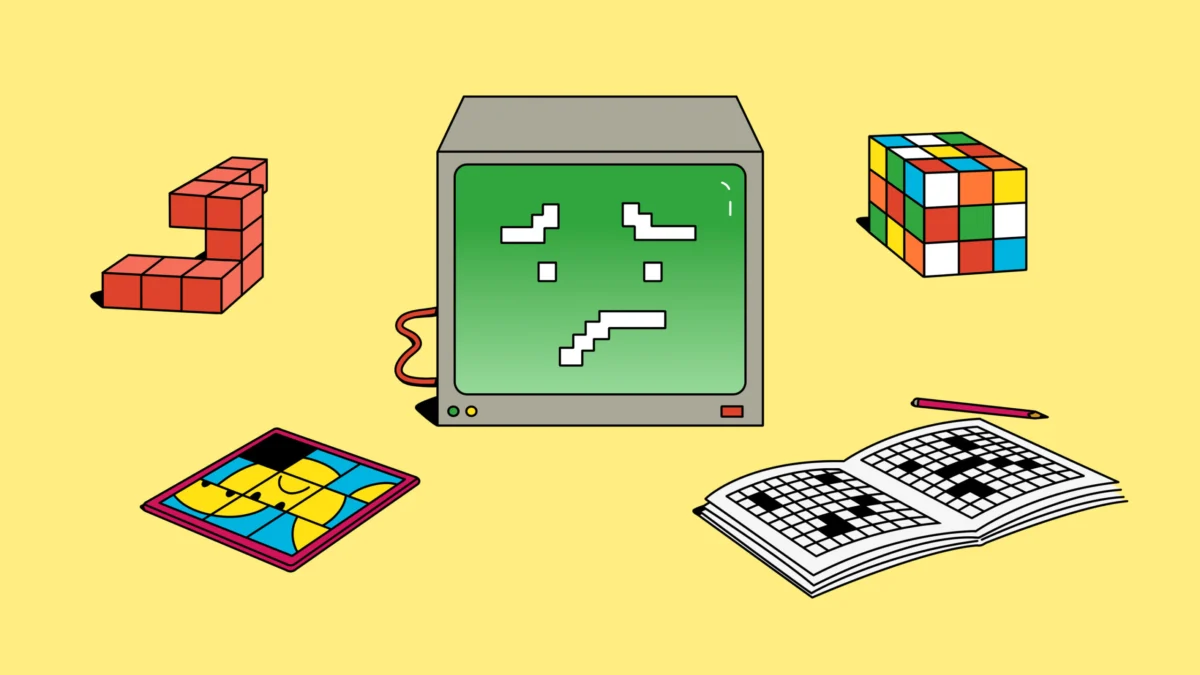
Since the dawn of the computing age, the quest to build a "thinking machine" has been inextricably linked to the humble puzzle. Whether it is a board game, a logic riddle, or a visual rotation task, games have served as the proving ground for artificial intelligence. From Arthur Samuel’s pioneering checkers-playing algorithm in 1959 to the seismic shocks of DeepMind’s AlphaGo, developers have used these "gaming gauntlets" to measure the distance between silicon-based computation and human intuition.
Today, we stand at a curious juncture. We are witnessing an era where Large Language Models (LLMs) can draft legal briefs, write functional code, and summarize complex medical journals in seconds. Yet, these same models frequently falter when faced with simple riddles that a primary school student might solve with ease. As we peel back the layers of these failures, we are not just measuring AI’s performance—we are gaining a rare, granular window into the fundamental differences between machine logic and human cognition.
A Brief Chronology of AI’s Puzzling Progress
The history of AI development is essentially a history of increasing complexity in game theory. In the mid-20th century, machines were restricted to "perfect information" games like checkers and chess, where every move could be calculated through brute-force computation. By the 2010s, AI had moved into the realm of intuition, with AlphaGo mastering the Chinese game of Go—a feat previously thought to be decades away due to the near-infinite number of potential board configurations.
The current frontier, however, is not just about raw power; it is about reasoning. In late 2024, researchers from Columbia University delivered a sobering report: the most advanced AI models of the time were only able to solve roughly 18% of the New York Times "Connections" puzzles. These puzzles require a sophisticated grasp of category association, wordplay, and cultural context.
The pace of improvement has been nothing short of blistering. By early 2025, optimized models were solving these same puzzles with near-perfect accuracy. This rapid ascent suggests that AI is moving beyond simple pattern matching into the territory of linguistic deduction. However, as the following sections demonstrate, this progress is uneven, characterized by surprising blind spots that reveal the artificial nature of their "intelligence."
The Spatial Reasoning Gap: Where Models Fumble
One of the most persistent hurdles for AI is spatial reasoning. Humans possess an innate, evolved ability to understand the physical world—to look at a 2D drawing of an object and mentally rotate it in 3D space. While modern multimodal LLMs can ingest visual data, they struggle to "manipulate" that information.
When presented with classic IQ-style mental rotation tasks, even state-of-the-art models often fail. This failure is significant because it highlights a disconnect between the model’s training data (often millions of images) and a true internal "world model." While an architect or a mechanical engineer can intuitively grasp how a gear meshes with a rod, an LLM often attempts to solve the problem by predicting the next logical token rather than simulating the physical interaction. This suggests that for all their linguistic fluency, LLMs remain largely disconnected from the physical laws that govern our reality.
The Memory Trap: Why Knowing Too Much Can Be a Liability
The irony of modern AI is that its greatest strength—its near-total recall of the internet’s collective knowledge—is often its greatest weakness. Frontier models have been exposed to a "monstrous volume" of text during training. This gives them an edge in trivia and historical data, but it blinds them to nuance.
This is best illustrated by studies on "Knights and Knaves" puzzles—classic logic problems involving truth-tellers and liars. Researchers from Google and the University of Illinois Urbana-Champaign found that when models were presented with variations of these puzzles, they often ignored subtle changes in the phrasing. Instead, the model defaulted to the version of the puzzle it had "memorized" during its training phase.
This behavior is echoed in "SimpleBench," a testing suite designed to catch models off-guard. These problems are phrased in ways that resemble standard textbook questions. A human reader pauses to identify the trick, while an AI, eager to provide a statistically probable answer, often trips over the discrepancy. The model is not reasoning; it is hallucinating a solution based on high-frequency patterns.
ARC-AGI: The Quest for Abstract Reasoning
If LLMs are to achieve anything resembling "General" Intelligence (AGI), they must be able to infer abstract rules from minimal information. This is the goal of the ARC-AGI (Abstraction and Reasoning Corpus) benchmark. Unlike traditional tests, ARC asks the model to look at three examples of a transformation and apply that rule to a new, unseen grid.
Current research suggests that even when AI models solve these puzzles, they often do so by utilizing overly complex, brittle logic that does not translate to other tasks. Humans, by contrast, use simple visual concepts (e.g., "move the blue dot to the corner"). The persistence of these failures suggests that while AI is getting better at mimicry, it is still struggling to develop the "generalizable rules" that define human common sense.
Cognitive Foibles: The Human Counter-Punch
Perhaps the most fascinating aspect of this research is the discovery that humans, too, have predictable cognitive biases. In a "Lightning Round" of psychological puzzles, researchers found that humans often fall for "knee-jerk" answers based on intuition, whereas models—which are not prone to the same biological shortcuts—can sometimes provide the correct, deliberative answer.
For instance, in a puzzle involving a population of bats that doubles daily, humans often intuitively grasp for the answer "30 days" (half of 60) because our brains are wired for simple linear division. A model, if properly prompted to calculate, will correctly identify "59 days." This underscores a fundamental truth: human intelligence is not always superior; it is simply different. Our "flaws"—our cognitive biases and heuristics—are the same mechanisms that allow us to navigate a complex, unpredictable world without having to perform a complex calculation for every decision.
Implications: The Scaling Wall
As we look toward the future, the question becomes: is the AI "intelligence" we are seeing a matter of scale, or is it a fundamental limitation of the underlying architecture?
Researchers at Apple recently explored this by testing LLMs on the "Tower of Hanoi" and river-crossing puzzles. They found that models perform exceptionally well on small-scale versions of these problems, but accuracy drops off a cliff as soon as the complexity reaches a certain threshold. This suggests that AI models are effectively "memorizing the path" to a solution for simple instances, but lack the abstract planning capabilities required to navigate truly complex, multi-step logical environments.
Some critics argue this is merely a "scaling" issue—that if we provide enough compute and data, the models will eventually "figure it out." Others, however, believe that we have reached a structural limit. They argue that without an underlying, persistent representation of logic and physical laws, an LLM will always be a sophisticated probabilistic engine rather than a true reasoner.
Official Responses and Industry Outlook
The AI research community is currently divided on the path forward. Advocates of the "scaling hypothesis" continue to push for larger, more parameter-dense models, pointing to the rapid gains made between 2024 and 2025. Conversely, proponents of neuro-symbolic AI argue that we must integrate formal, symbolic logic into the neural network architecture to ensure that models follow the rules of mathematics and physics, rather than just guessing what the next word should be.
The implications for the industry are profound. If we rely on models for high-stakes decision-making—in medicine, engineering, or legal strategy—we need to know where the "reasoning cliff" lies. If an AI can solve a simple logic puzzle but fails to account for a variable in a real-world scenario, the consequences could be catastrophic.
Conclusion: The Test of Time
The puzzles highlighted in this exploration are more than just games. They are the frontline of a revolution in how we understand both machine and human potential. When you solve one of these riddles faster than a multi-billion dollar supercomputer, you are witnessing the unique capacity of the human mind to contextualize, adapt, and reason in a way that remains, for now, distinctly our own.
As for the machines? They are improving. The 18% success rate of 2024 is already a memory. But until they can navigate the world with the same robust, intuitive grasp of reality that a human child possesses, the "gaming gauntlet" will remain the best way to ensure that we are building tools that understand the world, rather than just predicting it.
For the time being, the humans are still in the lead. But in the rapidly evolving world of artificial intelligence, the margin is shrinking every day.
