

The autonomous vehicle (AV) sector has long been characterized by grand promises, astronomical valuations, and, in many cases, prolonged timelines to commercialization. While high-profile developers of robotaxis and long-haul self-driving semi-trucks have frequently grabbed headlines—only to face regulatory headwinds and technical bottlenecks—a quieter, more targeted segment of the market has been steadily demonstrating commercial viability.
Gatik, a Silicon Valley-based autonomous vehicle startup specializing in "middle-mile" logistics, has emerged as a dominant force in this pragmatic slice of the industry. The company recently announced a major milestone, securing $200 million in its latest funding round. This significant capital injection comes just two months after Gatik finalized a landmark, multiyear commercial agreement with consumer goods giant PepsiCo.
Led by prominent global institutional investors, the funding round marks a transition for Gatik. The company is shifting from a promising technology startup executing localized pilot programs to a mature, scaled enterprise operating driverless commercial routes for some of the world’s largest retailers and consumer packaged goods (CPG) companies.
Main Facts: Inside Gatik’s $200 Million Funding Round
Gatik’s $200 million funding round represents the company’s largest single capital raise to date. The investment was co-led by the Qatar Investment Authority (QIA)—the sovereign wealth fund of the State of Qatar—and Koch Disruptive Technologies, an investment arm of the industrial conglomerate Koch Industries. Additional participation came from a diverse syndicate of institutional and strategic investors, including Millennium Management, ARK Invest, and Intact Private Capital.
GATIK FUNDING & REVENUE AT A GLANCE
┌──────────────────────────────────────┬──────────────────────────────────────┐
│ Total Capital Raised Since 2019      │ ~$500 Million                        │
├──────────────────────────────────────┼──────────────────────────────────────┤
│ Latest Funding Round (2024)          │ $200 Million                         │
├──────────────────────────────────────┼──────────────────────────────────────┤
│ Contracted Commercial Revenue        │ $600 Million                         │
├──────────────────────────────────────┼──────────────────────────────────────┤
│ Current Workforce Size               │ 350+ Employees                       │
└──────────────────────────────────────┴──────────────────────────────────────┘
While Gatik declined to disclose its exact post-money valuation, the size of the round and the caliber of the participating institutions reflect strong investor confidence. Since emerging from stealth mode in 2019, Gatik has raised approximately $500 million in total venture and institutional capital.
The primary objective of this fresh capital is rapid commercial scale. Gatik plans to use the funds to:
- Expand its engineering and operational teams beyond its current 350-person workforce.
- Increase the production and deployment of its third-generation autonomous box trucks.
- Deepen its market penetration in existing logistics hubs.
- Launch operations in new metropolitan markets across North America, with long-term plans to expand internationally.
The funding arrives on the heels of a massive commercial expansion. Gatik has secured $600 million in contracted revenue from its customer base, which includes retail giants and household brands such as Walmart, Kroger, Tyson Foods, Canada’s Loblaw Companies Limited, and PepsiCo.
Chronology: The Strategic Evolution of a Middle-Mile Pioneer
Gatik’s rise to prominence is the result of a highly disciplined, phased approach to autonomous vehicle development. Unlike competitors that attempted to solve the highly complex edge cases of urban passenger driving or the high-speed challenges of interstate long-haul trucking, Gatik focused exclusively on the "middle mile." This refers to the transport of goods between distribution centers, fulfillment hubs, and retail outlets.
GATIK's PATH TO COMMERCIAL SCALE
 ── 2019: Emerged from stealth; launched pilot with Walmart in Arkansas.
 ── 2020: Expanded to Canada through a strategic partnership with Loblaw.
 ── 2021: Achieved fully driverless commercial operations (no safety driver) with Walmart.
 ── 2022: Scaled operations to Texas and Kansas; partnered with Kroger and Tyson Foods.
 ── 2023: Deployed 3rd-generation autonomous platform capable of highway speeds and adverse weather.
 ── 2024: Signed multiyear PepsiCo deal; secured $200M in new funding to accelerate scaling.
2019: Stealth Exit and the Walmart Foundation
Gatik emerged from stealth in June 2019, announcing a strategic partnership with Walmart. The initial operations took place in Bentonville, Arkansas, where Gatik’s autonomous box trucks moved goods on a fixed, two-mile route between a dark store (a fulfillment center closed to the public) and a neighborhood market. This early phase allowed Gatik to validate its hardware and software stack in a controlled, predictable environment.
2020: International Expansion and Regulatory Milestones
In late 2020, Gatik expanded its geographic footprint into Canada by partnering with Loblaw Companies Limited, the country’s largest food and pharmacy retailer. Operating in the Toronto metropolitan area, Gatik began transporting PC Express online grocery orders from Loblaw’s micro-fulfillment center to retail locations.
2021: Removing the Safety Driver
A watershed moment for Gatik—and the broader AV industry—occurred in 2021. Following intensive safety testing and regulatory approvals, Gatik completely removed the safety driver from the cab of its trucks on commercial routes operated for Walmart in Arkansas. This marked the first time in autonomous trucking history that a company successfully transitioned to fully driverless commercial operations on a middle-mile route.
2022–2023: Scaling Up and Tech Iteration
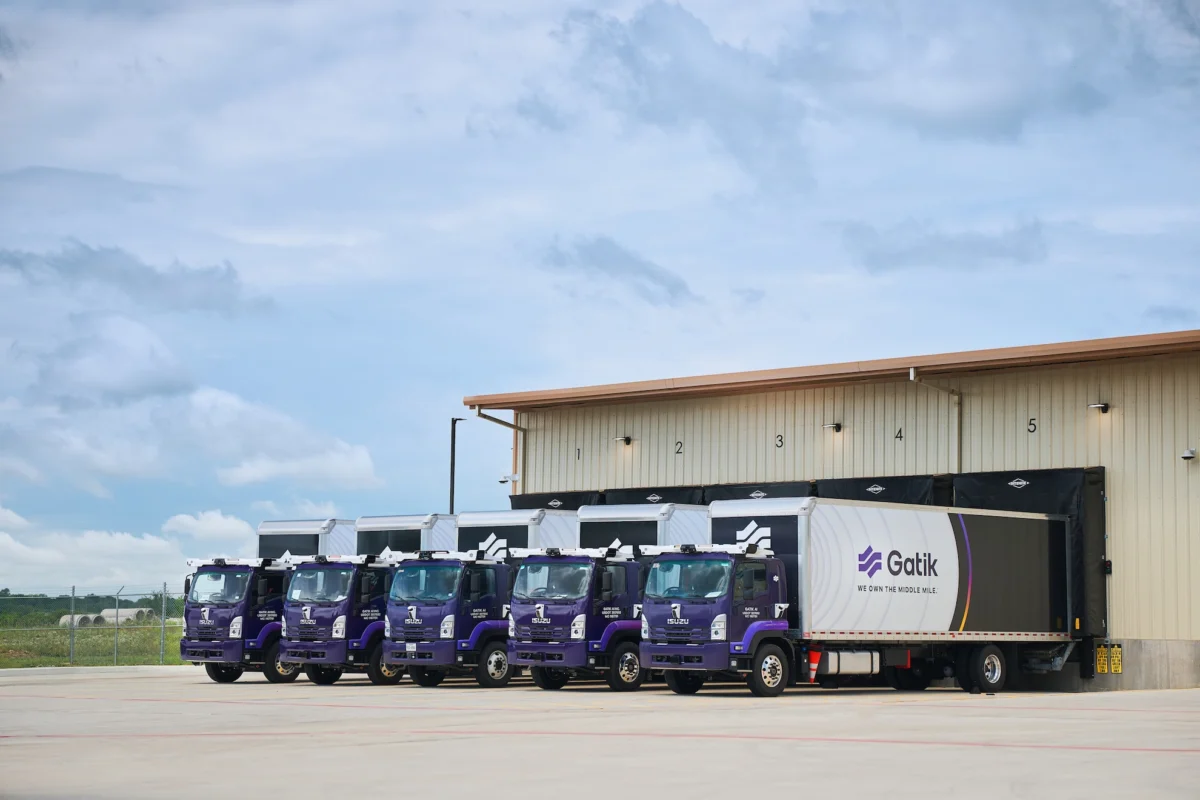
During this period, Gatik scaled its operations to Texas and Kansas, establishing partnerships with major grocery chain Kroger and food processor Tyson Foods. Concurrently, Gatik rolled out its third-generation autonomous driving technology. Developed in collaboration with Isuzu Motors, these medium-duty box trucks were engineered with redundant steering, braking, and electrical systems, enabling safe, driverless operations on both urban surface streets and high-speed highways.
2024: The PepsiCo Mega-Deal and Series C Funding
In mid-2024, Gatik finalized a multiyear agreement with PepsiCo’s Frito-Lay division. Under this agreement, Gatik deployed a fleet of 41 autonomous box trucks to transport products like Cheetos, Doritos, and Ruffles from distribution centers to retail locations in Dallas, Phoenix, and Northwest Arkansas. This high-volume commercial contract served as the prelude to the $200 million funding round, solidifying Gatik’s status as an active, revenue-generating AV operator.
Supporting Data: Fleet Metrics, Revenue, and Technical Capabilities
Gatik’s commercial success is anchored in tangible operational data and measurable efficiency gains for its customers. By focusing on fixed, repeatable routes, the company has bypassed many of the unpredictable variables that plague other autonomous driving applications.
Operational Reach and Route Dynamics
Gatik’s route capabilities have expanded significantly since its inception:
- Initial Operations (2019): Fixed-route trips of under 10 miles, operating primarily on low-speed surface streets.
- Current Operations (2024): Dynamic, multi-point routing structures spanning up to 400 miles, incorporating both urban corridors and high-speed interstate highways.
- Operational Availability: Gatik’s third-generation fleet is capable of 24/7 continuous operation, navigating challenging environmental conditions including light rain, snow, and night driving.
Fleet Specifications and Hardware Redundancy
Gatik’s fleet is built on the Isuzu medium-duty truck platform, customized with an automotive-grade, redundant sensor suite:
┌───────────────────────────────────────────────────────────────────────────┐
│                    GATIK 3RD-GENERATION AV PLATFORM                       │
├───────────────────┬───────────────────────────────────────────────────────┤
│ Vehicle Base      │ Isuzu Medium-Duty Box Truck (Class 3 to Class 6)      │
├───────────────────┼───────────────────────────────────────────────────────┤
│ Sensor Suite      │ High-resolution LiDAR, Radar, and Optical Cameras     │
├───────────────────┼───────────────────────────────────────────────────────┤
│ Redundancies      │ Dual-redundant steering, braking, and power systems   │
├───────────────────┼───────────────────────────────────────────────────────┤
│ Operational Scope │ Surface streets, arterial roads, and highways         │
└───────────────────┴───────────────────────────────────────────────────────┘
Commercial and Financial Performance
Unlike many venture-backed AV companies that operate at a loss with no clear path to profitability, Gatik has established a robust financial foundation:
- Contracted Revenue: $600 million in locked-in commercial contracts.
- Customer Retention: 100% of Gatik’s major enterprise clients (Walmart, Loblaw, Kroger, Tyson, PepsiCo) have transitioned from initial pilots to long-term commercial contracts.
- Labor and Efficiency Gains: By removing the driver, Gatik’s clients report up to a 30% reduction in middle-mile transportation costs, alongside improved transit predictability and asset utilization.
Official Responses: Executive and Investor Insights
The leadership team at Gatik and its primary financial backers view this funding round as validation of the company’s highly focused business model.
In an interview discussing the funding, Gautam Narang, co-founder and CEO of Gatik, emphasized the strategic importance of choosing the right investment partners:
"These are all long-term investors. All the scale-up plans that we have and the growth that we have in mind for the next few years—these are the kind of financial partners that can help us. For us, scaling means more driverless trucks, more customers, and more cities. Eventually, this capital will help us expand our footprint outside of North America."
Narang also highlighted the technical maturity that facilitated the funding, noting:
"The technology has evolved and matured a lot over the last few years, especially with the latest generation of our tech. Our third-generation self-driving trucks operate around the clock on surface streets and highways, and they can handle light rain and snow without compromising safety or delivery timelines."
Representatives from Koch Disruptive Technologies and the Qatar Investment Authority have echoed this sentiment, pointing out that Gatik’s immediate path to revenue sets it apart in a crowded AV landscape. According to institutional investment analysts close to the deal, QIA’s participation aligns with its broader mandate to invest in disruptive, late-stage technology companies that possess clear commercial utility and a sustainable competitive advantage.
Implications: The Future of Middle-Mile Logistics and the AV Landscape
Gatik’s successful $200 million raise has broader implications for the global logistics and autonomous vehicle sectors. It highlights a clear divergence in the AV market: while generalized, open-ended autonomous driving (such as urban robotaxis and interstate long-haul trucking) continues to face steep technical and regulatory hurdles, specialized, constrained autonomy is thriving.
AV MARKET DIVERGENCY: OPEN-ENDED VS. CONSTRAINED AUTONOMY

   OPEN-ENDED AUTONOMY                   CONSTRAINED AUTONOMY (GATIK)
   (Robotaxis & Long-Haul)               (Middle-Mile Logistics)
   ┌───────────────────────────────┐     ┌───────────────────────────────┐
   │ • High environmental chaos    │     │ • Repeatable, fixed routes    │
   │ • High-speed edge cases       │     │ • Predictable hub-to-hub runs │
   │ • Stiff regulatory resistance │     │ • Clear regulatory approvals  │
   │ • Delayed path to revenue     │     │ • Immediate commercial value  │
   └───────────────────────────────┘     └───────────────────────────────┘
1. Solving the Supply Chain Bottleneck
The middle mile has traditionally been one of the most inefficient segments of the retail supply chain. Consumer demand for rapid, same-day delivery has forced retailers to transition from massive, centralized distribution centers to decentralized networks of micro-fulfillment centers and local hubs.
This shift requires high-frequency, short-haul freight movements. However, a persistent shortage of commercial truck drivers, rising labor costs, and strict hours-of-service regulations have made scaling this model difficult. Gatik’s autonomous box trucks offer a direct solution, enabling retailers to run continuous, high-frequency logistics networks without being limited by driver availability.
2. A Blueprint for Sustainable AV Commercialization
The capital-intensive nature of AV development has led to consolidation across the industry. Several well-funded autonomous trucking startups have shut down or restructured due to high cash burn rates and distant commercialization timelines.
Gatik’s success offers a different path forward. By focusing on a constrained, highly repeatable operational design domain (ODD), Gatik was able to achieve fully driverless operations quickly. This pragmatic approach allowed the company to generate commercial revenue early in its lifecycle, de-risking the business for late-stage institutional investors like QIA and Koch Disruptive Technologies.
3. Regulatory and Public Acceptance
Because Gatik’s trucks operate on fixed, predictable routes—often bypassing dense, chaotic pedestrian centers—they have faced fewer regulatory challenges than robotaxis. The predictability of middle-mile routes allows Gatik to build deep, collaborative relationships with local law enforcement, state departments of transportation, and municipal planning departments. This collaborative approach has helped establish a safety-first precedent, building public trust in autonomous freight transport.
4. What Lies Ahead
With $200 million in fresh capital, a $600 million backlog of contracted revenue, and deep partnerships with world-class manufacturers like Isuzu, Gatik is well-positioned to dominate the middle-mile market.
As the company expands its fleet across North America and prepares for international market entry, its trajectory suggests that the future of autonomous transportation may not be defined by passenger vehicles navigating chaotic city centers, but rather by driverless box trucks quietly, efficiently, and reliably keeping retail shelves stocked around the clock.
