




Federal safety regulators have cleared one of the most significant regulatory hurdles for the autonomous vehicle (AV) industry, granting Amazon-owned Zoox a temporary exemption that will allow the company to charge passengers for rides in its custom-built, steering-wheel-less robotaxi.
The decision, announced by the National Highway Traffic Safety Administration (NHTSA) and published in the Federal Register, represents a historic shift in how the federal government regulates vehicles designed from the ground up without human controls. By permitting Zoox to bypass legacy safety standards written for human-driven cars, the federal government has signaled a new era of regulatory flexibility aimed at accelerating the commercialization of fully automated transport.
Main Facts: The NHTSA Exemption and Its Parameters
The core of the NHTSA’s decision lies in granting Zoox a temporary exemption from eight Federal Motor Vehicle Safety Standards (FMVSS). These standards, established decades ago, mandate physical features designed for human operators—such as steering wheels, accelerator and brake pedals, physical side-view mirrors, and windshield defrosting systems.
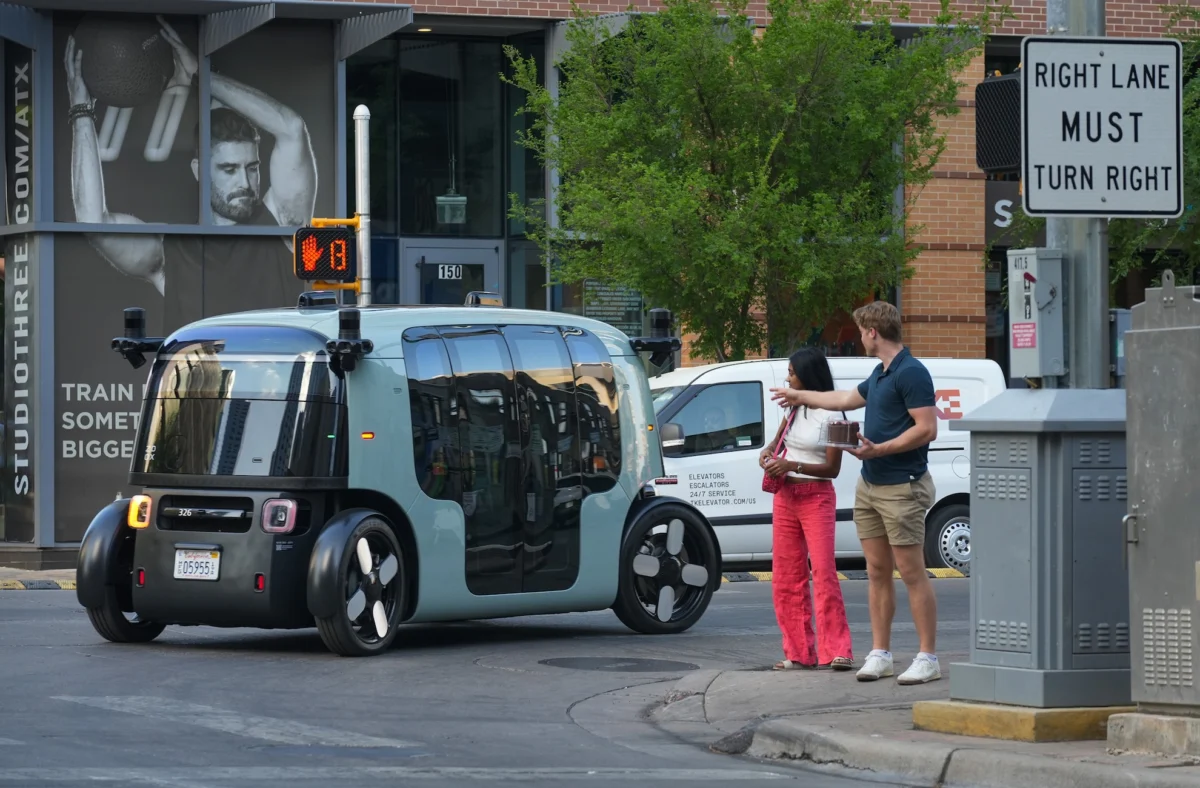
Because Zoox’s vehicle is a "purpose-built" robotaxi—a carriage-style vehicle where passengers sit facing one another with no driver’s seat—these traditional mechanisms are entirely absent. The vehicle relies instead on a complex array of lidar, radar, cameras, and proprietary software to navigate, alongside built-in sensor-cleaning systems that render traditional windshield defrosting standards obsolete for the vehicle’s operational safety.
+-----------------------------------------------------------------+
|                   NHTSA EXEMPTION PARAMETERS                    |
+------------------------------------+----------------------------+
| Fleet Limit                        | Up to 2,500 vehicles/year  |
+------------------------------------+----------------------------+
| Duration of Exemption              | Two Years                  |
+------------------------------------+----------------------------+
| Scope of Exemptions                | 8 FMVSS Standards          |
|                                    | (Braking, Defrosting, etc.)|
+------------------------------------+----------------------------+
| Primary Launch Market              | Las Vegas, Nevada          |
+------------------------------------+----------------------------+
| Regulatory Oversight               | Enhanced, adaptable        |
|                                    | monitoring structure       |
+------------------------------------+----------------------------+
To balance innovation with public safety, the NHTSA has placed strict guardrails on the commercial authorization:
- Production Caps: Zoox is permitted to deploy a maximum of 2,500 exempted vehicles annually.
- Timeframe: The exemption is valid for a temporary period of two years.
- Oversight Structure: Zoox will be subject to what the NHTSA describes as an "enhanced, adaptable oversight structure." This framework is designed to evolve in tandem with Zoox’s technology, requiring continuous data sharing regarding system performance, disengagements, and any safety-related anomalies.
Chronology: Zoox’s Journey from Stealth Startup to Commercial Competitor
The regulatory greenlight is the culmination of a decade-long development cycle for Zoox, which was founded in 2014 with the contrarian vision of building a bespoke autonomous vehicle rather than retrofitting existing passenger cars.
- June 2020: Amazon acquires Zoox for an estimated $1.2 billion, providing the capital-intensive venture with the deep financial backing needed to sustain long-term research, development, and regulatory testing.
- December 2020: Zoox officially unveils its purpose-built robotaxi, showcasing its bidirectional driving capabilities, four-wheel steering, and symmetrical design.
- February 2023: Zoox conducts its first successful run of its robotaxi on public roads in California with passengers on board, initially limiting transport to its own employees.
- August 2025: The NHTSA grants Zoox a preliminary testing exemption. This allows the company to demonstrate its custom-built vehicles on public roads and offer rides to public passengers in major urban centers like San Francisco and Las Vegas. However, under the terms of this permit, Zoox is strictly prohibited from charging fares.
- Present Day: The NHTSA upgrades this status to a commercial exemption, clearing the path for paid passenger operations. Zoox announces plans to launch its paid commercial service first in Las Vegas, Nevada, before expanding to other metropolitan areas.
  [2014] Zoox Founded (Vision of a purpose-built AV)
    │
  [2020] Acquired by Amazon ($1.2B) & Vehicle Unveiled
    │
  [2023] First Public Road Tests (Employee Shuttle in CA)
    │
  [2025] NHTSA Testing Exemption Granted (Free Rides Only)
    │
  [Present] Landmark Commercial Exemption Granted (Paid Rides Allowed)
Despite the federal milestone, Zoox must still navigate local regulatory landscapes before deploying its paid service at scale. In California, where the company is headquartered and currently runs extensive testing, Zoox must secure driverless deployment permits from both the California Public Utilities Commission (CPUC) and the Department of Motor Vehicles (DMV) before it can charge a single dime in the Golden State.
Supporting Data and the Broader Regulatory Shift
The decision to grant Zoox its commercial exemption was not an isolated ruling. It was part of a broader package of autonomous vehicle policy updates released by the NHTSA, aimed at streamlining the deployment of next-generation transportation technologies while establishing a unified safety baseline.
Accelerating National AV Standards
Alongside the Zoox announcement, the NHTSA revealed a new partnership with the SAE Industry Technologies Consortia. The agency is funding a three-year, $5 million consortium tasked with gathering real-world deployment data. The primary objective of this project is to accelerate the creation of a single, standardized national framework for AV safety performance. Currently, AV operators face a patchwork of state-level regulations, which industry advocates argue slows down deployment and creates confusion.
Updating the Exemption Process
The NHTSA is also updating its broader administrative exemption process. This reform will allow traditional and non-traditional automakers to temporarily sell a limited number of non-compliant vehicles, primarily to test new, experimental safety and driving technologies under real-world conditions.
Expansion to Autonomous Delivery
Demonstrating that the regulatory overhaul extends beyond passenger ride-hailing, the NHTSA confirmed it is formally reviewing an exemption application from Robomart. The Los Angeles-based startup has developed a low-speed, driverless delivery vehicle capable of carrying up to 500 pounds of consumer goods.
+-----------------------------------------------------------------+
|               NHTSA THURSDAY REGULATORY ROUNDUP                 |
+-------------------+---------------------------------------------+
| Zoox Decision     | Granted 2-year commercial exemption for     |
|                   | up to 2,500 purpose-built robotaxis/year.   |
+-------------------+---------------------------------------------+
| SAE Partnership   | $5 million, 3-year consortium to establish  |
|                   | a single national AV safety standard.       |
+-------------------+---------------------------------------------+
| Policy Update     | Streamlined exemption process for testing   |
|                   | non-compliant experimental vehicles.        |
+-------------------+---------------------------------------------+
| Robomart Review   | Undergoing initial evaluation for 500-lb    |
|                   | capacity autonomous delivery pods.          |
+-------------------+---------------------------------------------+
Official Responses: Industry and Regulatory Perspectives
The announcement drew strong reactions from corporate leadership and federal regulators, both framing the decision as a critical juncture for American technological competitiveness.
Aicha Evans, CEO of Zoox, hailed the decision as a validating moment for the company’s long-term product strategy.
"We are honored to receive the first-ever commercial exemption for a purpose-built robotaxi from NHTSA, enabling us to begin charging for our service and take another step toward bringing autonomous ride-hailing to more communities," Evans said in an official statement. "This marks an important milestone for our company and the future of autonomous mobility."
NHTSA Administrator Jonathan Morrison emphasized that the agency’s goal is to foster innovation without compromising public safety. He framed the regulatory updates as a balanced approach to cutting red tape.
"By removing unnecessary barriers to innovation, developing industry guidance, and providing strong enforcement oversight while we create performance requirements, NHTSA is taking a balanced approach to AV regulation," Morrison stated. "These advancements will ensure that the United States continues to lead the world in AV technology in a safe and responsible manner."
Implications: The Future of the Autonomous Ride-Hailing Market
The NHTSA’s ruling has profound implications for the competitive dynamics of the autonomous vehicle industry, shifting the battlefield from retrofitted passenger cars to purpose-built, high-utility cabins.
Purpose-Built vs. Retrofitted AVs
To date, the commercial robotaxi market has been dominated by retrofitted passenger vehicles. Alphabet’s Waymo and General Motors’ Cruise have scaled their services using modified SUVs and sedans (such as the Jaguar I-PACE and Chevrolet Bolt) that still retain steering wheels, pedals, and driver-centric cabins.
While retrofitting allowed these companies to get to market faster, it carries inherent economic and physical limitations. Standard passenger cars contain expensive components that are redundant in a driverless service, and their interior layouts are not optimized for passenger comfort or cargo efficiency.
+-----------------------------------------------------------------------+
|                 VEHICLE ARCHITECTURE COMPARISON                       |
+-----------------------+-----------------------+-----------------------+
| Feature               | Retrofitted AVs       | Purpose-Built AVs     |
|                       | (e.g., Waymo)         | (e.g., Zoox)          |
+-----------------------+-----------------------+-----------------------+
| Legacy Controls       | Steering wheel,       | None (No steering     |
|                       | pedals, mirrors       | wheel, pedals)        |
+-----------------------+-----------------------+-----------------------+
| Seating Layout        | Forward-facing rows   | Carriage-style        |
|                       |                       | (face-to-face)        |
+-----------------------+-----------------------+-----------------------+
| Bidirectional Driving | No                    | Yes                   |
+-----------------------+-----------------------+-----------------------+
| Space Efficiency      | Limited by engine/    | Maximized cabin space |
|                       | driver cabin space    |                       |
+-----------------------+-----------------------+-----------------------+
Zoox’s vehicle, by contrast, is designed specifically for ride-hailing. It features:
- Bidirectional Driving: The vehicle can change direction without backing up or turning around, making it highly maneuverable in tight urban environments.
- Carriage Seating: Passengers sit face-to-face, creating a more social, spacious, and lounge-like environment.
- Symmetrical Safety Systems: Because the vehicle has no front or back in the traditional sense, safety innovations—such as custom wrap-around airbag systems—are deployed symmetrically to protect all passengers equally.
By securing a pathway to monetize this architecture, Zoox can now test the commercial viability and consumer appeal of a vehicle designed strictly for passengers, potentially forcing competitors to accelerate their own purpose-built vehicle programs.
The Economics of Commercialization
For Amazon, the ability to charge for Zoox rides is a crucial step toward proving the financial viability of its multi-billion-dollar investment. Up until now, autonomous vehicle testing has been a capital sink, characterized by high research and development costs with zero passenger-driven revenue. Transitioning to a paid commercial model in Las Vegas allows Zoox to begin offsetting operational costs, testing pricing elasticity, and refining its customer acquisition strategies.
Furthermore, the data gathered from paying customers will provide invaluable insights into passenger behavior, ride preferences, and operational bottlenecks. This feedback loop is essential for scaling the service to high-density, highly regulated markets like San Francisco and New York.
The Precedent for Federal AV Policy
Finally, the NHTSA’s dual-track approach—granting Zoox its commercial exemption while launching a $5 million consortium with the SAE—indicates that federal regulators are preparing for a massive expansion of the AV sector.
By shifting away from a rigid, rules-based compliance framework and toward an "adaptable oversight structure," the NHTSA is acknowledging that software-driven vehicles require dynamic regulation. This regulatory flexibility will likely serve as a blueprint for other AV players, including delivery startups and long-haul autonomous trucking firms, as they seek their own pathways to commercialization.
