





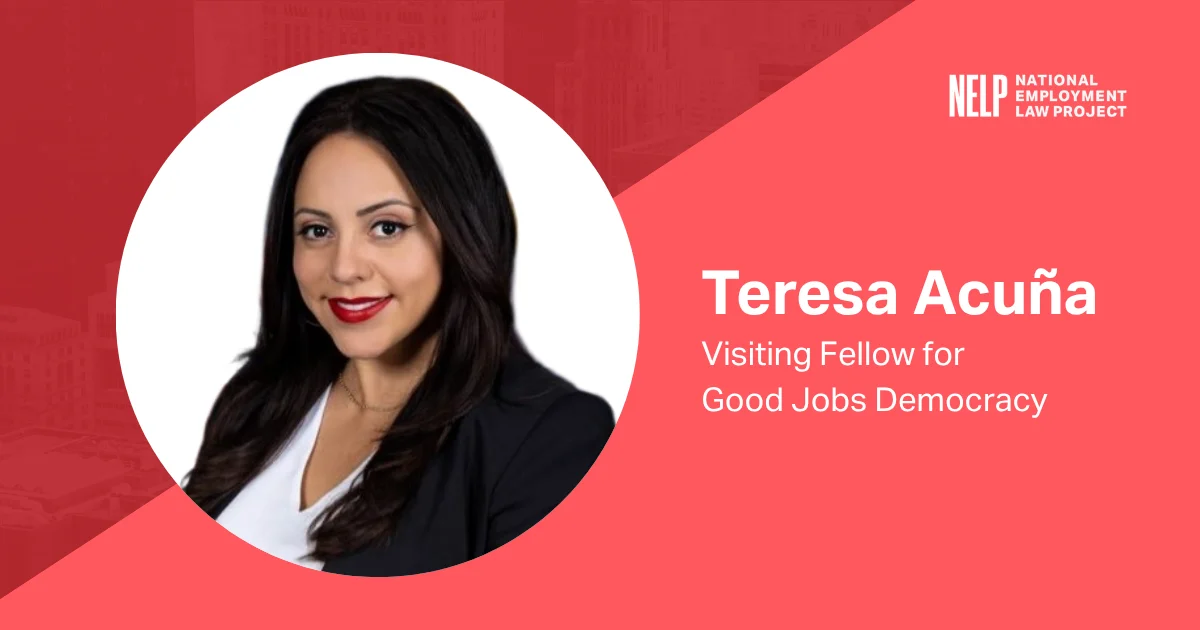
August 19, 2026 — The National Employment Law Project (NELP), a powerhouse in the advocacy sphere for labor rights and economic justice, officially announced today the appointment of Teresa Acuña as the organization’s new Visiting Fellow for Good Jobs Democracy.
The appointment marks a strategic pivot for NELP as it seeks to bridge the gap between high-level policy research and the granular, ground-level advocacy required to reshape the American workforce. Acuña, a veteran of both federal and state legislative arenas, joins the organization at a time when the nexus between industrial policy and worker protections has become the central focus of the national economic debate.
The Mandate: Bridging Research and Reality
As the Visiting Fellow for Good Jobs Democracy, Acuña is tasked with a mission that goes beyond traditional policy analysis. Working in close collaboration with NELP’s existing cohort of senior policy fellows, she will spearhead the effort to convert the organization’s pioneering research into actionable, high-impact advocacy strategies.
The core objective is to ensure that the "Good Jobs" philosophy—the idea that government investment must prioritize the creation of stable, well-paying, and secure employment—is woven into the fabric of legislative and regulatory outcomes across the United States. In an era of rapid technological change and shifting global markets, NELP’s leadership views this role as essential to expanding economic opportunity for all workers, regardless of their sector or geography.
A Proven Track Record: From Capitol Hill to the Labor Department
Teresa Acuña’s career trajectory has been defined by a commitment to legislative precision and a focus on the human impact of economic policy. Her professional history serves as the foundation for her new role, providing her with the unique ability to navigate the complexities of both the U.S. House of Representatives and the California State Legislature.
Legislative Experience
During her tenure as a legislative director, Acuña managed portfolios that demanded deep dives into labor law, social safety nets, and economic equity. Her experience on the front lines of the California State Legislature—a state often viewed as the "laboratory of democracy" for progressive labor laws—provided her with a masterclass in how state-level policies can influence national trends.
The Good Jobs Initiative
Most recently, Acuña served as the Director of the Good Jobs Initiative at the U.S. Department of Labor under the Biden-Harris administration. Operating under the leadership of Acting Secretary Julie Su, Acuña was instrumental in the government’s efforts to synchronize public investment with labor standards.
Her work during this period was pivotal in shaping how the federal government approaches large-scale funding for infrastructure, clean energy, and manufacturing. By ensuring that federal grants and contracts were tied to "good job" requirements—such as prevailing wages, robust safety protections, and support for collective bargaining—Acuña helped establish a new standard for how the government can leverage its spending power to build a more resilient middle class.
Official Response: Defining the Vision
The announcement of Acuña’s appointment was accompanied by a statement from Rebecca Dixon, CEO of the National Employment Law Project, who emphasized the intersection of economic stability and civic participation.
"Teresa’s experience in translating policy ideas into tangible wins for workers and their communities is critical to advancing NELP’s vision of an inclusive democracy where all workers have the economic foundation to contribute to and share in progress," Dixon stated.
Dixon further articulated the philosophical underpinning of the new role, noting, "Good jobs enable people to be active citizens." This perspective—that economic security is a prerequisite for a functioning democracy—is expected to be the guiding principle of Acuña’s fellowship.
Supporting Data: Why "Good Jobs" Matter Now
The appointment of a fellow dedicated to "Good Jobs Democracy" comes at a time of significant transformation in the American labor market. As of mid-2026, the U.S. economy continues to navigate the long-term effects of the post-pandemic recovery, the green energy transition, and the integration of artificial intelligence into the workplace.
The Quality Gap
Data consistently shows that while job numbers remain a primary metric for economic health, the quality of those jobs remains a point of intense volatility. Research by NELP and its partners suggests that:
- Income Inequality: Despite nominal wage growth, the purchasing power of the average hourly worker in service-heavy sectors has struggled to keep pace with the cost of essential goods.
- The Infrastructure Multiplier: Investments in infrastructure and clean energy are projected to create millions of jobs over the next decade. However, without the regulatory "guardrails" that Acuña helped champion at the Department of Labor, there is a risk that these new roles could mirror the low-wage, high-turnover models of the past.
- Demographic Disparities: The "good jobs" gap disproportionately affects workers of color and women, who are overrepresented in sectors with fewer benefits and less stability.
By bringing an expert like Acuña on board, NELP is signaling its intention to influence the regulatory implementation of major spending bills, ensuring that the "good jobs" promised by policy actually manifest in the daily lives of the workforce.
Implications for Future Advocacy
Acuña’s role will likely influence NELP’s strategy in three key areas over the next several years:
1. Scaling State-Level Successes
With her background in the California legislature, Acuña is expected to assist NELP in identifying and replicating successful state-level labor protections at the federal level. This "bottom-up" approach to policy change has historically been one of the most effective tools in the labor movement’s arsenal.
2. Monitoring Federal Spending
The Biden-Harris administration’s focus on industrial policy requires a sophisticated watchdog mechanism. Acuña’s intimate knowledge of the Department of Labor’s Good Jobs Initiative makes her uniquely qualified to help NELP monitor whether corporations receiving federal funds are adhering to high labor standards.
3. Integrating Democracy and Economics
The phrase "Good Jobs Democracy" suggests that NELP intends to deepen the connection between labor rights and civic engagement. The logic is clear: when workers are empowered, protected, and well-compensated, they are more likely to participate in their local communities, vote, and contribute to a healthier democratic process.
About the National Employment Law Project (NELP)
Founded in 1969, the National Employment Law Project has spent over half a century acting as a vanguard for workers’ rights. The nonprofit organization has consistently pushed for legal and policy solutions that promote economic justice.
With a reach that spans from local municipal ordinances to national legislative reform, NELP’s impact is significant. Over the last decade alone, the organization has been a key player in movements that have improved the lives of an estimated 100 million workers and their families. Their work covers the full spectrum of a worker’s career, including:
- Wage Standards: Fighting for higher minimum wages and the elimination of sub-minimum wage loopholes.
- Job Security: Advocating for paid leave, predictable scheduling, and fair termination laws.
- Workplace Safety: Championing robust enforcement of safety standards in high-risk industries.
- Equity and Inclusion: Working to dismantle systemic barriers that prevent marginalized populations from accessing high-quality employment.
As NELP looks toward the future, the addition of Teresa Acuña to their senior ranks reinforces a commitment to long-term, structural change. In an increasingly polarized and complex economic landscape, the organization is positioning itself to be a decisive voice in the fight for a truly inclusive economy.
For those tracking the intersection of labor policy and industrial strategy, the tenure of the new Visiting Fellow for Good Jobs Democracy will be a critical space to watch. By turning research into advocacy, and policy into practice, Acuña and NELP aim to ensure that the next generation of American jobs is not just a source of income, but a cornerstone of a robust and equitable democracy.
