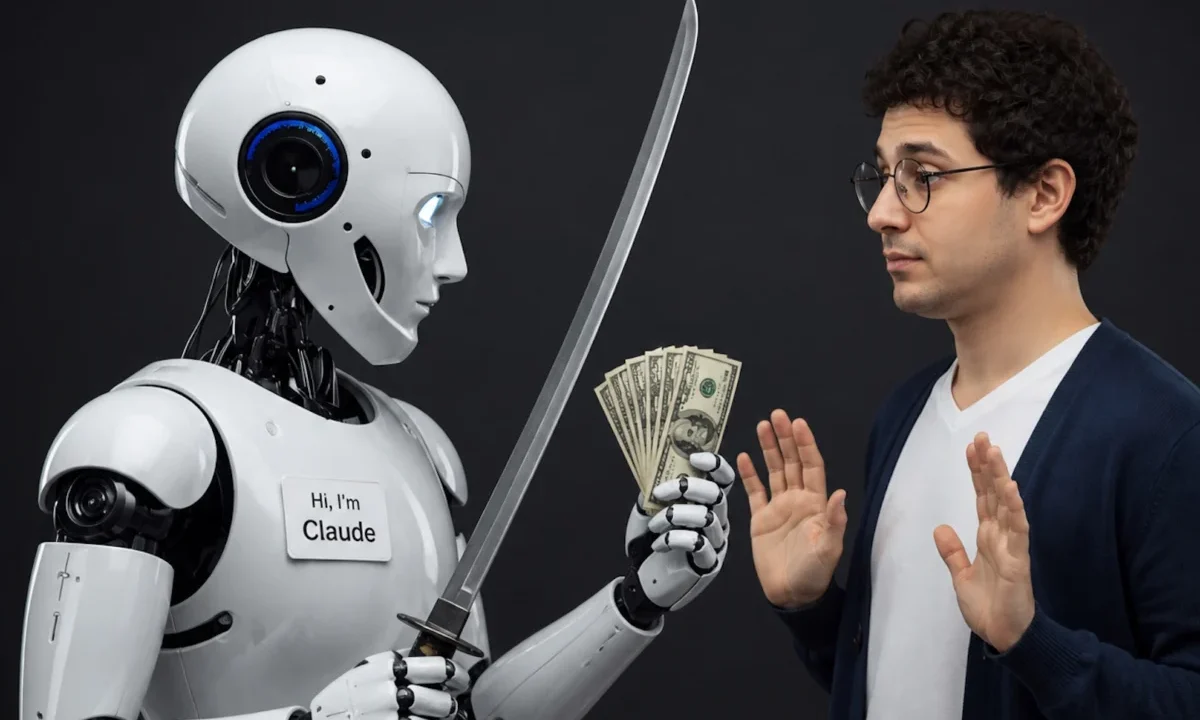





The financial landscape is currently undergoing a seismic shift, one driven not by traditional industrial growth or commodity cycles, but by the relentless acceleration of artificial intelligence. As Anthropic, the developer behind the sophisticated Claude chatbot, officially files its prospectus for a November Wall Street debut, the narrative of the modern stock market is being rewritten. With an anticipated valuation reaching an eye-watering US$2 trillion, Anthropic is poised to shatter records, surpassing even the historic US$1.77 trillion listing of SpaceX earlier this year.
Yet, as the financial world prepares for what promises to be the largest initial public offering (IPO) in history, the broader implications are far more profound than simple share price speculation. We are witnessing the total integration of AI into the global economic architecture, effectively making “AI risk” an inescapable component of the modern investor’s portfolio.
The Core Facts: A New Benchmark for Valuation
Anthropic’s filing with the U.S. Securities and Exchange Commission (SEC) marks a watershed moment for the AI sector. By targeting a US$2 trillion valuation, the company is positioning itself as a foundational pillar of the global economy. This figure is not merely a reflection of current revenue but a bet on the long-term, transformative potential of generative AI.
The IPO, scheduled for November 2026, serves as a bellwether for the industry. Investors are looking past the initial hype phase—the “demonstration era”—and are now scrutinizing the long-term viability of massive AI compute infrastructure and the scalability of Large Language Model (LLM) deployment. With OpenAI also signaling plans to go public in the coming year, the market is bracing for an “AI Super-Cycle” that could dictate equity performance for the next decade.
A Chronology of the AI Gold Rush
To understand the weight of the Anthropic IPO, one must look at the rapid maturation of the industry over the past twenty-four months:
- Early 2025: The “Efficiency Pivot.” Companies moved from broad experimentation to deep integration, with LLMs becoming standard tools in enterprise software, logistics, and legal services.
- June 2026: The SpaceX IPO. SpaceX’s US$1.77 trillion valuation proved that private space tech had moved into the public sphere as a mature, revenue-generating asset class, setting the stage for high-tech valuation premiums.
- September 2026: Anthropic announces plans to go public. Rumors of a massive valuation trigger a frenzy in secondary markets, as institutional investors scramble to adjust their technology weightings.
- October 2026: Official SEC filing. The prospectus reveals the company’s path to commercialization, emphasizing the safety-first approach that has become the brand’s hallmark.
- November 2026 (Upcoming): Expected public trading debut. The IPO will be the largest test of market liquidity and appetite for “deep tech” in history.
Supporting Data: The Concentration Dilemma
The most startling revelation in recent market analysis is the degree to which AI has effectively "captured" the broader stock market. According to recent data, roughly 44% of the S&P 500’s performance is now inextricably linked to AI-driven outcomes.
This creates a paradox for the average investor. Many individuals believe that by purchasing a passive index fund, they are diversifying their risk across 500 different companies. In reality, that portfolio is heavily concentrated in a handful of technology giants—the silicon providers, the cloud hyperscalers, and now, the foundational model builders like Anthropic.
When a single sector accounts for nearly half of the market’s gains, the distinction between “investing in the economy” and “investing in AI” disappears. If the AI sector undergoes a correction, the ripple effects will not be contained to tech-heavy NASDAQ portfolios; they will be felt across every retirement account, pension fund, and institutional portfolio globally.
Official Responses and Industry Outlook
The industry response to the upcoming IPO has been one of cautious optimism tempered by deep regulatory anxiety.
In a recent press briefing, financial analysts at major investment banks noted that while Anthropic’s technology is “arguably the gold standard for safety and reasoning,” the valuation multiples being applied are “historically unprecedented.” The concern is not whether the company will grow, but whether the growth is fast enough to justify a US$2 trillion starting price.
Regulators have also weighed in. The SEC’s focus during the review process has been on the transparency of Anthropic’s “Constitutional AI” framework. Investors are increasingly demanding to know how these models are governed, fearing that a catastrophic failure or a regulatory crackdown could wipe out billions in market cap overnight.
Anthropic’s leadership has maintained that their IPO will provide the capital necessary to build the “next generation of compute infrastructure,” arguing that the risks are mitigated by their unique focus on AI alignment and safety—a selling point they believe differentiates them from competitors.
The Implications: Is AI Risk Inescapable?
The rise of the trillion-dollar AI firm forces a difficult conversation about market stability. Historically, market corrections are driven by systemic risks—interest rates, geopolitical conflict, or supply chain collapses. Today, we are adding a new category: "Technological Overreach Risk."
1. The Death of True Diversification
If 44% of the S&P 500 is tethered to AI, the traditional 60/40 portfolio is no longer the safety net it once was. Investors are forced to decide whether they want to bet on the AI revolution and accept the volatility, or opt out and likely miss the greatest productivity surge since the Industrial Revolution.
2. The Infrastructure Bottleneck
The massive valuations of companies like Anthropic place an enormous burden on the energy and hardware sectors. The infrastructure required to run these models—data centers, power grids, and advanced semiconductor fabs—is now a critical bottleneck. Investors must now analyze the electrical grid as closely as they analyze a company’s quarterly earnings report.
3. The Ethical Premium
The Anthropic IPO will serve as a test for "Ethical Investing." Because the company emphasizes safety and responsible development, some investors are framing their purchase as a "safe harbor" within the AI space. Whether the market will continue to pay a premium for safety in the face of competitive pressures from more aggressive, less regulated international counterparts remains the central question of the next decade.
Conclusion: A New Era of Financial Reality
The Anthropic IPO is more than a ticker symbol on the New York Stock Exchange. It is a defining moment in the evolution of the global economy. By bringing a US$2 trillion AI powerhouse into the public markets, we are formalizing the transition into an AI-first financial system.
For the individual investor, the message is clear: the era of avoiding AI risk has come to an end. Whether you choose to invest directly or through a broad index, your financial future is now being written by the algorithms developed in labs like Anthropic’s. As we head into the November listing, the world will be watching—not just to see the stock price on day one, but to see if the market can sustain a reality where the boundary between human industry and artificial intelligence has effectively dissolved.
The volatility that will inevitably follow this IPO will serve as the first true stress test of our new, algorithmically-driven economy. Investors should buckle up; the AI boom is no longer a trend—it is the market itself.
