





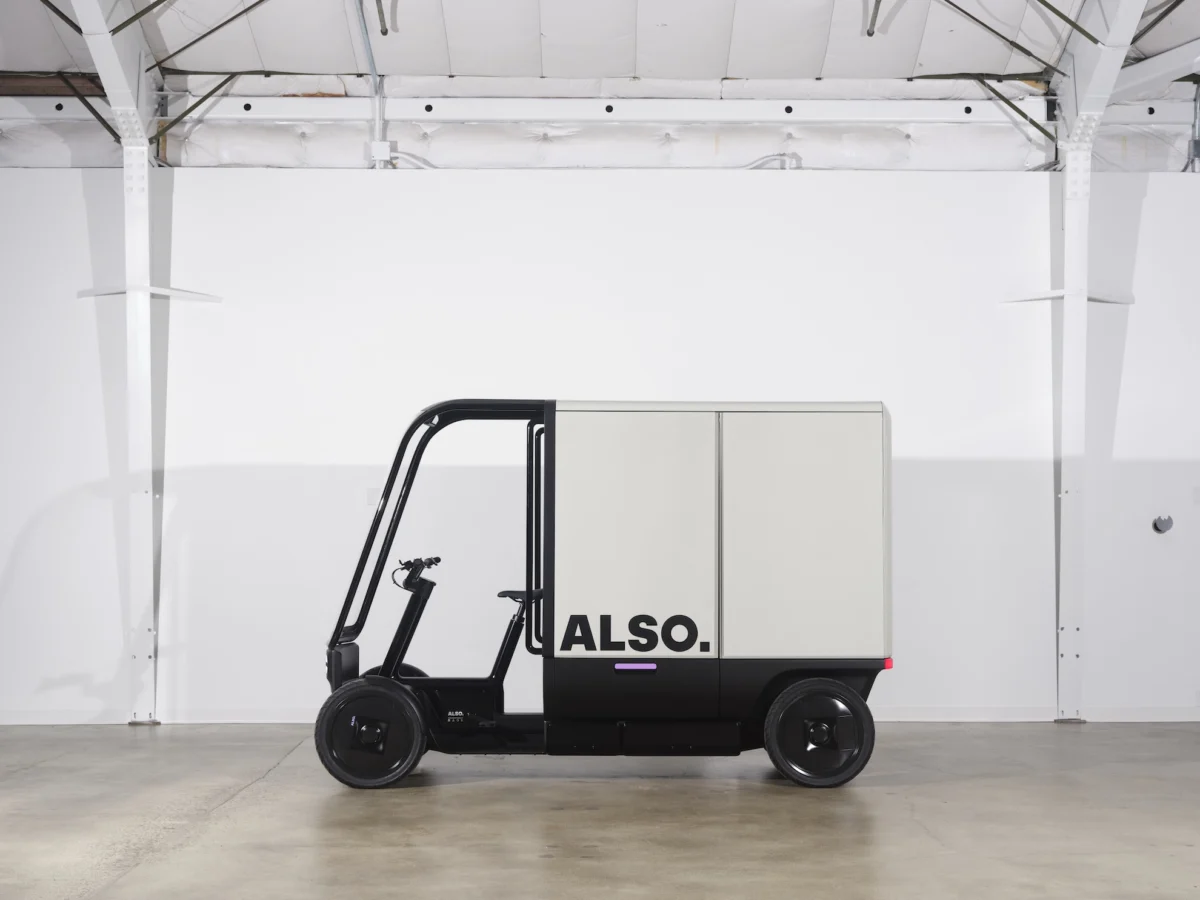
The landscape of urban logistics and micromobility is undergoing a rapid technological convergence. What began as a consumer-facing electric bicycle initiative has officially evolved into a well-capitalized race to dominate autonomous last-mile delivery.
Also, the high-profile micromobility startup that spun out of electric vehicle manufacturer Rivian Automotive last year, has successfully raised $150 million in a Series D funding round. This latest injection of capital brings the company’s total funding to an impressive $455 million in less than two years of independent operation. The round, led by Prysm Capital, highlights a significant strategic pivot for the startup: expanding beyond premium consumer e-bikes and commercial cargo quads into the high-stakes domain of self-driving delivery vehicles.
Main Facts: The Series D Capital Influx and Strategic Mandate
The $150 million Series D funding round marks a critical milestone for Also as it transitions from a hardware-focused micromobility player to a deep-tech robotics developer.
Key Transaction Details
- Funding Amount: $150 million
- Funding Stage: Series D
- Lead Investor: Prysm Capital
- Participating Investors: Eclipse, Greenoaks, and MVP Ventures
- Total Cumulative Capital Raised: $455 million (within 24 months of inception)
The Shift to Autonomous Driving Technology
According to internal company roadmaps, the primary mandate for the newly secured capital is to accelerate the development of Also’s proprietary autonomous driving technology. Rather than building isolated hardware platforms, the company is pursuing the simultaneous progression of multiple autonomous form factors.
Crucially, these future self-driving delivery vehicles will not require a ground-up engineering redesign. Instead, they will utilize the exact same underlying electric architecture, battery management systems, and drive units developed for Also’s existing consumer electric pedal-assist bike (the TM-B) and its commercial electric delivery quad. This shared-platform architecture is designed to drastically reduce research and development costs, streamline supply chains, and expedite the time-to-market for autonomous fleets.
Chronology: The Rapid Evolution of Also
The trajectory of Also—from a secretive internal project within an EV automaker to an independently funded autonomous robotics startup—represents one of the fastest scaling timelines in the modern transportation sector.
[Pre-2025: Rivian Skunkworks] ──> [Early 2025: Independent Spinout] ──> [Oct 2025: Product Reveal & Amazon Deal] ──> [Early 2026: DoorDash Partnership] ──> [Mid-2026: Manufacturing Milestones] ──> [Present: $150M Series D]1. The Skunkworks Era (Pre-2025)
The genesis of Also lies within Rivian Automotive. Driven by founder and CEO RJ Scaringe’s long-standing fascination with urban micromobility and the inefficiencies of last-mile delivery, Rivian established a highly secretive internal "skunkworks" division. To staff this project, the automaker recruited elite engineering, software, and design talent from industry leaders including Apple, Google, Specialized, and Tesla. The goal was to re-engineer small-form-factor electric vehicles with the same rigorous vertical integration applied to full-sized highway vehicles.
2. The Spinout and Launch (Early 2025)
Recognizing that a micromobility and robotics business required a distinct capital structure and operational focus separate from passenger SUVs and electric delivery vans, Rivian spun the division out into an independent entity in early 2025. Armed with the name "Also" and an initial $150 million funding round led by Eclipse, the startup established its own corporate identity while maintaining close ties to its parent company.
3. Product Reveal and the Amazon Agreement (October 2025)
In October 2025, Also made its public debut, unveiling its inaugural product lineup:
- The TM-B: A premium, high-performance, two-wheeled consumer e-bike priced at $4,500.
- Commercial Quads: Two heavy-duty four-wheeled electric vehicles optimized for urban delivery.
Concurrently, Also announced a major commercial breakthrough: a contract with e-commerce giant Amazon to purchase thousands of its pedal-assist commercial cargo quads to support green last-mile delivery initiatives in dense urban centers.
4. The DoorDash Alliance and Autonomous Pivot (Early 2026)
A few months prior to the Series D round, Also raised $200 million in a funding round led by Greenoaks. This round featured a highly strategic investment from on-demand delivery giant DoorDash. Alongside the capital injection, DoorDash and Also entered into a multi-year commercial agreement specifically focused on co-developing and deploying autonomous delivery vehicles to automate local food and grocery delivery networks.
5. Manufacturing Hurdles and Launch Resolution (Mid-2026)
Despite its deep pockets, Also was not immune to the production bottlenecks that plague hardware startups. The highly anticipated Launch Edition of the $4,500 TM-B e-bike faced consecutive delays, frustrating early adopters. However, by mid-2026, the company resolved its supply chain issues and began shipping the Launch Edition to customers. Simultaneously, the company opened preorders and configurator access for its standard and performance e-bike models, with deliveries scheduled to begin in the fall of 2026.
6. Series D and the Autonomous Acceleration (Present)
With its consumer hardware finally rolling off the assembly line and into customer hands, Also closed its $150 million Series D round to pivot its primary engineering focus toward scaling its autonomous software and sensor suites across its commercial vehicle portfolio.
Supporting Data: Funding, Pricing, and Market Dynamics
To understand Also’s competitive position, it is necessary to analyze the financial and product metrics that have attracted nearly half a billion dollars in capital in such a short window.
| Funding Round | Date | Primary Investors | Amount Raised | Strategic Focus |
|---|---|---|---|---|
| Spinout / Seed | Early 2025 | Eclipse | $105M – $150M | Spinout logistics, core hardware engineering |
| Series C | Early 2026 | Greenoaks, Prysm Capital, DoorDash | $200M | Commercial quads, DoorDash autonomous pilot |
| Series D | Present | Prysm Capital, Greenoaks, Eclipse, MVP | $150M | Autonomous software, multi-form factor scaling |
| Total Capital | — | — | $455 Million | — |
Hardware and Fleet Economics
The shared-architecture strategy employed by Also is designed to maximize capital efficiency. By using identical battery modules, motor controllers, and connectivity hardware across both consumer e-bikes and autonomous delivery pods, Also achieves significant economies of scale.
- Consumer TM-B E-Bike Price Point: $4,500 (Launch Edition)
- Commercial Quad Customers: Amazon (thousands of units committed)
- Autonomous Delivery Partner: DoorDash (multi-year deployment roadmap)
This dual-revenue model—combining high-margin consumer hardware sales with recurring B2B commercial fleet contracts and autonomous-delivery-as-a-service (ADaaS) potential—distinguishes Also from competitors who rely solely on consumer sales or unproven autonomous delivery networks.
Official Responses: Investor Confidence and Corporate Governance
The investment thesis behind Also is heavily tied to the concept of vertical integration—a philosophy borrowed directly from the electric vehicle revolution of the last decade.
Jay Park, co-founder and managing partner of Prysm Capital, explained that his firm’s decision to lead the Series D round was rooted in their early experience backing Rivian:
"We backed Rivian early because we saw the potential behind wonderfully designed, vertically integrated electric trucks, vans, and SUVs. Also is applying that same disciplined, vertically integrated approach to smaller-form-factor vehicles, where the market opportunity in both consumer mobility and commercial delivery is massive."
The Rivian Connection and Board Oversight
Although Also operates as an independent startup, it remains intrinsically linked to Rivian’s corporate ecosystem:
- Equity Stake: Rivian retains a significant minority ownership stake in Also.
- Governance: Rivian Founder and CEO RJ Scaringe actively serves on Also’s board of directors, ensuring close strategic alignment between the two companies.
- Shared Resources: Also officially leverages Rivian’s advanced battery technology, retail network footprint, and global supply chain leverage to lower component costs.
Implications: Redefining Micromobility and Last-Mile Logistics
The aggressive capitalization of Also has profound implications for both the micromobility sector and the broader logistics industry.
                             ┌────────────────────────┐
                             │  Rivian Spinoff 'Also' │
                             └───────────┬────────────┘
                                         │
                ┌────────────────────────┴────────────────────────┐
                ▼                                                 ▼
┌──────────────────────────────┐                  ┌──────────────────────────────┐
│      Consumer Segment        │                  │      Commercial Segment      │
│  • Premium TM-B E-Bike       │                  │  • Amazon Cargo Quads        │
│  • High-Margin Hardware      │                  │  • DoorDash Autonomous Pods  │
└──────────────────────────────┘                  └──────────────────────────────┘
1. The Convergence of Hardware and Deep Tech
For years, the micromobility industry struggled with unit economics, as cheap, off-the-shelf electric scooters and bikes suffered from short lifespans and high maintenance costs. Also is challenging this paradigm by treating micromobility vehicles as high-performance, long-lifecycle computers on wheels. By integrating autonomous driving capabilities directly into small-form-factor vehicles, Also is bridging the gap between pure hardware manufacturing and high-margin software services.
2. A New Paradigm for Last-Mile Logistics
The cost of last-mile delivery represents over 50% of total shipping costs for e-commerce and food delivery companies. Rising labor costs, driver shortages, and urban congestion have made traditional delivery van models increasingly unsustainable.
By deploying autonomous, low-profile vehicles—ranging from cargo quads operating in bike lanes to sidewalk-friendly robotic pods—Also offers logistics giants like Amazon and DoorDash a pathway to dramatically lower delivery costs per drop-off. Because these vehicles share a common electric architecture, fleet operators can manage mixed fleets of piloted e-bikes, cargo quads, and fully autonomous pods using unified maintenance protocols and software dashboards.
3. The Strategic Buffer for Rivian
For Rivian, Also serves as a highly valuable, off-balance-sheet innovation engine. Developing small-form-factor vehicles and complex autonomous software internally would distract Rivian from its primary goal of scaling its R1, R2, and R3 passenger vehicle lines. By spinning Also out, Rivian preserves its focus while retaining a lucrative stake in a company targeting the hyper-growth last-mile logistics sector. If Also succeeds in scaling its autonomous delivery network with DoorDash and Amazon, Rivian stands to benefit immensely from its equity position and shared technological IP.
As urban centers globally continue to restrict internal combustion engines and prioritize pedestrian-friendly infrastructure, the demand for quiet, zero-emission, autonomous delivery systems will only accelerate. Backed by nearly half a billion dollars, top-tier automotive engineering talent, and powerful commercial partners, Also is uniquely positioned to transition from a delayed e-bike startup into the foundational operating system for autonomous urban commerce.
